Lovebug Sightings Map for Seoul: See Where They Swarm Today
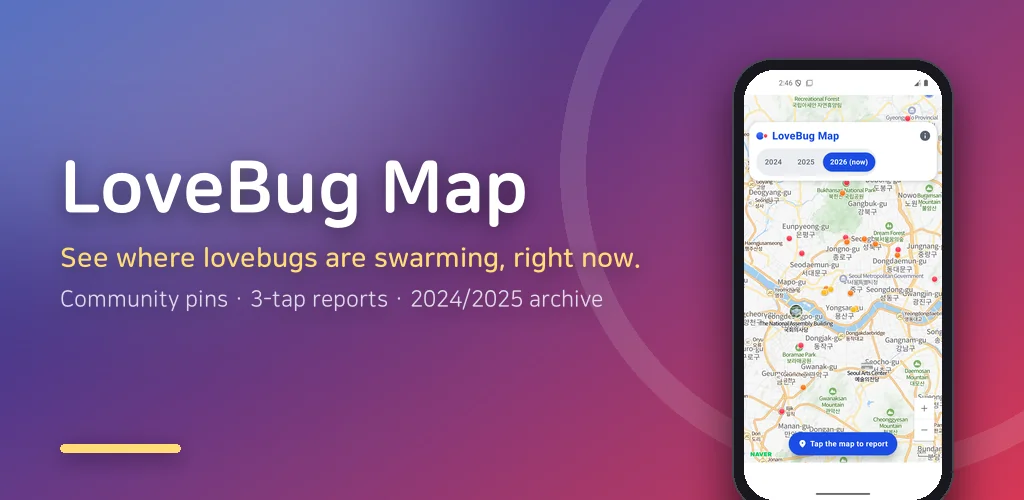
Where are the lovebugs in Seoul right now? If you have lived through a Korean summer in the last few years, you have asked that question, probably while standing at a trailhead watching a black cloud of paired-up insects drift toward you. One neighborhood gets its walls and window screens carpeted; the next district over has none. The news reports a few hotspots, but by the time an article is out, the swarm has moved, and there was no lovebug sightings map you could check on the spot.
So I made a lovebug sightings map. It is a plain map of Seoul and the wider capital area where anyone can drop a pin where they saw them, and everyone can see where the pins are piling up. Free, no account, and the whole app is one screen.
▶ Get it on Google Play (free): https://play.google.com/store/apps/details?id=com.thefacegood.lovebugmap
What the lovebug sightings map shows
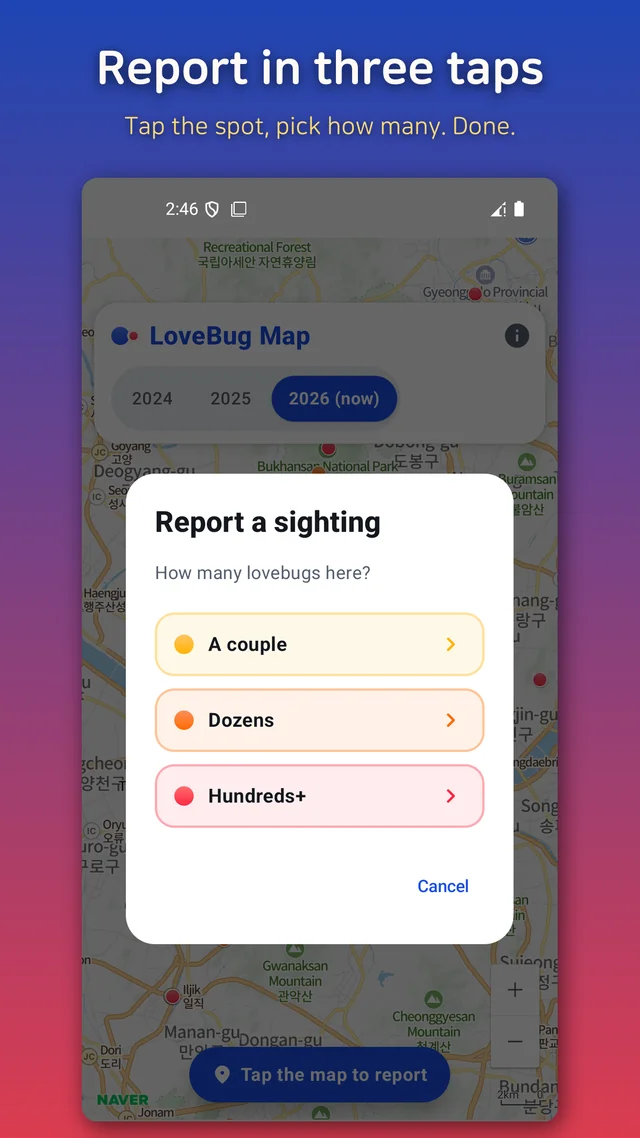
Open it and you are looking at pins. Each pin is one lovebug sighting, and its color tells you how bad it was:
- Yellow for a few, a couple on the balcony rail
- Orange for dozens, the kind you notice on a walk
- Red for hundreds or more, the wall-covering, can't-open-the-door level
Where red pins cluster, that is where lovebugs are swarming near you today. I check it before a hike or a picnic in the same way I check the rain forecast, because a red cluster at the trailhead means the day is going somewhere else. The map is never empty, either. This year's reported hotspots, thirteen of them from June news coverage (Gyeyangsan in Incheon, Baengnyeonsan and Bongsan in Eunpyeong, Buramsan in Nowon, and so on), are preloaded, so the first time you open it there is already something to look at.
Reporting takes three taps
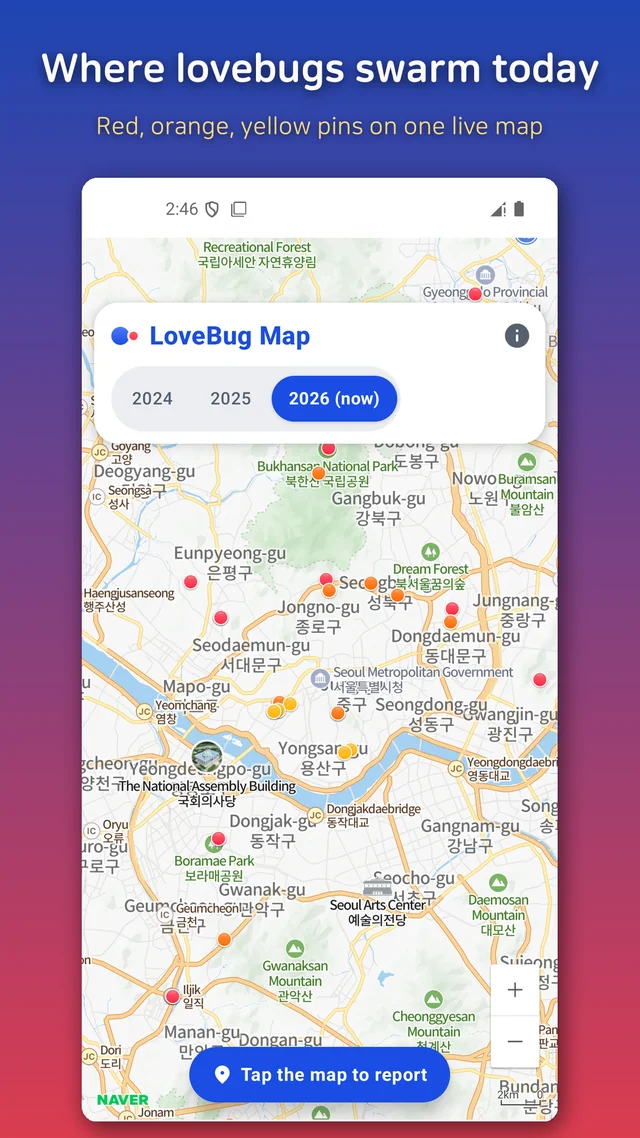
Tap the map where you saw them. Pick one of three answers to "how many?" (a few, dozens, hundreds or more). Done. No photo, no name, no sign-up; only an approximate location and a time are saved. If someone has already dropped a pin where you are standing, you can add your own on top of it, which is how a spot turns from one report into a cluster you can trust.
The map gets better in direct proportion to how many people bother. If your street is crawling and the map shows nothing there, that gap is the reason to report.
Last year's hotspots, and the year before
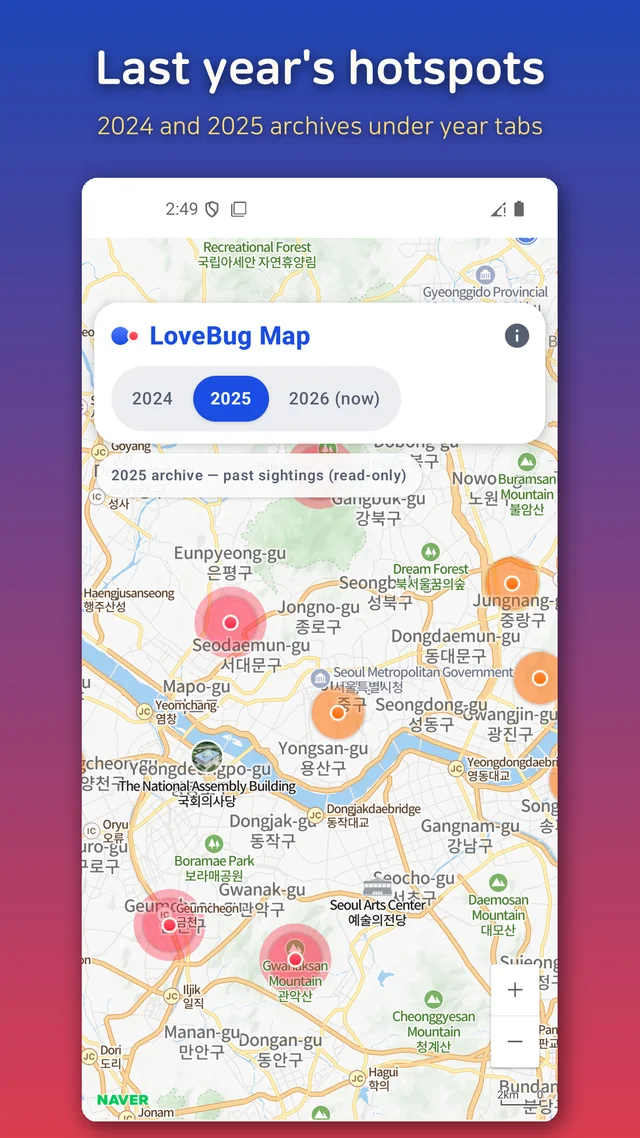
Lovebugs do not come back to the same places every summer. In 2024 the worst complaints came from Ujangsan and Bongjesan in Gangseo and the lake park in Yangcheon. In 2025 the headlines belonged to Gyeyangsan in Incheon, which was reported as the heaviest site in the country. I collected those past locations from news coverage and complaint statistics and put them in the app under year tabs, so you can flip between the current map and the 2024 or 2025 archive and see how the pattern has drifted.
It is not a forecast, but if you are choosing between two hills for a weekend hike, knowing which one was buried last July is useful.
When does lovebug season end, and do they bite
A few things I learned while building this, since the questions come up every year:
- Do lovebugs bite? No. They do not bite or sting, they carry no venom, and they do not spread disease. They are a nuisance, not a hazard.
- When does the season end? They peak in the hot, humid stretch around the start of the rainy season, usually late June into July, and a heavy rain thins them out fast. Adults live only a few days, so once the peak passes the numbers drop quickly. A glance at the last few days of pins tells you whether you are before, in, or past the peak.
- They are drawn to bright walls and strong light. Dimming outdoor lights at night and keeping screens closed reduces how many end up indoors.
To be completely clear: this app does not kill, repel or get rid of lovebugs. It only shares where they are, and the pins are user reports and estimates that can differ from what you find on the ground.
Who this is for
- Hikers and runners in the Seoul area picking a route for the weekend
- Anyone who has been ambushed at a bus stop and wants to know if it is just their block
- Expats and visitors trying to work out what the black cloud actually is
- People who want to help their neighbors by adding a pin
Download (Google Play, free): https://play.google.com/store/apps/details?id=com.thefacegood.lovebugmap
※ Sighting pins are user reports and approximate archive locations, not an official survey. Coverage is currently the Seoul capital area.
If you see them somewhere the map is blank, drop a pin. That one tap is the whole reason this exists, and it makes the map right for the next person.

Comments
Post a Comment