How Big Is the Universe? Step by Step From Earth to the Edge
The observable universe is about 93 billion light-years across, even though the universe is only 13.8 billion years old, because space itself stretched while the light was on its way to us. That figure is the size of what we can see, not the size of the universe, which almost certainly continues beyond it.
The universe as a ladder of distances
A number like 93 billion is hard to feel, so it helps to climb there one rung at a time. Each step below is roughly a jump to a larger structure. Figures come from the NASA, ESO and ESA material we used to build a zoom app, and some of the largest values are still debated.
| Step | Size or distance |
|---|---|
| Earth | 12,742 km across |
| Geostationary orbit | 35,786 km above the surface |
| The Moon's orbit | 384,400 km from Earth |
| The Sun | About 109 Earths wide |
| Earth's orbit (1 AU) | 149.6 million km from the Sun |
| Neptune's orbit | About 30 AU, or 4.5 billion km |
| Heliopause | Around 120 AU, where the Sun's wind stops |
| Nearest star (Proxima Centauri) | 4.24 light-years |
| Our stellar neighbourhood | Barely a dozen stars within 10 light-years |
| Orion Nebula | 1,344 light-years |
| Milky Way | About 87,400 light-years across |
| Local Group (with Andromeda) | About 10 million light-years across |
| Virgo Cluster | 54 million light-years away, more than 1,300 galaxies |
| Laniakea supercluster | About 404 million light-years long |
| Observable universe | About 93 billion light-years across |
Why 93 billion light-years if the universe is 13.8 billion years old?
It looks like a contradiction, since light cannot have travelled further than 13.8 billion light-years in 13.8 billion years. The resolution is that space expanded while the light was in flight, so places that were close at the moment the light departed are far away by the time it arrives.
The most distant light we can detect is the cosmic microwave background, released when the universe was about 380,000 years old and became transparent for the first time. That light is passing through your body right now. Beyond the observable edge there is almost certainly more universe, but its light has not reached us yet.
What is a light-year in travel time?
A light-year is the distance light covers in a year. Knowing that does not help much, because the unit is so large that every distance measured in it feels like "far". Converting distances to travel time makes the scale clearer:
- The Moon: light crosses the gap in 1.3 seconds, Apollo took about three days, and a train running nonstop at 300 km/h would need about 53 days.
- The Sun: light takes 8 minutes 20 seconds, while a high-speed train would need about 57 years.
- The edge of the Sun's wind (heliopause): light needs about 17 hours. Voyager 1 crossed it in August 2012, 35 years after launching on 5 September 1977.
- Proxima Centauri: four years and three months at the speed of light, but about seventy thousand years at Voyager 1's speed of 17 km per second.
How many light-years to the nearest star?
The nearest star to the Sun is Proxima Centauri, 4.24 light-years away. Alpha Centauri A and B sit slightly further, at 4.37 light-years, and those three are the only stars within that range. Within 10 light-years there are barely a dozen stars in total. Sirius, the brightest star in the night sky, is 8.6 light-years away.
To picture that emptiness, shrink the Sun to a marble 1 cm across. The next marble, Proxima, would be about 290 km away, with nothing in between. Space is not full of stars; it is emptiness with stars thinly sprinkled through it.
How many stars are in our galaxy?
Estimates for the Milky Way run from about 100 billion to 400 billion stars, with a black hole of around four million solar masses at the centre. Light needs about 87,000 years to cross the galaxy. We cannot photograph it from outside, so any "photo of the Milky Way" you see is either an artist's picture or a look-alike galaxy such as NGC 6744.
Seeing it on your phone
We made an Android app, Space Zoom, that puts the whole ladder on a pinch gesture: you start at Earth, spread two fingers, and the view pulls back through 25 steps to the cosmic web. Each step writes the distance as light travel time, train time and Voyager time, and uses real photographs from NASA, ESO and ESA, with credits inside the app. It works offline. Product page: wing40.github.io/apps/spacezoom. Google Play: Space Zoom on Google Play.
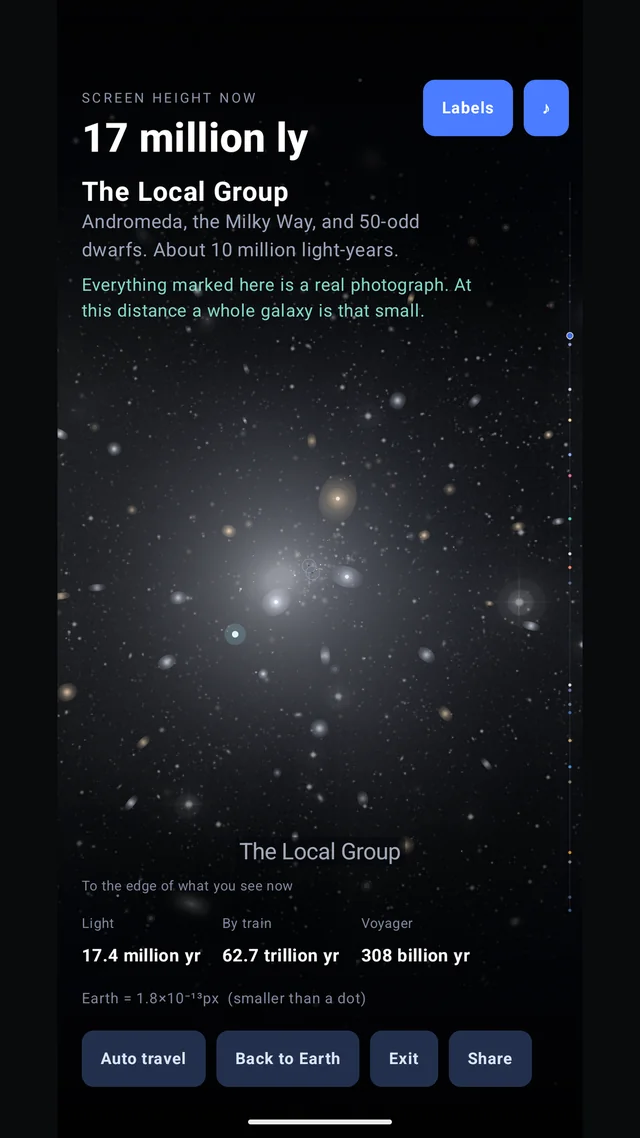
The imagery and data are public releases by NASA, ESO, ESA and other institutions; none of them is affiliated with or endorses the app. Some of these distances are still argued over by astronomers, so treat the figures as current best estimates.

Comments
Post a Comment