Korean National Treasures: 207 Relics Explained First
Two hundred photos on my phone and not one name to go with them. That was my honest tally after a Saturday at the National Museum of Korea last autumn: a gold crown, "the sitting Buddha one", a lot of celadon, and a headache. I had walked past some of the most famous Korean national treasures in existence and could not tell a friend a single thing about any of them.
I blamed my memory for a while. Then I noticed that anyone who walks into a gallery cold and tries to absorb several hundred objects in an afternoon comes out the same way. The wall labels are short and the crowd behind you is not patient, and the basement galleries have no phone signal for a quick search. So I flipped the order. Learn ten pieces on the subway the night before, then walk in and recognize them like old acquaintances. I could not find an app for that, so over six months I built one.
▶ Get it on Google Play (free): https://play.google.com/store/apps/details?id=com.thefacegood.museum
Walking out of the museum with nothing
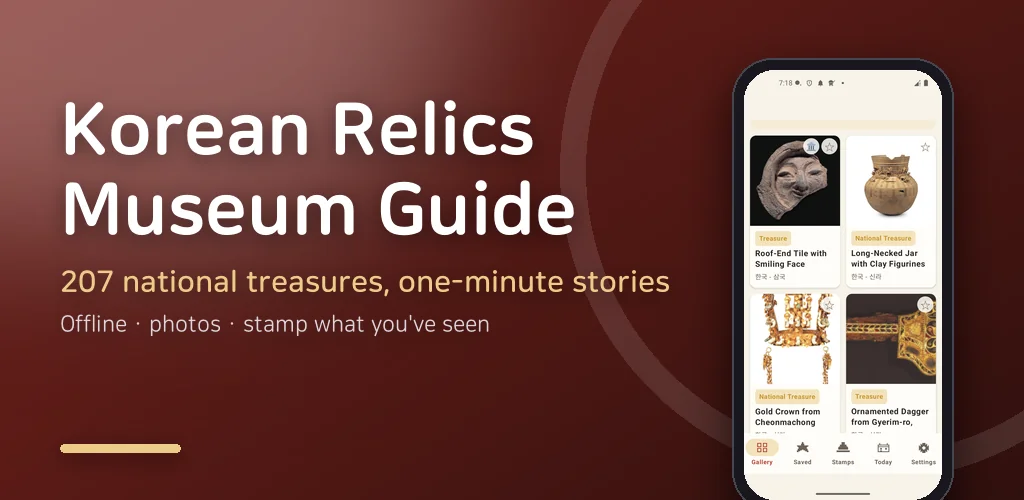
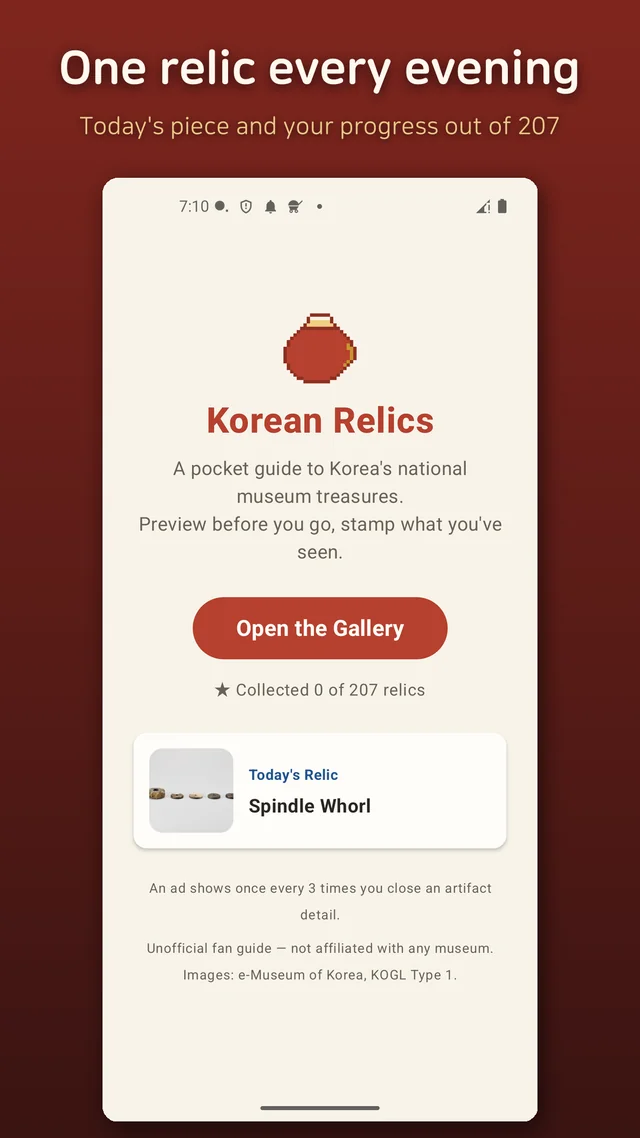
Korean Relics opens on a single piece for today and your progress so far. It is not a study app. It is something to flick through for ten minutes on a train, so there is no login, no account and no tutorial; install it, open it, and the first relic is already on screen with its photo and a short story.
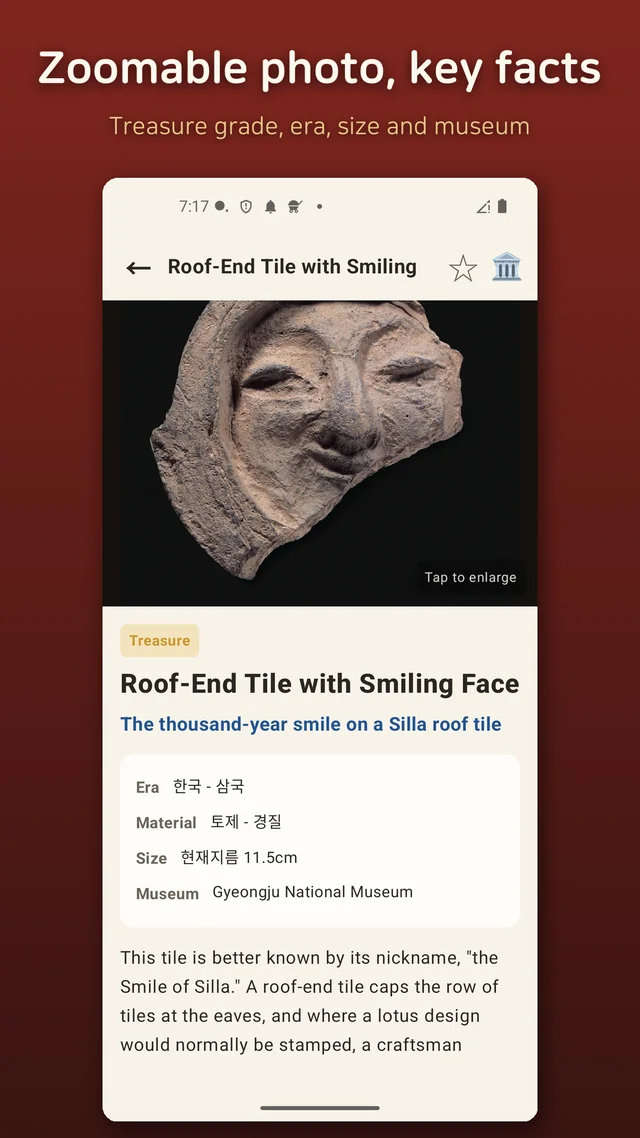
The difference a picture and a story make is bigger than I expected. I had seen Baekje's famous gilt-bronze incense burner in textbooks for years and only learned, while writing its entry, that there is a phoenix perched on the lid. The photos are bundled at high resolution and zoom with a pinch, so the inlaid pattern on a celadon vase or a single jade pendant on a Silla crown is right there, closer than any glass case allows.
Choosing 207 Korean national treasures took longer than coding
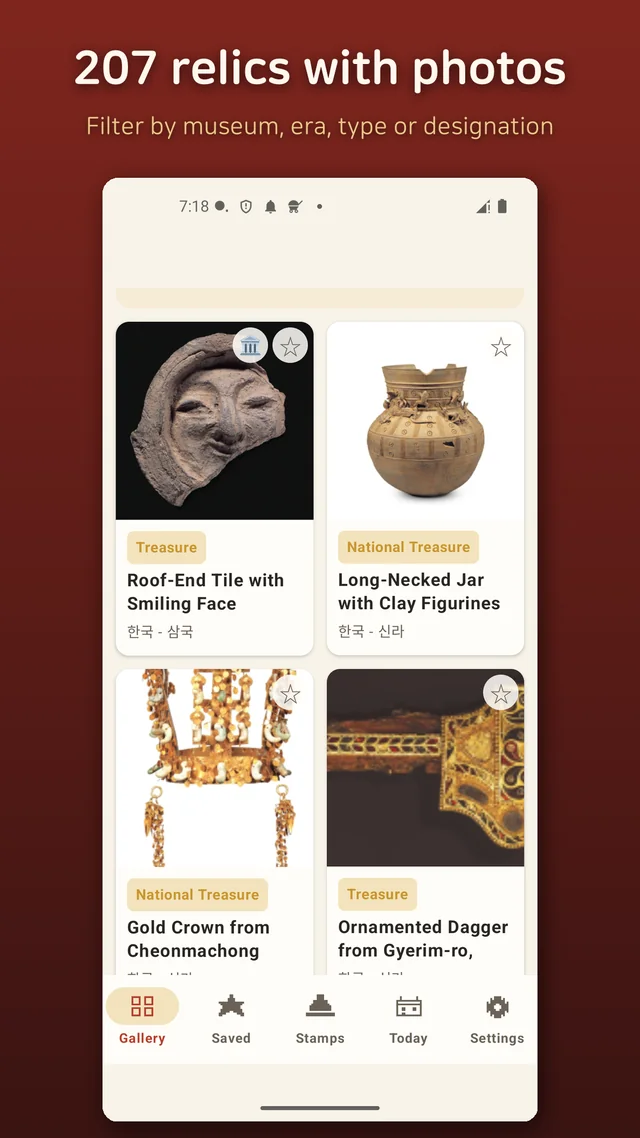
Korea's national museums hold hundreds of thousands of objects. I started with a target of a thousand entries, realized nobody would ever get to the end, and kept cutting. The final list is 207 Korean relics, including 45 designated National Treasures and 43 Treasures. The rule for staying in was simple: how likely are you to actually stand in front of it? Pieces that live in storage came out, and pieces that sit on the permanent display, the Pensive Bodhisattva and the White Porcelain Moon Jar among them, stayed in.
You can sort the list by era, by material, or by which museum owns each piece, so the night before a trip to Gyeongju you filter to Gyeongju and skim only what you will see. Search works on part of a name.
Rewriting every explanation to fit in one minute
The official catalogue text is accurate and, for a non-specialist, unreadable. "Exemplifies the mature inlay technique of mid-Goryeo" is information for a curator and noise for me. So I rewrote all 207 entries as easy history notes, each meant to be read in about a minute, in both English and Korean.
The Muryeong tomb pieces, for instance, begin with the 1971 drainage works that accidentally broke into a brick tomb nobody knew was there, the only Baekje royal tomb ever found unlooted, and the excavation that was rushed through in a single night and is still regretted today. After that, a pair of gold earrings looks different. That is the goal of every entry: one story that makes you look twice.
The stamp that made me visit museums I had skipped
A guide you read once and never reopen is a problem, so I added stamps. Reading an entry marks it as seen; meeting the real thing in a museum lets you press a stamp for that visit. Completion is shown overall, per museum and per era. It sounds trivial. It sent me to two regional museums I had never bothered with, purely because their column of stamps was nearly empty.
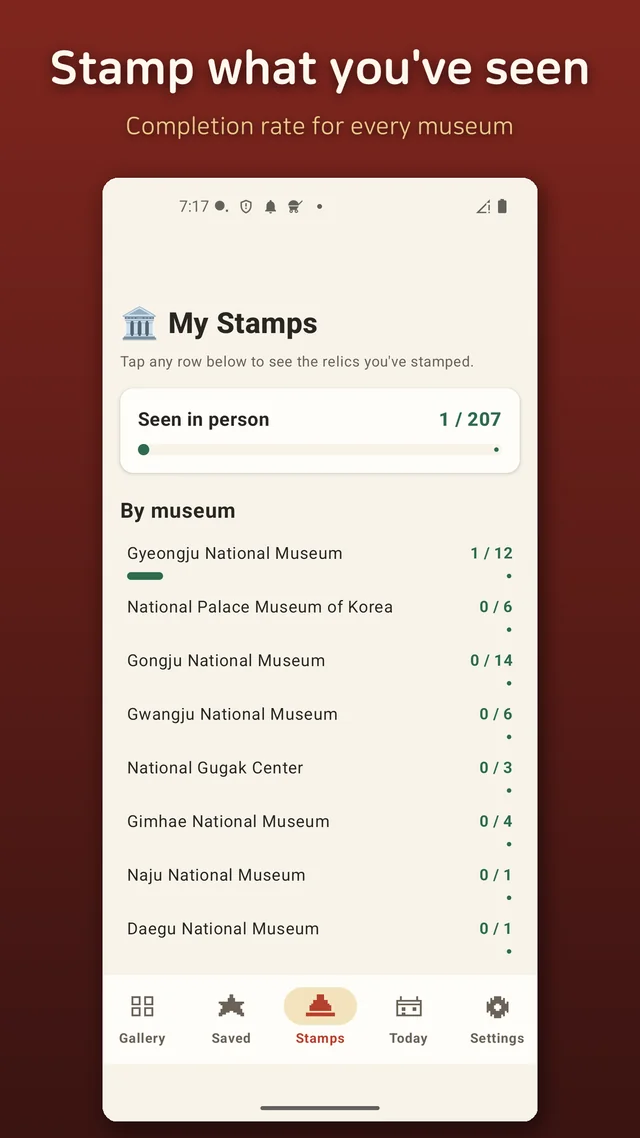
One relic every evening, and no signal required
At eight every evening the app suggests one relic, a one-minute habit that never feels like homework. Star the ones you like and they collect in their own list, and any relic can be turned into a share card with its photo, name and one-line description for sending to a friend.
The whole thing is offline. Every image and every note is inside the install, so it opens in a basement gallery, on a plane, or anywhere in Korea with no data plan. That was the one condition I refused to compromise on.
Who this is for
- Visitors planning a museum outing who would like some background before entering
- Parents who need an answer ready for "what is that?"
- Travelers exploring Korean culture with patchy mobile data
- Anyone who saw the Pensive Bodhisattva on a poster and wants the story
- Collectors who enjoy watching a completion percentage climb
Download (Google Play, free): https://play.google.com/store/apps/details?id=com.thefacegood.museum
※ This is an unofficial fan-made guide with no affiliation to any museum or government body. Images and collection data come from open public sources licensed for reuse, and each page links back to the source record. Exhibits rotate, so check the museum's website before a visit.
I built this alone, so there will be relics you feel are missing and sentences that read oddly. If you spot one, leave a review or write to me and it goes into the next update.


Comments
Post a Comment