Korean Spelling Quiz: 164 Mistakes Even Native Speakers Make
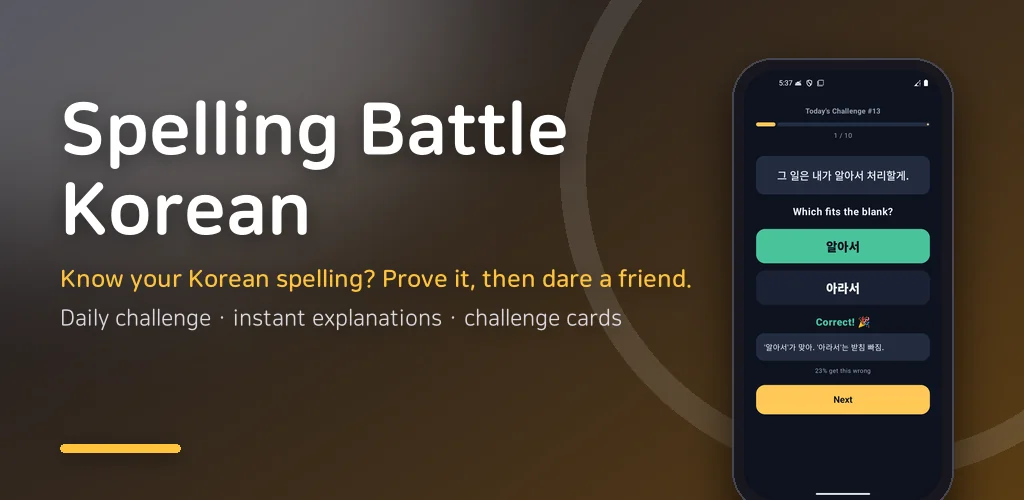
You are halfway through a message to a Korean friend, and your thumb stops on the last syllable. Is it the form with the plain vowel or the one with the extra stroke? You know a rule exists. You also remember the rule has something to do with whether the word ends the sentence, and suddenly you are not sure any more. Native speakers stop at exactly the same spot, which is the small comfort behind this Korean spelling quiz. I built it because that argument kept breaking out in my group chats, and nobody could settle it without looking it up.
▶ Get it on Google Play (free): https://play.google.com/store/apps/details?id=com.thefacegood.spellbattle
A Korean spelling quiz that hides the trap inside a sentence
Plenty of apps already drill Korean spelling. Most of them ask about one word at a time, and that never matched my experience. The confusion is not in the word; it is in the sentence. The two forms of "become" (romanised doe and dwae) are the same problem on a flashcard, but whether the sentence ends right there is what decides which one is correct, and you only know that when you can see the sentence.
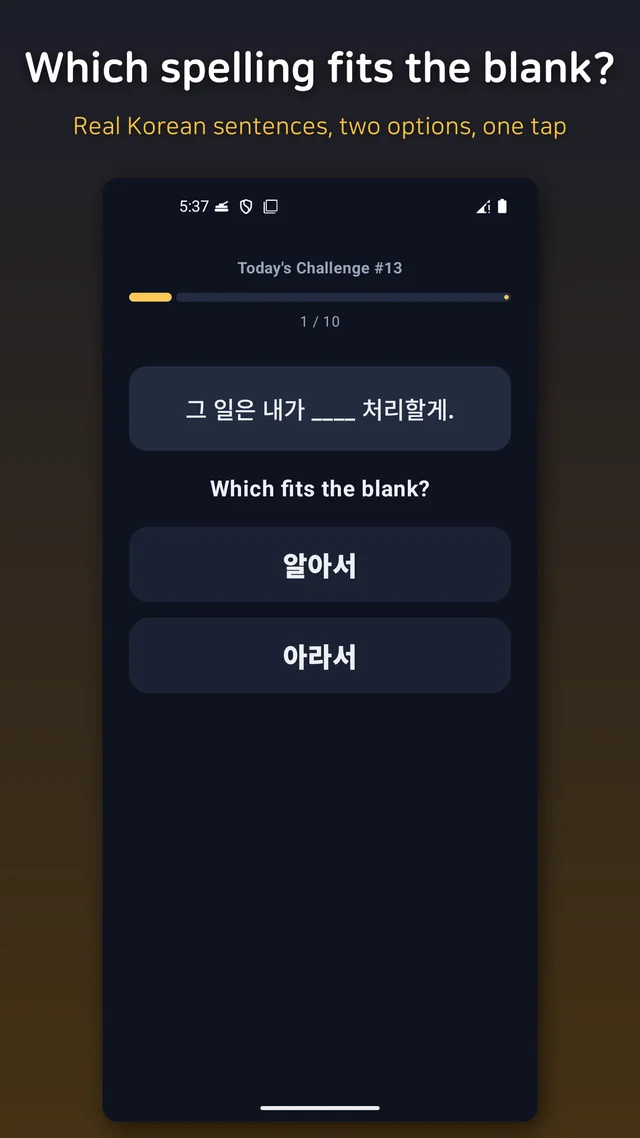
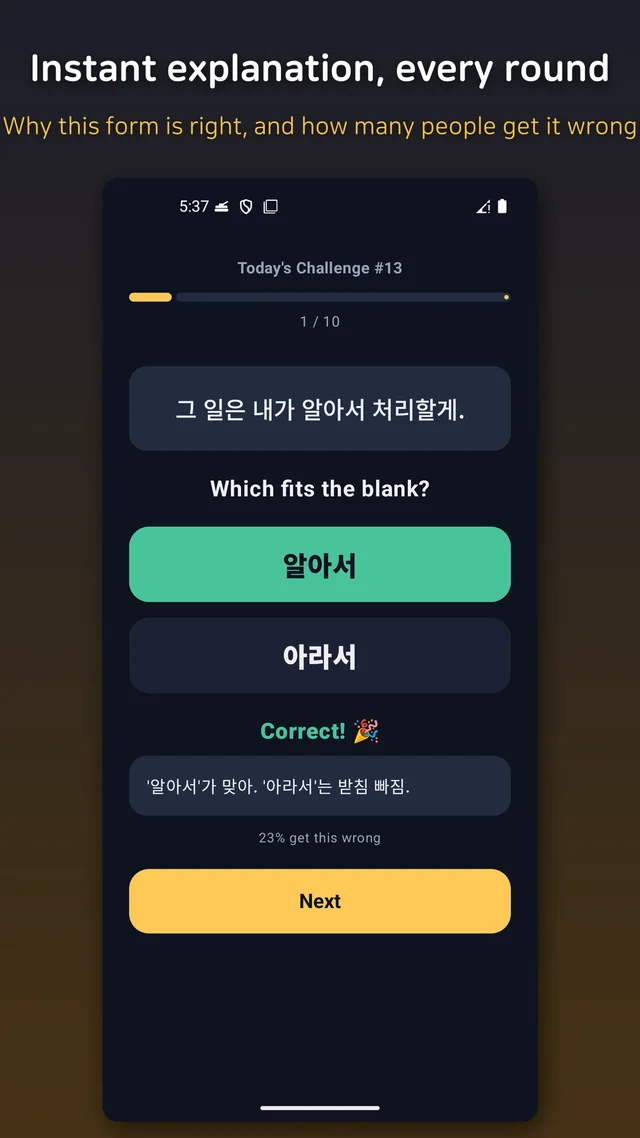
So every round is a real sentence with a blank and two options. Pick one, and a short explanation appears straight away: why this form, what the full word contracts from, when the other one would have been right. Getting it wrong still leaves you with something.
164 fill-in-the-blank rounds, and the pairs that catch everyone
There are 164 fill-in-the-blank rounds, and I did not pad them out with easy ones. Every item is a mistake Korean speakers actually make, checked against the National Institute of Korean Language standard. The regulars are all here: the two spellings of "become" (doe versus dwae), the two ways to write "not" (an versus anh), the "somehow" pair (waenji versus wenji), "get better" against "give birth" (natda versus nahda), "different" against "wrong" (dareuda versus teullida), and "hit the target" against "match up" (machida versus matchuda). The first three of those have pass rates under fifty percent among native speakers. Everyone is sure they know them until the sentence is in front of them.
Spacing, loanwords, and the ones that trip me up too
Beyond the classic pairs there are three groups that surprised even me. Spacing: Korean word spacing has rules that most people follow by feel, and feel is wrong surprisingly often. Loanwords: the official Korean spelling of chocolate, buffet, message and Halloween is not what half the country types. And the polite closers: the contraction people use for "see you tomorrow" has an official form that a great many text messages get wrong. Difficulty is mixed on purpose, so a strong speller will still drop a few, and an intermediate learner will find the easy tier reassuring rather than crushing.
Ten questions, a grade, and a challenge card
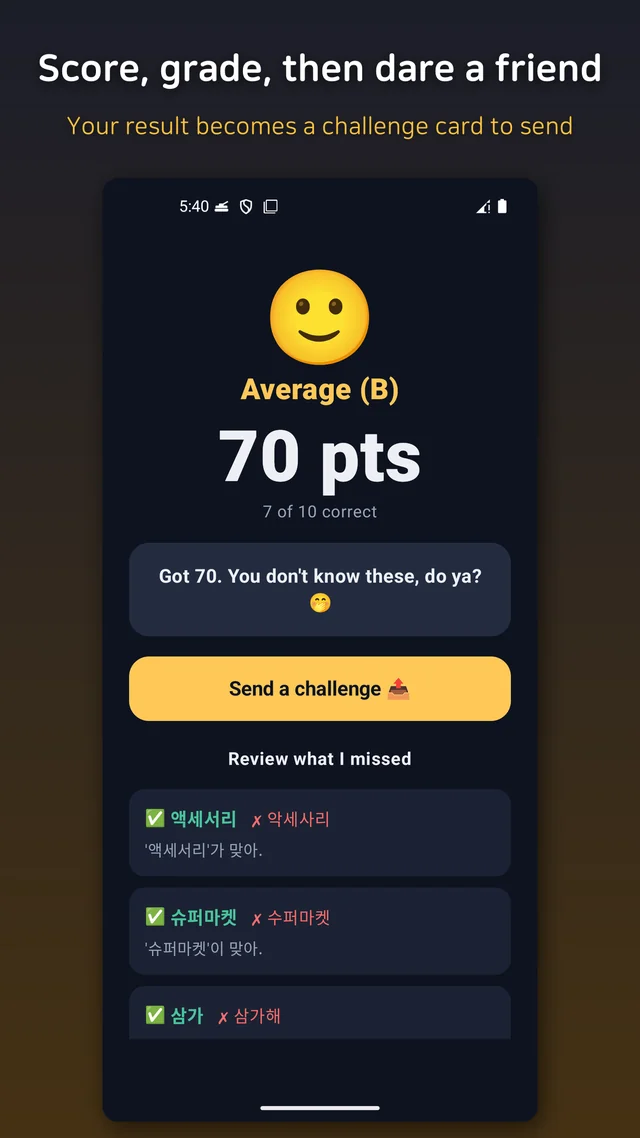
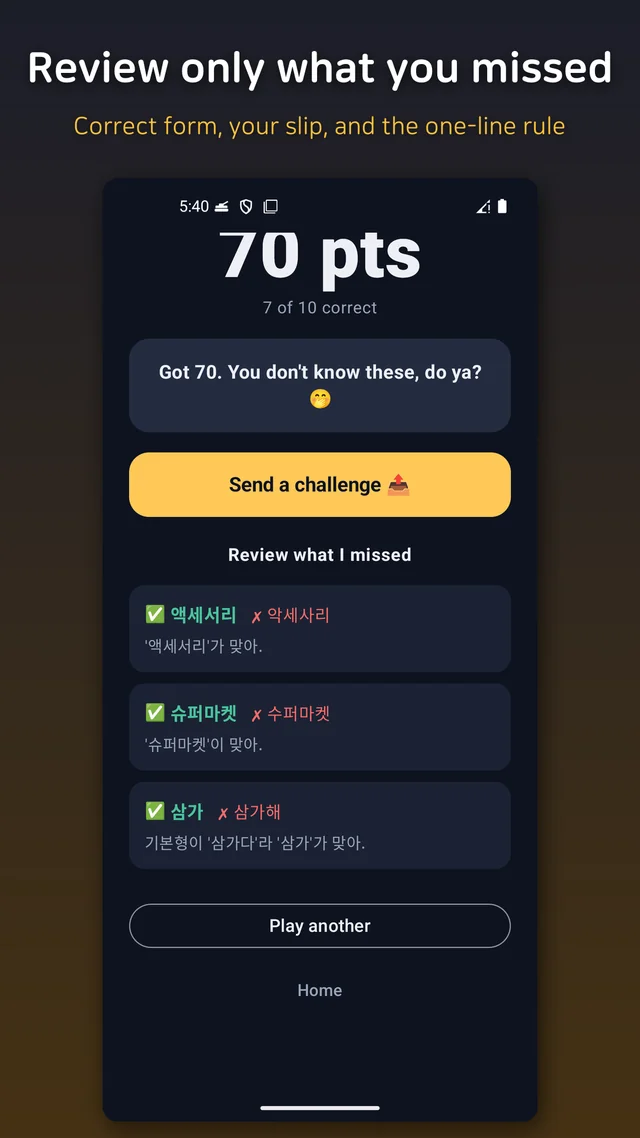
A round is ten questions. At the end you get a score out of 100 and one of five grades, and this is where the app earns the word "battle". Your result becomes a challenge card, an image you can send to a friend with your score on it. The card is the whole reason my group chat installed it: someone posts 92, someone else refuses to accept that, and the app gets opened five more times that evening. There is a daily challenge with the same ten questions for everyone on the same day, so scores compare directly, plus a streak counter and a review screen that collects only the ones you missed.
One choice I want to be clear about: this is deliberately not a checker. It will not correct your text and it will not proofread anything. It only ever asks, in the kind of sentences you would actually send.
Who this is for, honestly
The menus and buttons are in English. The sentences, the answer choices and the explanations are in Korean, short and casual, because they are written for people who already read Korean. So this is for:
- Heritage speakers and long-term learners who read comfortably but hesitate on the tricky pairs
- Intermediate learners who want a quick test of common Korean spelling mistakes, not a grammar course
- Korean speakers living abroad whose spelling has drifted while nobody was checking
- Anyone in a Korean group chat who likes settling arguments with a scoreboard
If you are at the very start of learning Korean, this one will frustrate you; come back in a year and it will be fun.
It works offline, needs no account, and keeps nothing on a server. It is free, with ads, and nothing is locked behind them.
Download (Google Play, free): https://play.google.com/store/apps/details?id=com.thefacegood.spellbattle
※ This is a quiz made for entertainment. The grades are for bragging rights, not for assessment.
If there is a pair you keep losing to in real life that is not among the 164, leave a review and I will add it to the next batch.


Comments
Post a Comment