Meteor Shower Tonight? An App That Says Yes, No, or Not Here
Two summers in a row I went outside for the Perseids on the wrong night. The first year I had read a headline, remembered "mid-August", and stood in the garden on the 15th looking at a nearly full Moon and nothing else. The second year I got the date right and the time wrong: I gave up at eleven, and the best hours were after two in the morning. Both times the question I actually had was simple, "is there a meteor shower tonight, from here, and when should I look," and both times the answer was scattered across three websites and a forum thread.
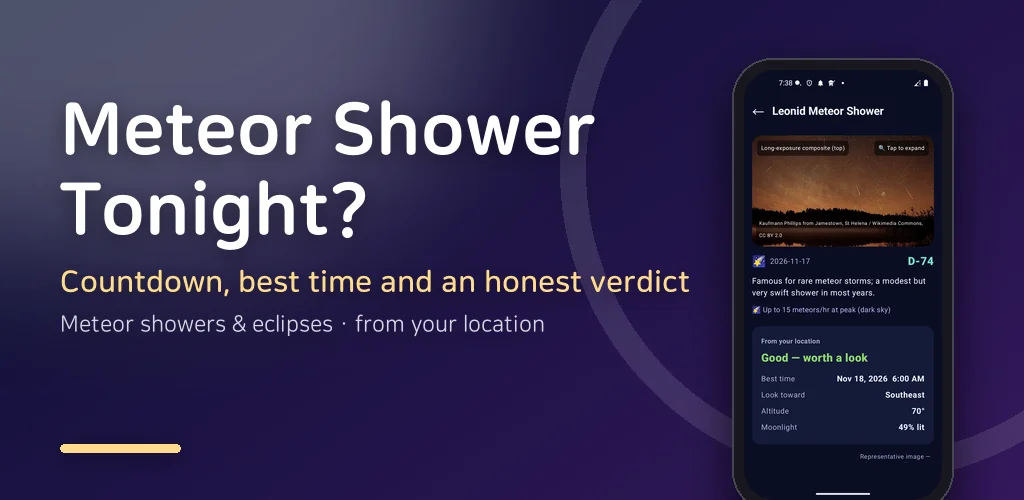
Skygaze is the app I built so that question has a one-screen answer. It keeps a short list of upcoming events, meteor showers and solar and lunar eclipses, counts down to each one, and once you allow location it calculates the best hour to watch from where you are, which way to look, and how badly the Moon will wash it out.
▶ Get it on Google Play (free): https://play.google.com/store/apps/details?id=com.thefacegood.skygaze
Is there a meteor shower tonight, and is it worth going outside
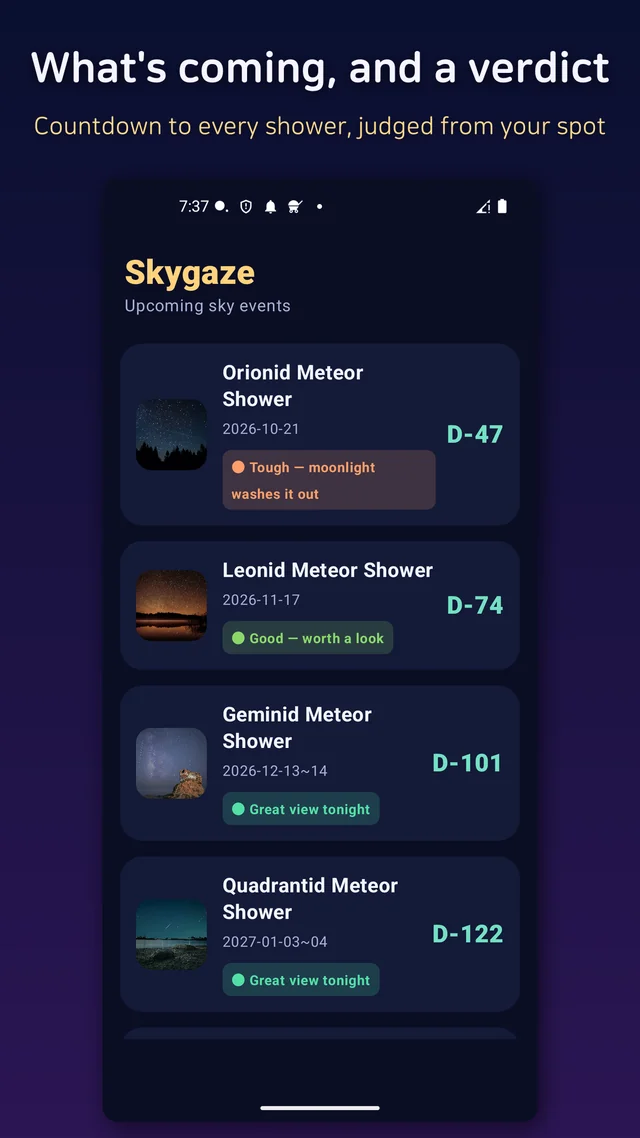
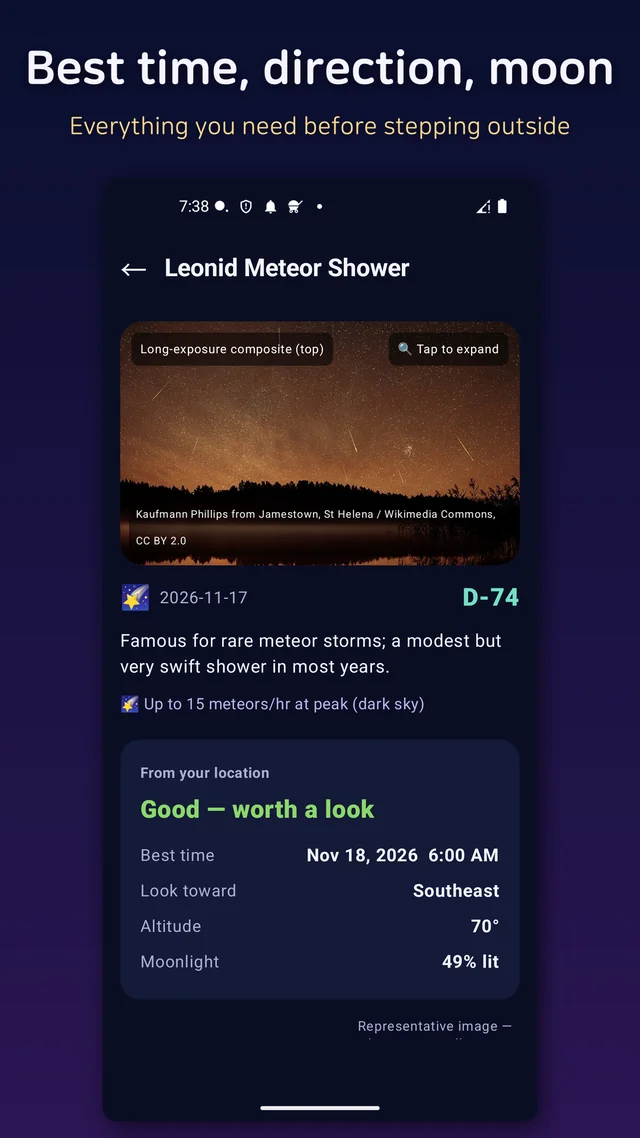
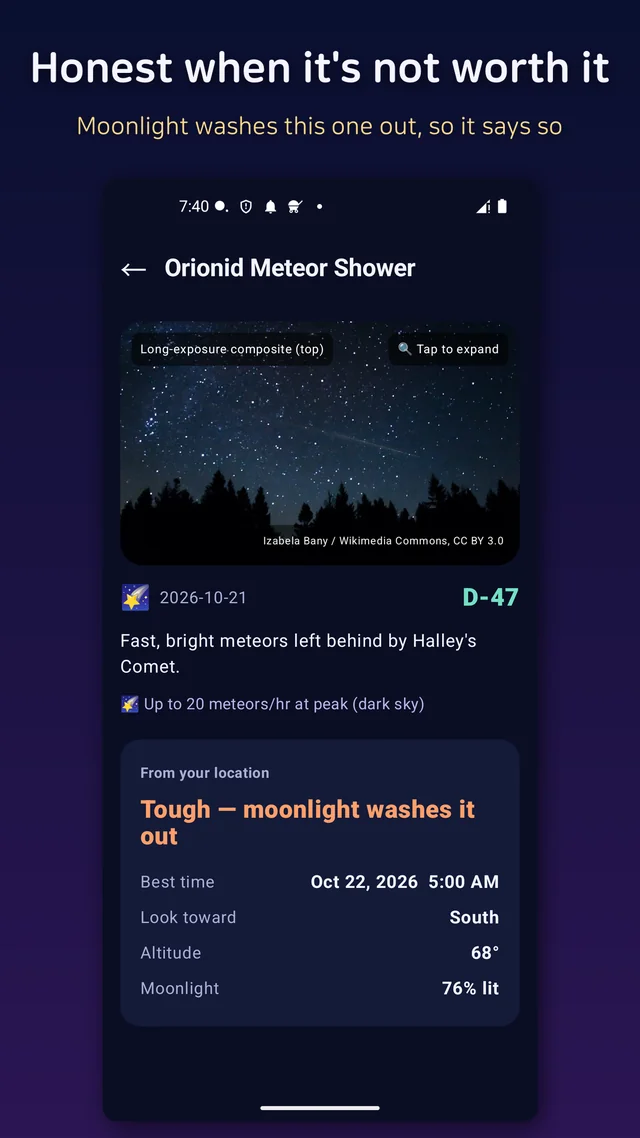
The home screen is a list with a countdown on every row: days until peak, or TODAY. Tap an event and the detail screen gives you the parts that matter for a decision. Best time, in your own clock. Look toward, as a compass direction. How high the radiant gets. Moonlight, as a percentage lit. And a one-line verdict that ranges from "great view tonight" down to "tough, moonlight washes it out", or, if you are simply in the wrong hemisphere, "not visible from your area".
That verdict is the whole reason the app exists. Meteor shower coverage online tends to quote the peak rate under a perfectly dark sky and leave you to work out that a 90% Moon will eat most of it. I wanted the app to tell me not to bother, when that is the truth, so that when it says go, I go. Times and directions are computed on the device for your exact location; there is no account and it works offline.
What is coming up: from the Orionids to next summer
The list is deliberately short, ten events at the moment, because a page listing forty minor showers that produce two meteors an hour is exactly the noise I was trying to get away from. The current entries run from the Orionids in late October (fast, bright meteors left behind by Halley's Comet) through the Leonids in November and the Geminids in mid-December, which are the best shower of the year for most people: slow, bright, and plentiful, up to 120 an hour under a dark sky. After that come the Quadrantids in early January, with a sharp peak that lasts only hours, then the Lyrids in April, the Eta Aquariids in May, and the Perseids again next August.
Each entry carries a real preview: an actual photograph, a long-exposure composite, or an illustration, and the app labels which of those it is. I added that label after realising that most people's mental image of a meteor shower comes from stacked composites showing a hundred streaks at once, which is not what the eye sees. Knowing what you are actually going to see, and that it will still be worth it, matters more than a pretty picture.
The honesty rule, and why the eclipse guide says "not visible" sometimes
Eclipses are where honesty gets expensive. A total solar eclipse is visible along a narrow path and nowhere else, and a lunar eclipse only from the half of the planet where the Moon is up. An eclipse guide that just shows a countdown with a dramatic photo sets a lot of people up for disappointment. So this one lists the regions each eclipse can be seen from, tells you plainly if your area is not among them, and points you to where it is instead.
I used the same rule for the reminder. There is one notification a day, at nine in the morning, and only about what is coming up: "Tonight: Geminid Meteor Shower", or an event a few days out. No streaks, no nudges, no "you have not opened the app". If nothing is happening, it stays quiet. I would rather it be trusted than opened.
A few smaller things. Every image is public-domain or Creative Commons, credited inside the app, and you can pinch to zoom the high-resolution versions. The interface is in English plus seven other languages. And no space agency, NASA, ESA or otherwise, has any connection to the app; it is one person's answer to "what time is the meteor shower tonight".
Who this is for
- Anyone who has typed "meteor shower tonight" into a search bar and got last year's article
- Parents who want one reliable night to take the kids outside, not a subscription
- Travellers checking whether the solar and lunar eclipse dates line up with a trip
- Anyone who wants a countdown to the Geminids and one gentle reminder, nothing more
Download (Google Play, free): https://play.google.com/store/apps/details?id=com.thefacegood.skygaze
※ Times and directions are computed for your approximate location. Eclipse visibility depends on the exact path, so check the regions listed for each event. What you see on the night depends on weather, light pollution and your eyes adapting to the dark, so give it twenty minutes before deciding the sky is empty.
If you use it for the Orionids or the Geminids this year, tell me how the verdict compared with what you actually saw. That comparison is how the moonlight rule gets tuned, and it is the feedback I want most.


Comments
Post a Comment