90s K-Pop Songs: No. 1 Hits Year by Year, 1990 to 1999
Between January 1990 and December 1999, 166 different songs reached No. 1 in the weekly Korean TV chart data behind this page: KBS Gayo Top 10 up to February 1998, then SBS Inkigayo. That is 494 recorded weeks, roughly 45 to 52 per year, so it works as a year-by-year answer to “what was the number one K-pop song then?”
The decade was dominated by long ballad runs early on and faster turnover at the end, and the table shows it.
Year by year, 1990 to 1999
| Year | Chart | Weeks recorded | Different No. 1 songs | Most weeks at No. 1 in that year |
|---|---|---|---|---|
| 1990 | KBS Gayo Top 10 | 45 | 12 | 5: Byun Jin-seop, “Huimangsahang”; Haetbitchon, “Yurichangen Bi” and 3 more |
| 1991 | KBS Gayo Top 10 | 52 | 14 | 6: Lee Sang-woo, “Geunyeoreul Mannaneun Got 100m Jeon”; Lee Bum-hak, “Ibyeol Anin Ibyeol” |
| 1992 | KBS Gayo Top 10 | 50 | 14 | 6: Lee Hyunwoo, “Dream” |
| 1993 | KBS Gayo Top 10 | 51 | 16 | 5: Jang Hyun-chul, “Walking to Heaven”; Noise, “What I Wanted From You” and 3 more |
| 1994 | KBS Gayo Top 10 | 51 | 15 | 5: Kim Gun-mo, “Excuse”; Kim Min-kyo, “The Last Game” and 4 more |
| 1995 | KBS Gayo Top 10 | 50 | 16 | 5: Kim Gun-mo, “Wrong Encounter”; Roo'Ra, “The Angel Who Lost Wings” and 3 more |
| 1996 | KBS Gayo Top 10 | 50 | 19 | 5: Kim Jung-min, “Sad Promise”; Clon, “Kung Ddari Sha Bah Rah” |
| 1997 | KBS Gayo Top 10 | 49 | 18 | 5: COOL, “Destiny”; Yangpa, “Young Love” and 2 more |
| 1998 | KBS then SBS | 48 | 22 | 5: Lee Hyun Woo, “The Day After You Left” |
| 1999 | SBS Inkigayo | 48 | 28 | 3: 1TYM, “1TYM”; S.E.S., “I Love You” and 5 more |
In every year up to 1998 the leading song stayed on top for five or six weeks. In 1999 the longest run in the data is three weeks, which matches the move to the Inkigayo chart, whose data in the 2000s also tops out at three weeks. The number of different winners climbs from 12 in 1990 to 28 in 1999.
What was No. 1 in the summer
Seasons fix a song in memory better than years do, so here are three summers from the data:
- Late June to mid-July 1992: Shin Seung-hun, “Uyeonhi” (24 June), then Seo Taiji and Boys, “Nan Arayo” (1 and 15 July).
- Late June to July 1994: Marronnier, “Cocktail Love” on 29 June, 13 July and 20 July.
- July 1996: Kim Gun-mo, “Speed” on 3 and 10 July, then Clon, “Kung Ddari Sha Bah Rah” on 17 July.
How the two charts differ
- Gayo Top 10 (KBS), 1990 to February 1998: 404 weeks in the data. Songs commonly held No. 1 for five or six weeks.
- Inkigayo (SBS), from 15 February 1998: 90 weeks in the data, with runs capped at three weeks in 1999.
- Both are TV chart records, not sales charts, so treat a No. 1 as a show winner, not as the best-selling song of the week.
Tips for tracking down a 90s song
- Pin down the season or school year first, then read the winners for that week across several years in a row.
- Search by artist in Latin letters; titles are often romanized in several ways.
- Remember that a hit that never reached No. 1 will not appear in this list at all.
The 90s on your phone
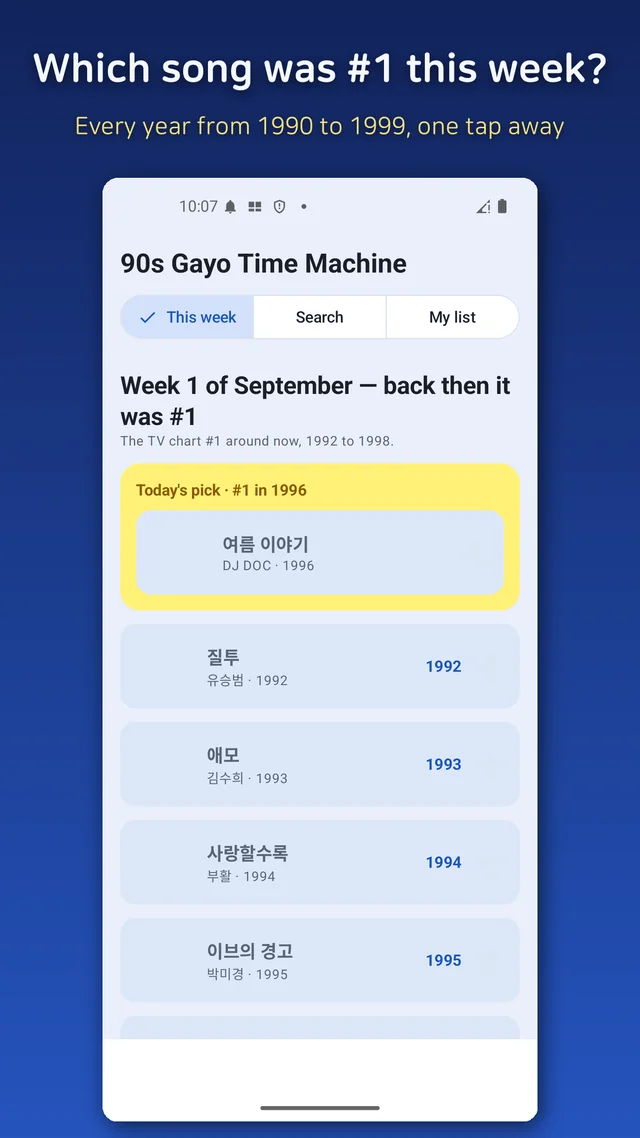
90s K-Pop Hits: Time Machine is a free Android app that opens on this calendar week across 1990 to 1999 and shows the No. 1 song for each year. It holds about 950 songs, each with credits and an English story, and plays the original stage performance through YouTube’s own player. It needs a connection for video and album art only.


Comments
Post a Comment