A planet destruction game where the planet never breaks
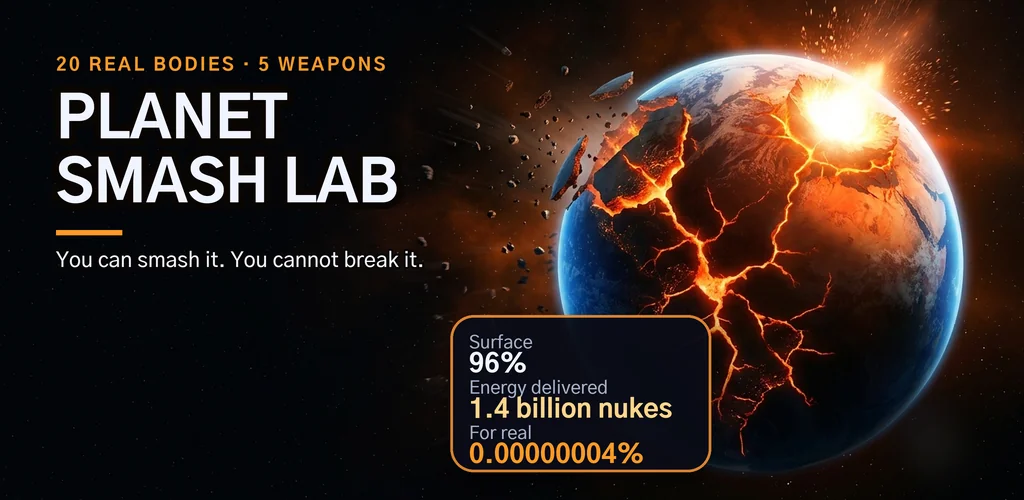
This planet destruction game started as a stupid question I could not drop. Games blow up planets all the time, so how much energy would it actually take to break one? I looked it up, did the arithmetic, and felt slightly cheated. Breaking the Earth apart takes 2.2 x 10^32 J. Every bomb humanity has ever built, added together, is not close. It is not off by a factor of ten. It is off by more than ten orders of magnitude.
So I built the whole thing around that gap. You can scorch a world's entire surface. You still have not touched the world. That is the premise of the whole destruction sim.
▶ Get it on Google Play (free): https://play.google.com/store/apps/details?id=com.thefacegood.stardudu
The number that refuses to move
Two numbers sit at the top of the screen. The first is surface damage, and it climbs fast, which is the fun part. The second is real destruction: the total energy you have poured in, expressed as a fraction of the gravitational binding energy holding the body together. Hit the Earth with the heaviest thing in the game for as long as your thumb holds out and that second number parks near 0.0000001% and stays there.
The app also converts your delivered energy into a count of nuclear bombs, because raw exponents mean nothing to anyone. Watching "630 billion nukes" sit next to a real destruction figure of zero is the whole joke, and also the whole physics lesson.
Those are real planets, not decorative marbles
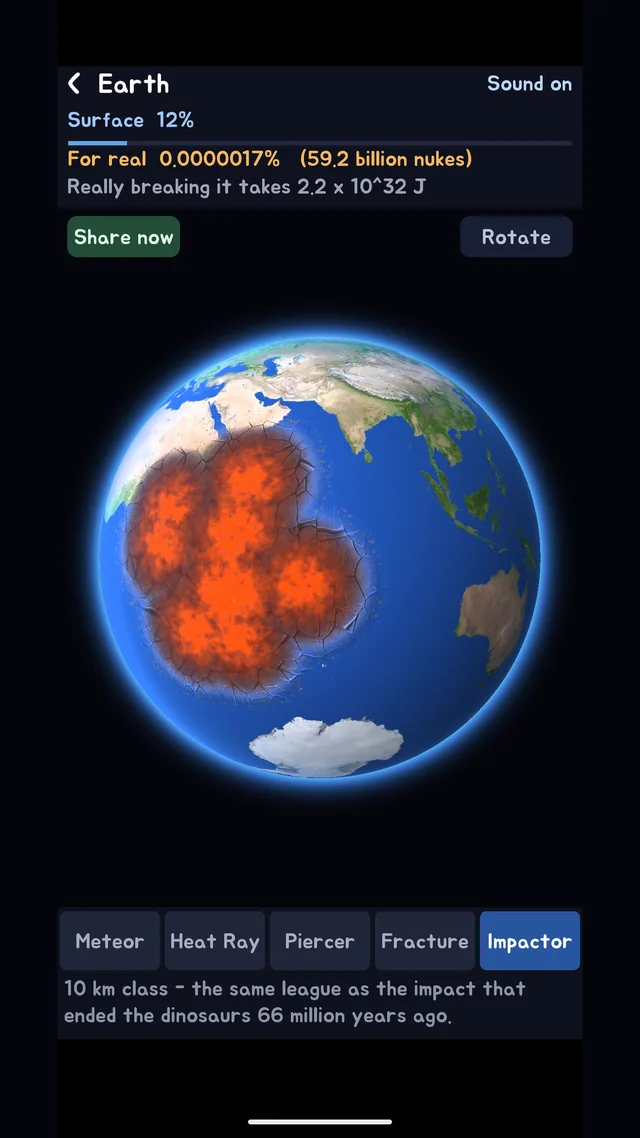
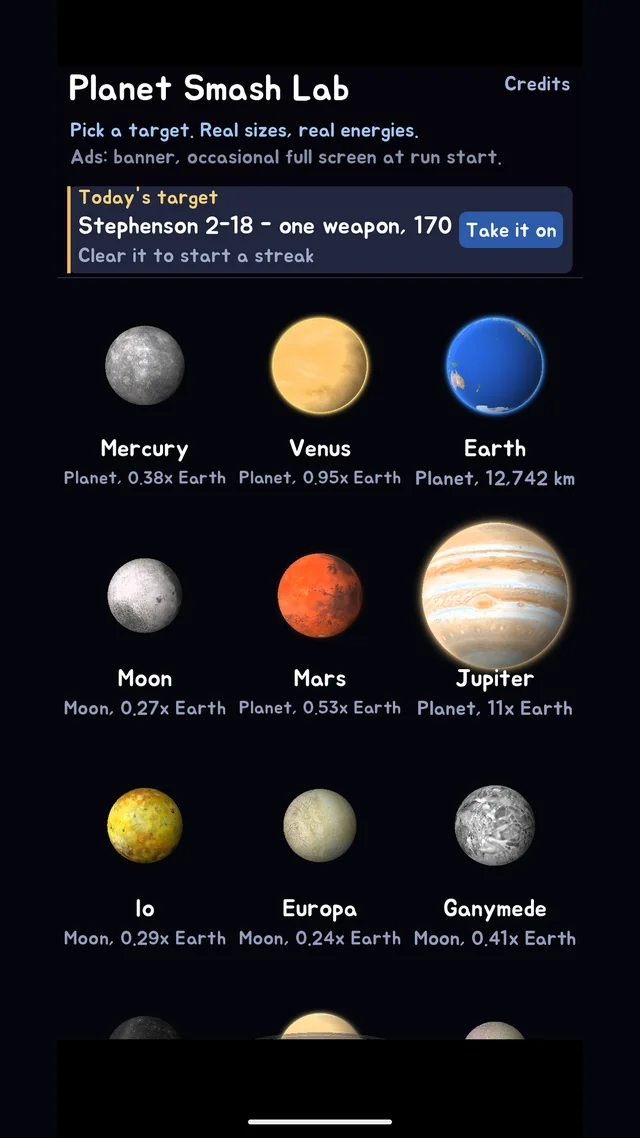
I installed a few similar apps first and most of them were pretty spheres with no relationship to anything. This one uses actual observation data for the surfaces. Eight planets, seven moons, five stars, twenty bodies in total, all available from the first launch. Radii and masses come from NASA's published fact sheets, and the binding energies are calculated from those values rather than tuned by feel.
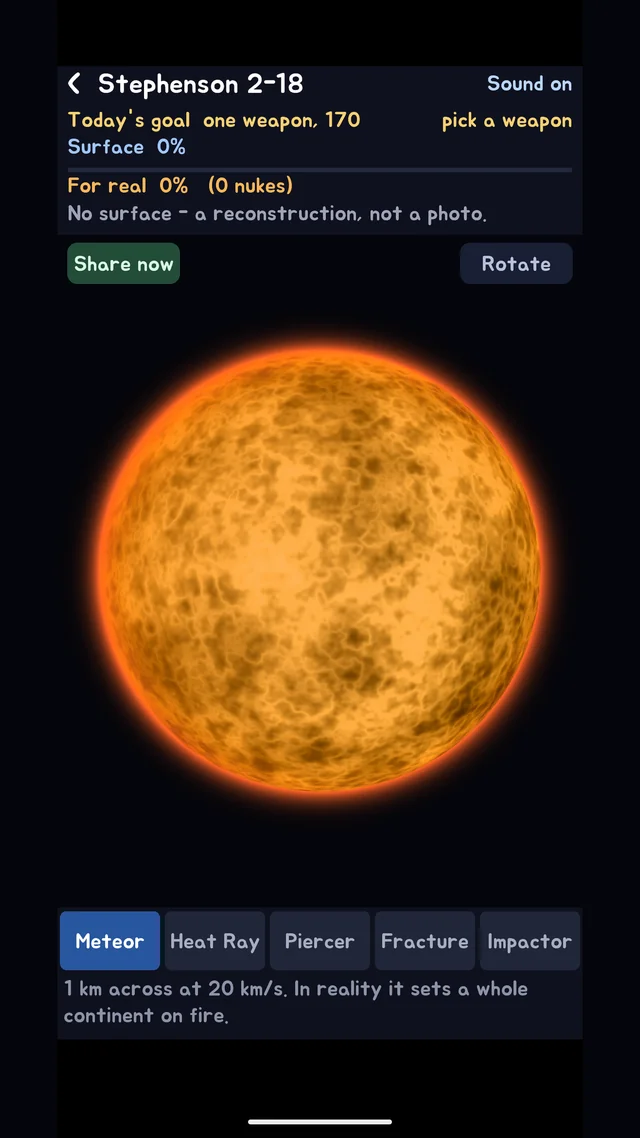
One honest note, which is also in the app's credits screen: Betelgeuse, Rigel, UY Scuti and Stephenson 2-18 have no photographed surfaces. Those stars are unresolved points from Earth and no surface image of them exists. What you see is drawn in code from their measured temperature and size. The Sun, by contrast, is a real photograph.
Five weapons, five different kinds of scar
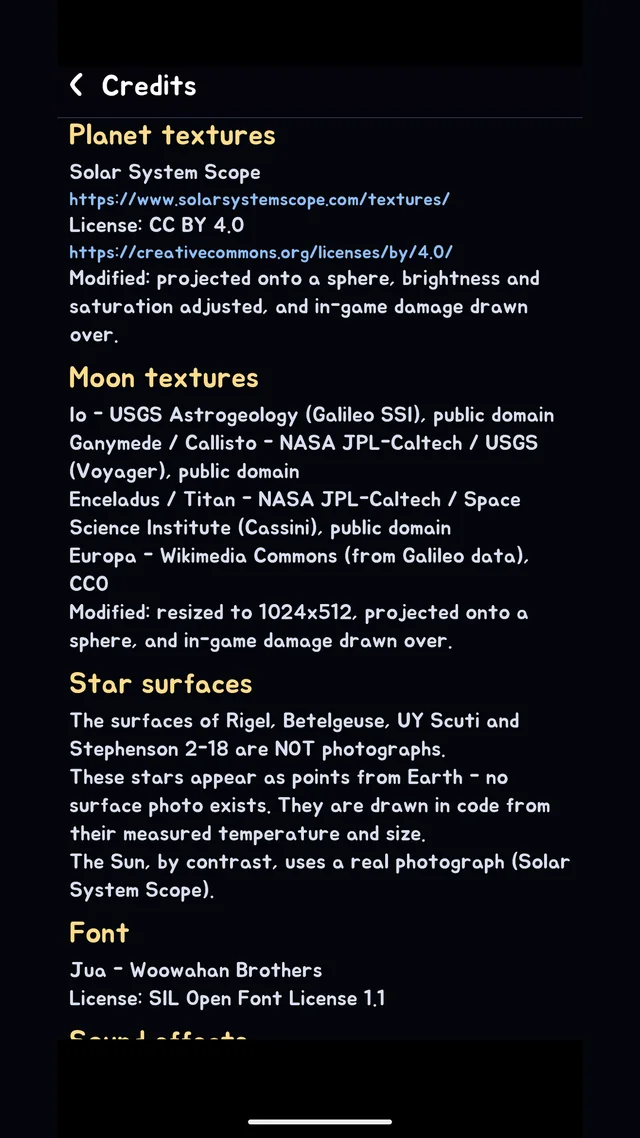
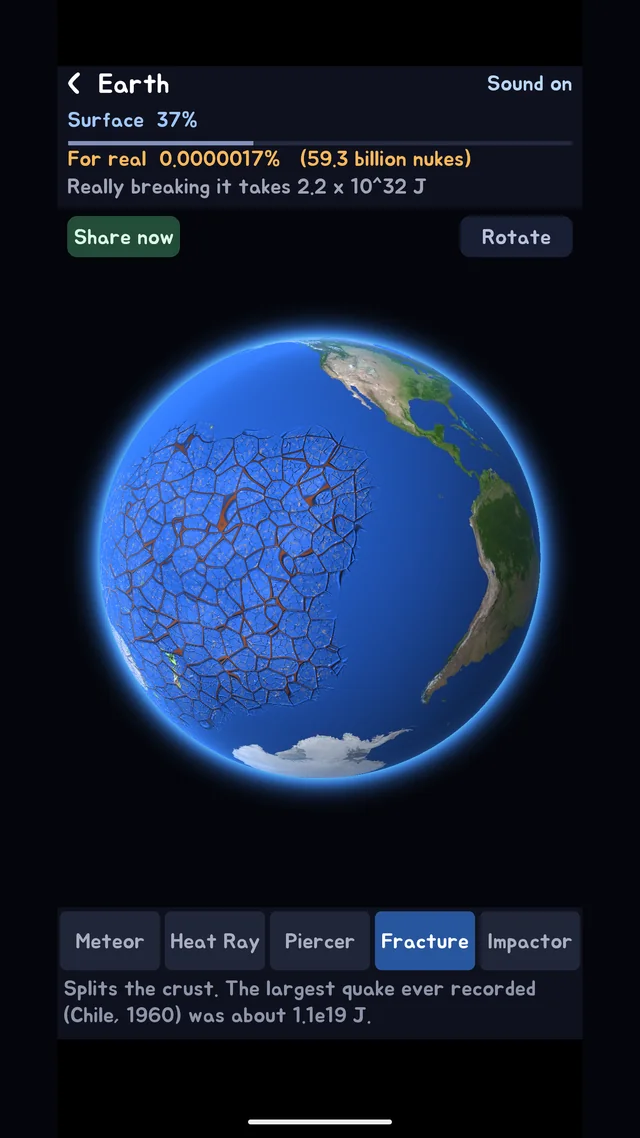
The thing I most wanted to avoid was building 5 weapons that are really one weapon in five colours. Every weapon feeds its own damage layer. Craters come from the Meteor. The Heat Ray turns rock into flowing lava. Holes clean through the body come from the Piercer. The Fracture cracks the crust open along its seams. The Impactor removes something continent sized in a single hit. The marks they leave genuinely look different, and they overlap differently too.
One target a day
Each morning the app picks one body and attaches one condition. Sometimes it times you. Sometimes it counts your shots. Sometimes it takes the strongest weapon away, or locks you to whichever weapon you fire first. The limits move with the size of the body that got drawn, because giving a small moon and a hypergiant the same target would be meaningless.
Getting those limits right took embarrassingly long. My first pass was far too generous, and a player finished a ninety second goal in twelve. So I put a measuring harness inside the app, made it collapse each body with each weapon over and over, and rebuilt the whole table from the numbers that came back instead of from my intuition.
The planet destruction game with nothing locked behind an ad
If you read the reviews of anything in this genre, the top complaint by a wide margin is advertising. So there is nothing to unlock. The complete set, five weapons and twenty bodies, is available the moment you install. No progression gates, no wait timers, no energy bar. It all works offline, so it is a fine space game for a plane or a tunnel.
There is a banner, and an occasional full screen ad when a run starts. A rewarded ad appears in exactly one place: if you fail the daily target and want one more attempt today. Skip it and you simply try again tomorrow.
There is no 3D engine in here. The sphere in the middle of the screen is a single fragment shader on a full screen quad, and the damage lives in an equirectangular mask that gets stamped wherever you touch. Turning a screen coordinate back into a latitude and longitude sounds trivial and is not, and when it is even slightly wrong your finger and the crater end up in different places.
The stars were the real problem. Planets just need a photo wrapped around them. Stars have no photo, so the surface had to be generated from temperature and radius. Then the Sun turned out to be so bright that damage on it was invisible, which is a problem I did not anticipate and spent a whole evening on.
Who this is for
- Anyone who likes astronomy and enjoys being told the scale of things
- People who want a harmless destruction game to decompress with
- Parents whose kid just discovered the solar system
- Anyone tired of progression locks and wait timers
- Anyone who needs something that works with no signal
Download (Google Play, free): https://play.google.com/store/apps/details?id=com.thefacegood.stardudu
※ The numbers are rough approximations built from publicly available data, and the purpose is entertainment and education. No real country or city is targeted and no casualties are represented.
If you try it and something feels wrong, especially the daily target difficulty, leave a review and say so. That is how the last round of numbers got fixed.


Comments
Post a Comment