How Much Does an Air Conditioner Add to Your Korean Power Bill?
A wall-mounted air conditioner run 8 hours a day for a 30-day August adds roughly 48 kWh, which is about 7,300 won extra if your usual use is 150 to 250 kWh, while a floor-standing unit adds about 132 kWh and between roughly 20,000 and 44,000 won depending on your usual use. The same hours cost very different amounts in different households because of Korea’s progressive electricity tiers.
This guide shows the residential tariff used in these figures (the standard low-voltage residential table as of mid-2026), how the bill is built, and a table of what an extra AC adds, so you can estimate before the heat wave instead of after the bill.
The residential tariff: three tiers
| Tier | July and August | Other months | Base charge | Energy charge |
|---|---|---|---|---|
| 1 | 0–300 kWh | 0–200 kWh | 910 won | 120.0 won/kWh |
| 2 | 301–450 kWh | 201–400 kWh | 1,600 won | 214.6 won/kWh |
| 3 | Over 450 kWh | Over 400 kWh | 7,300 won | 307.3 won/kWh |
Every July and August the first two tier limits are raised (to 300 and 450 kWh instead of 200 and 400), while the prices stay the same. In addition the bill carries a climate and environmental charge of 9.0 won per kWh, a fuel cost adjustment (+5 won per kWh for the third quarter of 2026, reset every quarter), 10 percent VAT and a 3.7 percent power industry fund.
How the bill is built
- Base charge, set by the tier that your usage reaches.
- Energy charge, summed across tiers.
- Climate and environment charge plus fuel adjustment, each multiplied by total kWh.
- Add VAT (10%) and the power industry fund (3.7%).
The result is rounded down to 10 won. Welfare discounts and special tariffs are not included in these figures.
Whole bills at a given usage
| Monthly use (kWh) | August bill (won) | Other-month bill (won) |
|---|---|---|
| 100 | 16,260 | 16,260 |
| 200 | 31,500 | 31,500 |
| 300 | 46,740 | 58,270 |
| 400 | 73,510 | 84,270 |
| 450 | 86,500 | 109,010 |
| 500 | 111,260 | 127,280 |
| 600 | 147,780 | 163,810 |
At 300 kWh in August you pay 46,740 won, but at 450 kWh the bill is 86,500 won, and every kWh above 450 is charged at the tier 3 rate of 307.3 won with a 7,300 won base charge.
What an extra air conditioner adds in August
Assumptions: 30 days, a typical average power draw of 200 W for a wall unit and 550 W for a floor unit (rough estimates of real use for inverter models, not the rated power), and a usual monthly use before the AC of 150, 250 or 350 kWh.
| Air conditioner | Hours per day | Extra use | Extra at 150 kWh base (won) | Extra at 250 kWh base (won) | Extra at 350 kWh base (won) |
|---|---|---|---|---|---|
| Wall-mounted (about 200 W average) | 2 h | 12 kWh | +1,830 | +1,830 | +3,130 |
| Wall-mounted (about 200 W average) | 4 h | 24 kWh | +3,650 | +3,650 | +6,240 |
| Wall-mounted (about 200 W average) | 8 h | 48 kWh | +7,310 | +7,310 | +12,480 |
| Floor-standing (about 550 W average) | 2 h | 33 kWh | +5,030 | +5,020 | +8,580 |
| Floor-standing (about 550 W average) | 4 h | 66 kWh | +10,050 | +12,560 | +17,160 |
| Floor-standing (about 550 W average) | 8 h | 132 kWh | +20,110 | +29,720 | +44,160 |
Read it row by row. A floor unit at 8 hours adds the same 132 kWh to every household, yet costs about 20,110 won in a light-use household and about 44,160 won in one that already uses 350 kWh, because the extra kWh land in a higher tier. A wall unit that adds 48 kWh costs 7,310 won at both 150 and 250 kWh, since neither crosses 300 kWh.
Why trimming an hour can save more than an hour’s worth
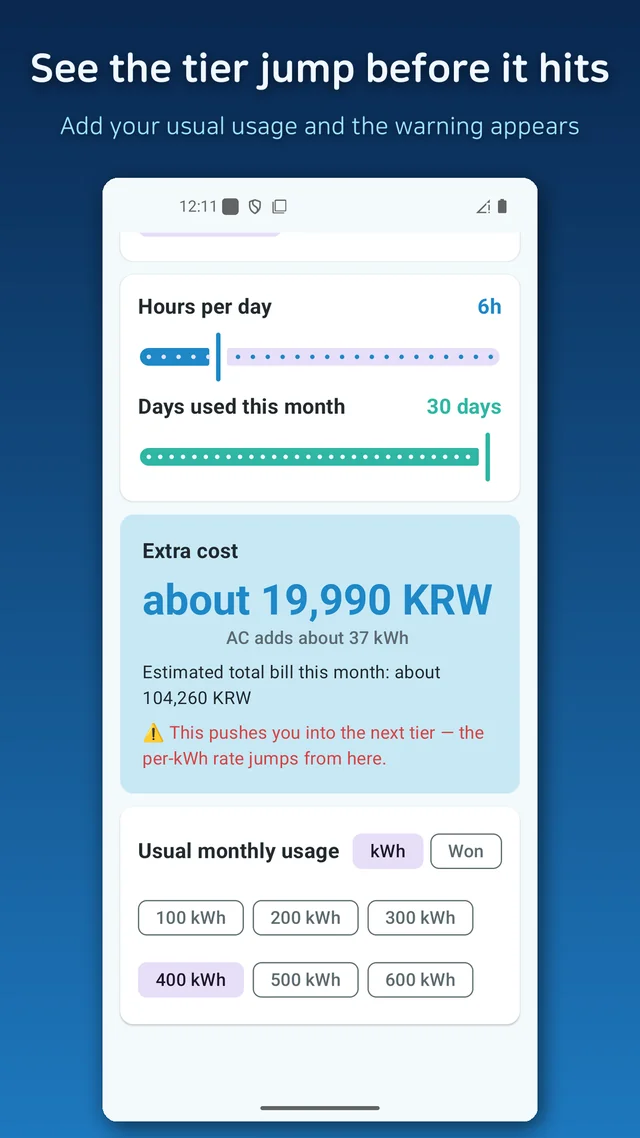
The tier effect is the key. If a household at 350 kWh adds a floor unit at 8 hours, it crosses 450 kWh. Using the AC less so that total use stays at or below 450 kWh keeps every kilowatt-hour in tier 2 at 214.6 won instead of 307.3 won and avoids the 7,300 won base charge. The cheapest hour to cut is usually the one that pushes you over a boundary.
Spring and autumn are different
The same extra 12 kWh from a wall unit at 2 hours a day costs 1,830 won at 250 kWh in August but 3,120 won in May, because the lower non-summer tier limits mean 250 kWh is already in tier 2. Knowing the limits keeps you from being surprised outside summer.
Limits of these estimates
- The 200 W and 550 W averages are rough estimates, not measurements.
- Welfare discounts, special tariffs and contract types change the real bill.
- The fuel cost adjustment changes every quarter; check the current figure.
- Meter reading dates mean the billing month may not match the calendar month.
Keeping track on Android
AC Electricity Bill Calculator is a free Android app that asks for the type of air conditioner, hours per day and your usual monthly usage, then shows what the AC adds, warns when you cross a tier, and has a detailed tab that follows the official line items. The tariff is bundled in the app so it works offline. It is an estimate for reference only.


Comments
Post a Comment