Commonly Confused Words Quiz: 178 Blanks, Two Choices Each
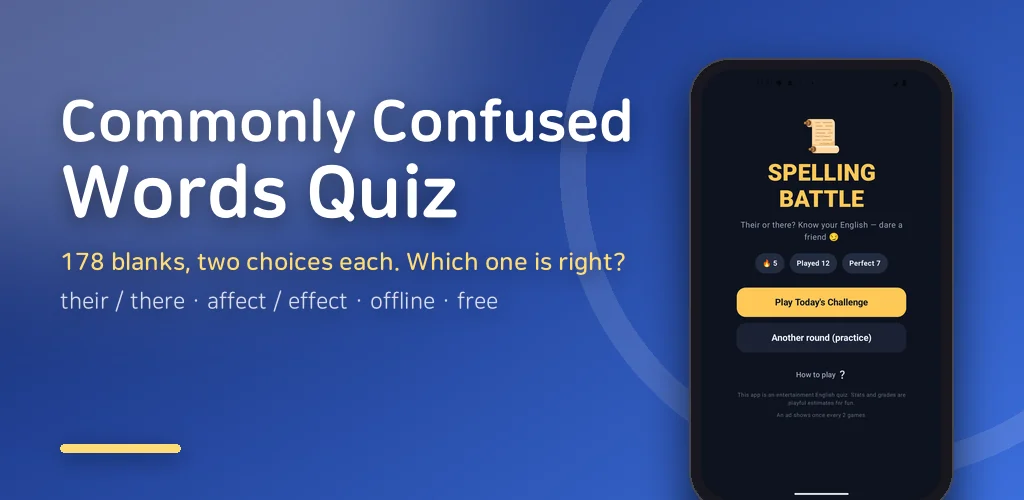
I made a commonly confused words quiz with exactly two buttons per question. That is the whole app, and the restraint is the point. their/there, your/you're, its/it's, affect/effect, lose/loose: the words native speakers get wrong in emails every day are never hard to spell. They are hard to choose, in the half second before you hit send, inside a sentence that gives you only a small clue. A list of definitions does not train that half second. A blank in a real sentence does.
▶ Get it on Google Play (free): https://play.google.com/store/apps/details?id=com.thefacegood.spellbattleen
A commonly confused words quiz that lives in full sentences
Every question is a sentence with one word missing and two candidates. "I left ___ keys on the table" with their or there. "I think ___ going to be late tonight" with their or they're. You tap one, the blank fills, and the app tells you immediately whether the sentence now says what you meant. There is no typing, no timer, no memorising. It is closer to a reflex test than a spelling test, which is exactly how these words fail people in real life.
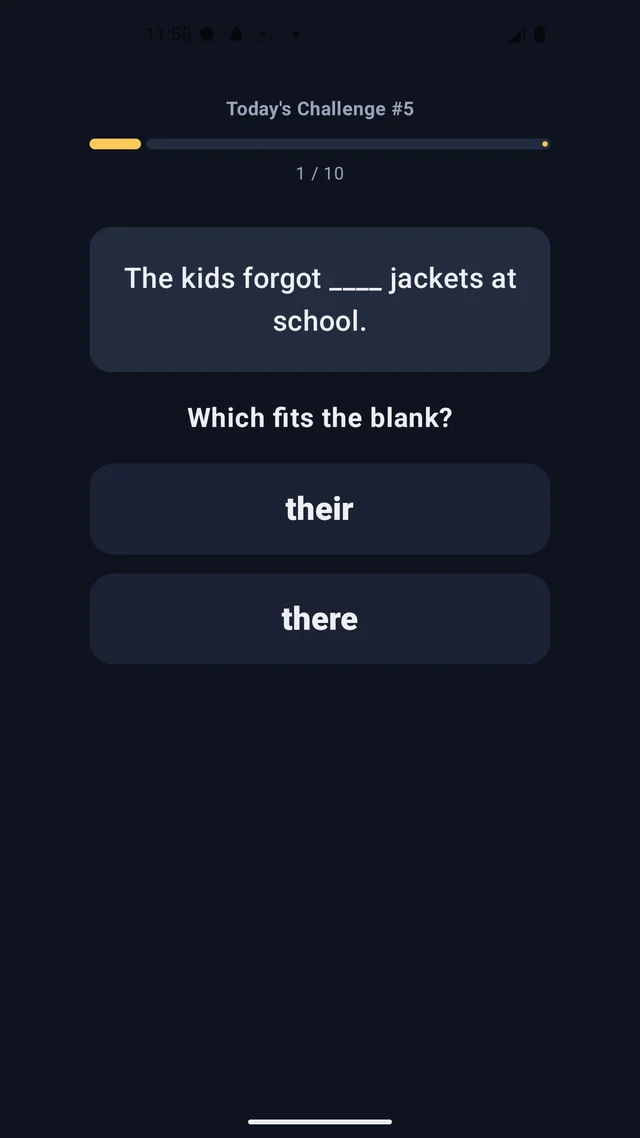
178 blanks: their/there, your/you're, affect/effect and 79 other pairs
There are 178 questions built from 82 confusable pairs. your/you're and its/it's get nine sentences each, because they deserve it; their/there, to/too and then/than get seven; affect/effect, weather/whether and lose/loose six. Further down the list are the pairs that make confident people swear: advice/advise, accept/except, principal/principle, complement/compliment, stationary/stationery, lay/lie, farther/further, breath/breathe. Each question carries a difficulty rating: 45 are the warm-up tier, 108 sit in the middle, and 25 are the hard ones.
Each also carries a rough figure for how often people miss it, and the worst offenders are not the ones you would guess. The single hardest blank in the set is rhythm against its misspelling, missed by roughly seven people in ten. Right behind it are occurrence, conscience and accommodate, then "I'm going to ___ down for a nap" (lay or lie) and "The weather will ___ the trip" (affect or effect). So this is not only a their/there test; the spelling side is real too.
Why every answer comes with a reason
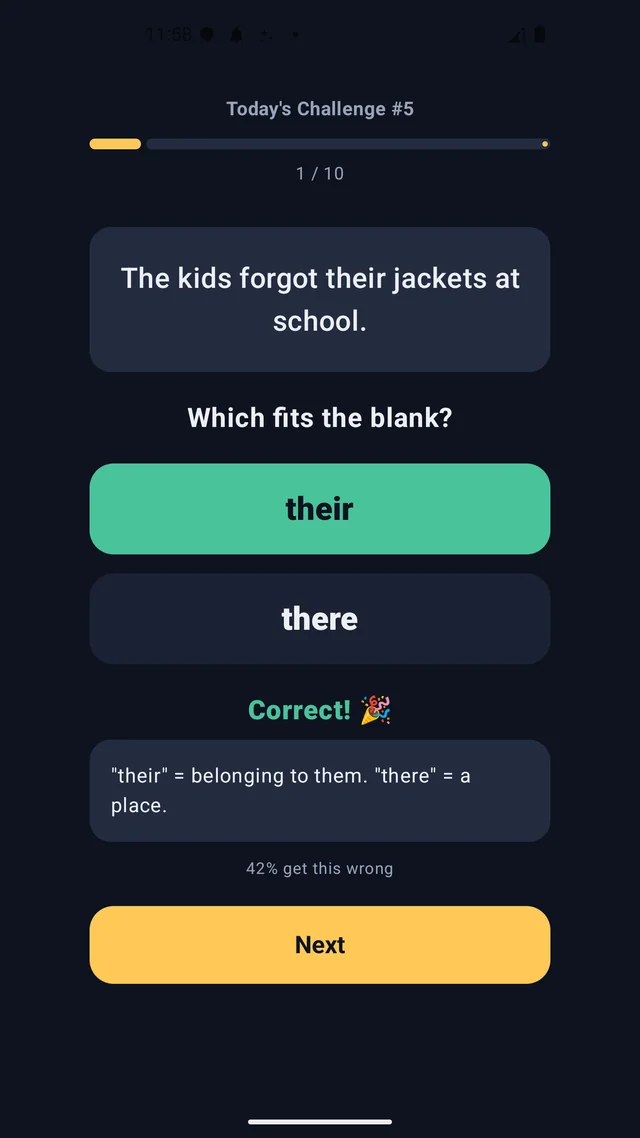
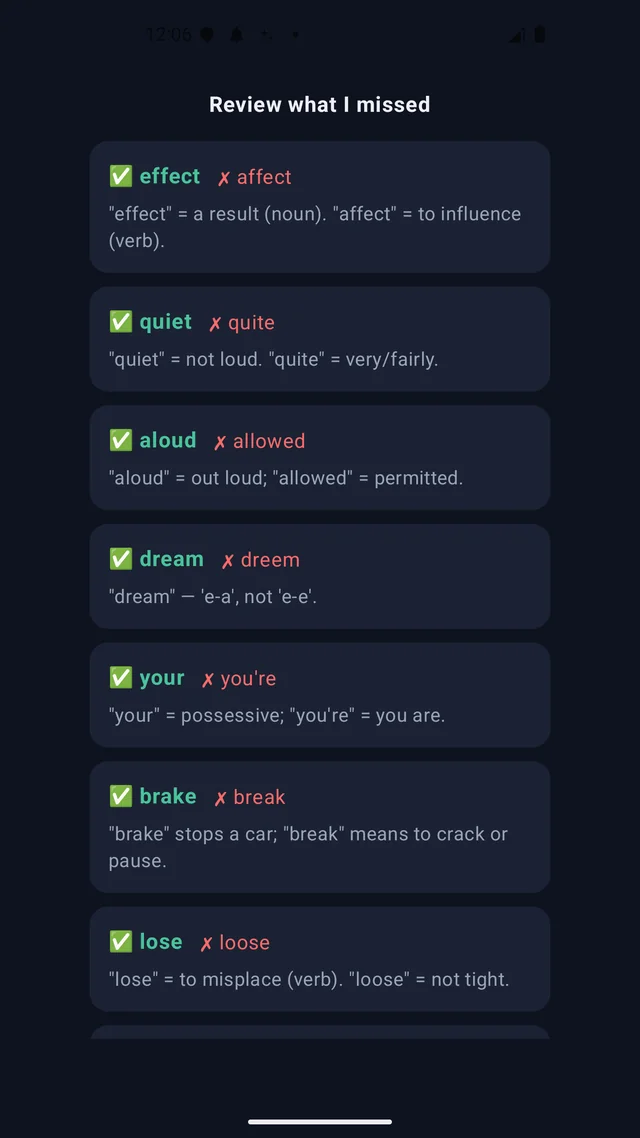
After each choice a one-line explanation appears: "their" is possession, "there" is a place; "they're" is "they are". It is short on purpose. The explanation is what turns a wrong tap into a fixed habit, and a paragraph would get skipped. The explanations are written in English, and a Korean version is shown on Korean-language phones, because the app was built in Korea for both native speakers and people learning English as a second language. What surprised me while writing them is how often both groups need the same reminder: the confusion is about instinct, not vocabulary.
Score, rank, and the challenge card
A round is ten questions. Finish it and you get a score and a rank, plus a button that turns the result into a challenge card you can send to someone. That card is where the name Spelling Battle comes from: this is an English quiz that is far more fun as a fight than as homework. Post a 90 in a group chat and watch three people install it to prove you wrong. A daily challenge gives everyone the same ten questions on the same day, so scores compare directly; a review mode replays only what you missed; and your history stays on the phone and nowhere else.
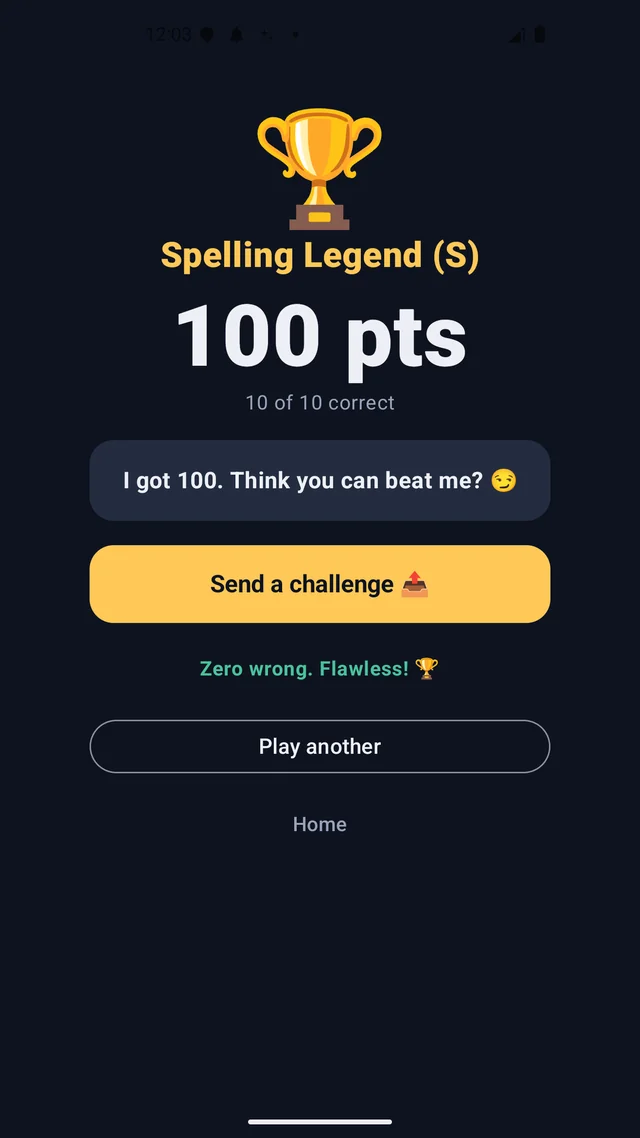
Two choices, not four, was a deliberate call. The words people confuse come in pairs, so a 2-choice quiz puts the exact two you mix up in front of you and makes you commit. Four options would just be padding that turns a decision into a guess.
Who this is for
- Anyone who pauses over their/there or your/you're before pressing send
- ESL learners who want a light daily check on confusing English words, not a grammar course
- Native speakers who are certain they never mix these up and would like that tested
- Friends, classmates and coworkers who settle things with a scoreboard
It is fully offline, has no login and no account, and is free with ads. Nothing is locked.
Download (Google Play, free): https://play.google.com/store/apps/details?id=com.thefacegood.spellbattleen
※ Spelling Battle is a casual quiz made for fun. Treat the rank as bragging material, not a language certificate.
If a pair that trips you up is missing from the 178, leave a review naming it. The list grows from exactly those messages, and the next batch is already forming.


Comments
Post a Comment