Cups to Grams: Conversion Chart by Ingredient
One cup of all-purpose flour is about 120 grams, but one cup of granulated sugar is about 200 grams and one cup of honey is about 340 grams. There is no single cups-to-grams number, because a cup measures volume and a gram measures weight, so the answer depends on the ingredient.
The table below uses a standard 240 ml cup and typical baking densities. Treat the figures as good starting points: how tightly you pack the cup changes them, especially for flour and brown sugar.
Cups to grams by ingredient
| Ingredient | 1 cup (g) | 1/2 cup (g) | 1/4 cup (g) | 1 tbsp (g) | 1 tsp (g) |
|---|---|---|---|---|---|
| Flour (all-purpose) | 120 | 60 | 30 | 7.5 | 2.5 |
| Sugar (granulated) | 200 | 100 | 50 | 12.5 | 4.2 |
| Brown sugar (packed) | 213 | 106.5 | 53.2 | 13.3 | 4.4 |
| Butter | 227 | 113.5 | 56.8 | 14.2 | 4.7 |
| Cocoa powder | 90 | 45 | 22.5 | 5.6 | 1.9 |
| Salt (fine table) | 288 | 144 | 72 | 18 | 6 |
| Baking powder | 192 | 96 | 48 | 12 | 4 |
| Baking soda | 220 | 110 | 55 | 13.8 | 4.6 |
| Milk | 240 | 120 | 60 | 15 | 5 |
| Vegetable oil | 218 | 109 | 54.5 | 13.6 | 4.5 |
| Honey | 340 | 170 | 85 | 21.2 | 7.1 |
| Heavy cream | 240 | 120 | 60 | 15 | 5 |
Tablespoon and teaspoon values assume 15 ml and 5 ml, so a tablespoon is 1/16 of a cup and a teaspoon is 1/48. Salt and baking powder are where small errors matter most: 1 teaspoon is only 4 to 6 grams, so weigh them if you can.
Why one number is wrong
Using a blanket figure such as "1 cup = 125 g" for everything is the usual reason bakes come out dry or dense. Flour is light and airy, sugar is dense, and salt is heavier still, so the same cup holds very different weights. Flour also changes with how you scoop it. Spoon it loosely into the cup and level it; do not dig the cup into the bag and pack it.
Oven temperature: Celsius, Fahrenheit and fan ovens
| Celsius | Fahrenheit | Fan oven (Celsius) |
|---|---|---|
| 150 | 302 | 130 |
| 160 | 320 | 140 |
| 170 | 338 | 150 |
| 180 | 356 | 160 |
| 190 | 374 | 170 |
| 200 | 392 | 180 |
| 220 | 428 | 200 |
Fahrenheit is Celsius times 9/5 plus 32; recipes round 356 to 350 and 392 to 400. The fan-oven column uses the common rule of subtracting 20 degrees Celsius, because a fan moves hot air across the bake so it cooks faster and drier at the same setting. Recipes rarely say which kind of oven they were written for, so if a recipe is silent, assume a standard (non-fan) oven.
Your own oven can also be off. Put a cheap oven thermometer inside, compare it to the dial, and add or subtract that difference every time.
Changing the pan size
Pan capacity scales with area, not with the number printed on the side. Divide the area of the pan you have by the area of the pan the recipe used, and multiply every ingredient by that ratio.
- 20 cm round to 23 cm round: area goes from about 314 to about 415 cm², a multiplier of 1.32.
- 20 cm round to 20 cm square: 400 divided by 314 is 1.27.
- 23 cm round to a 23 x 33 cm rectangle: 759 divided by 415 is 1.83.
- Round pan area is pi times radius squared; square is side squared; rectangle is width times length.
Pour the same batter into a bigger pan and you get a thin, overbaked layer; into a smaller one and it domes, cracks and stays raw in the middle.
Dough temperature for bread
Bakers who want consistent bread aim for a target dough temperature and adjust the water temperature to hit it.
- Water temperature = target dough temperature x 3, minus (room temperature + flour temperature + friction factor). Example: target 26, room 24, flour 22, friction 12 gives 78 minus 58, or 20 degrees Celsius.
- Friction factor: after a mix, take the result temperature x 3 and subtract room, flour and tap water temperature. That gives your mixer's own number for next time.
- Ice = total water x (tap temperature minus target water temperature) divided by (80 + tap temperature). Example: 600 g water, tap 25, target 10 gives 600 x 15 / 105, about 86 g of ice replacing some of the water.
Let your phone do the math
Baking Calculator has these conversions built in: cups, tablespoons and teaspoons to grams by ingredient, pan size multipliers, oven Celsius and Fahrenheit with fan adjustment and a saved offset for your own oven, and dough temperature with ice. It works offline and has no account.
Baking Calculator product page | Baking Calculator on Google Play
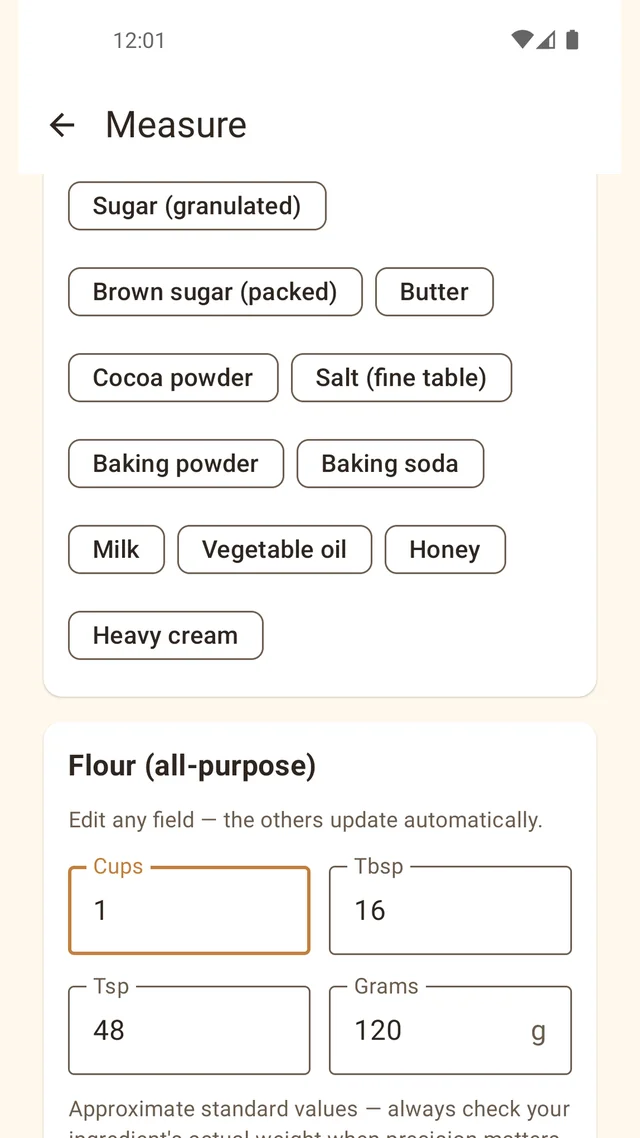
These are guideline figures; flour packs differently depending on how you scoop it and ovens vary.


Comments
Post a Comment