How to Find a Mosquito in Your Room at Night
To find a mosquito in your room, turn the light on and look first at the places it is most likely to rest: the ceiling above the bed, plain walls and the bathroom wall, and behind curtains. If you find nothing, a camera set up in advance can watch a wall for you, because a resting mosquito is only a few millimetres long.
The hard part is not killing it but locating it. Once it has landed and gone still, it is a small dark speck on a pale surface, and it usually moves the moment the light comes on.
Where to look first
- The ceiling above the bed. A white ceiling is the easiest surface to scan.
- The bathroom wall. Plain tiles or paint make a small dark spot easy to see.
- Curtains and the gap behind them.
- Corners, mouldings and picture frames. Look here last. Edges and patterns hide a speck far better than a flat wall does.
A quick search routine
- Switch the main light on and stay still for a few seconds. Listen for where the whine comes from.
- Scan one wall at a time from top to bottom, rather than glancing around the room.
- Hold a torch at a shallow angle to the surface. Small specks show up better in raking light.
- Check the same few surfaces again after a minute. A mosquito that moved will have settled elsewhere.
Why it is hard to find a mosquito at night
A resting mosquito is a few millimetres long. On a pale ceiling it is a speck, in a room lit by a bedside lamp the eye misses it, and if you have just woken up your attention drifts. Searching again and again at 3 a.m. is why people give up and sleep with the bite.
A camera does the watching for you
A phone camera does not tire or blink, and it can compare each frame with the last. A new dark spot on a bright, plain wall is exactly what it is good at noticing. The setup is simple:
- Plug an old phone into a charger and prop it where you tend to see mosquitoes, such as facing a white ceiling or a plain wall.
- Aim it at a bright, pattern-free surface about 1 to 1.5 metres away. The brighter the surface, the better it sees.
- Start watching, dim the screen and leave it.
What this will and will not do
- It needs the phone close to the surface (about 1 to 1.5 m) and some light. In a pitch-dark room the camera sees nothing.
- It works best on a plain, single-colour background. Mouldings, corners, frames and patterned wallpaper increase false alarms.
- It will miss some mosquitoes, such as one that lands out of frame or on a dark surface.
- It finds where one landed. It does not repel, catch or kill anything.
Keeping a photo of each alert helps. In the morning you can see whether it caught a mosquito or a speck of fluff, and move the phone to a better spot.
Let your phone do the math
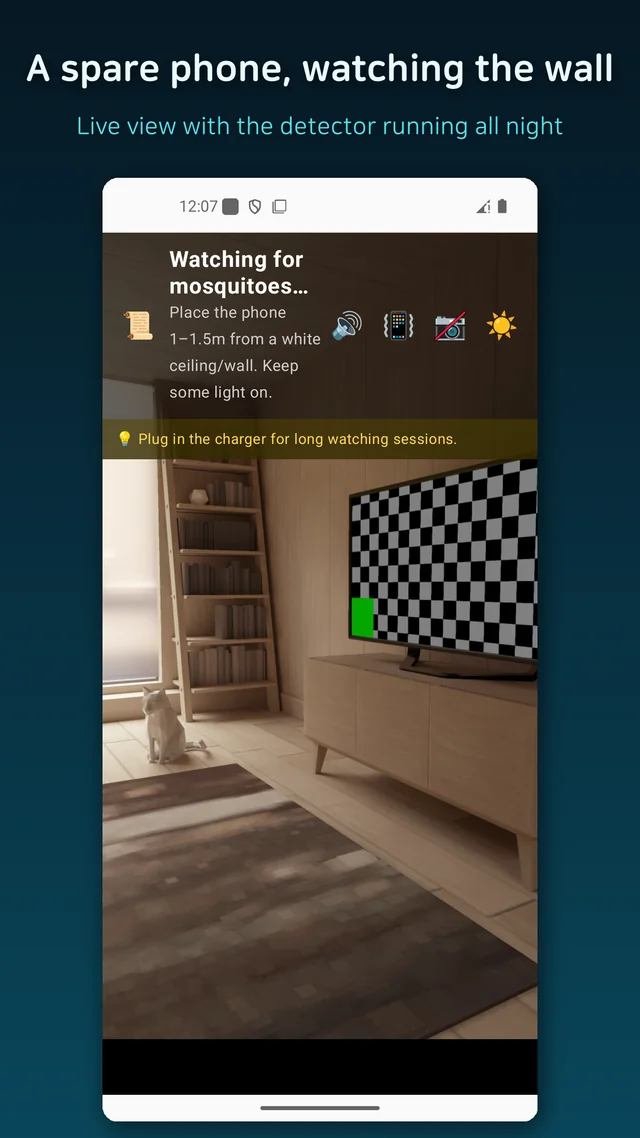
Mogicam is a free app, supported by ads, that turns a spare phone into this camera. It analyses the view on the device, plays a sound and vibration when it sees a mosquito-like spot, and draws a red circle on the spot. An optional auto screenshot saves photos to your gallery only if you switch it on. It also includes a setup guide, a charging reminder and a dim-screen mode. Frames are never sent anywhere.


Comments
Post a Comment