Ghost Leg Game With Lines You Can't Trace by Eye
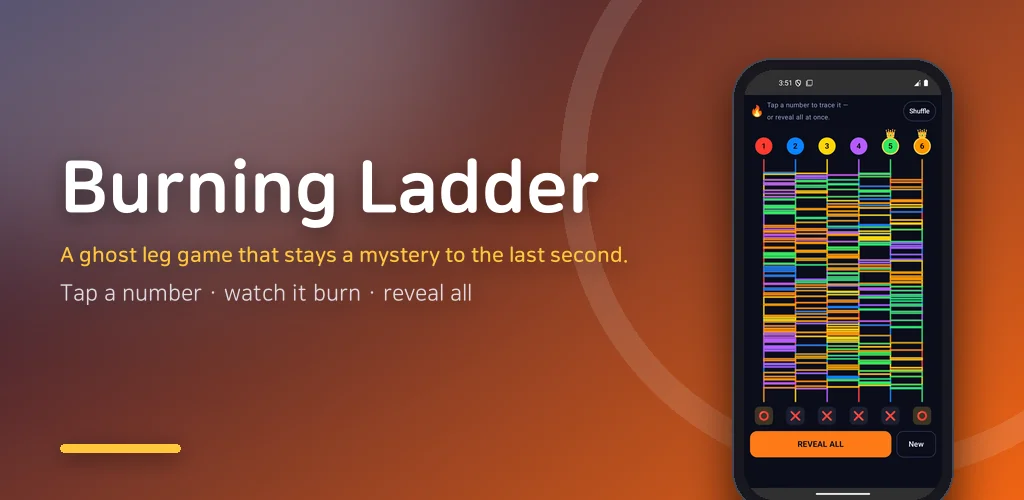
Ten people, one restaurant bill, and a ladder drawn on the back of a napkin. Somebody draws the vertical lines, somebody else adds the rungs, and before anyone has picked a number, two people at the table have already followed the lines with their eyes and know exactly who is paying. That is the problem with the ghost leg game as it is usually played: it is a random draw that anyone can spoil by looking. I built a version where looking does not help.
The trick is not clever software. It is simply that the lines are drawn to be an unreadable tangle — far more rungs, far closer together, than any human can follow — and then each path burns down the screen like a lit fuse so you find out where it lands at the same moment everyone else does.
▶ Get it on Google Play (free): https://play.google.com/store/apps/details?id=com.thefacegood.sadari
How to play ghost leg, in thirty seconds
If you have never met it: ghost leg — amidakuji in Japan, sadaritagi in Korea — is a ladder of vertical lines connected by random horizontal rungs. Each player picks a line at the top. You follow it down, and every time you meet a rung you must cross to the neighbouring line. Where you come out at the bottom is your result: a prize, a chore, a lose. Because the rungs shuffle everyone's paths, nobody can pick a winning line on purpose.
It is used across East Asia for anything a group needs to decide fairly: who buys coffee, who does the dishes, what order to present in, which team you are on.
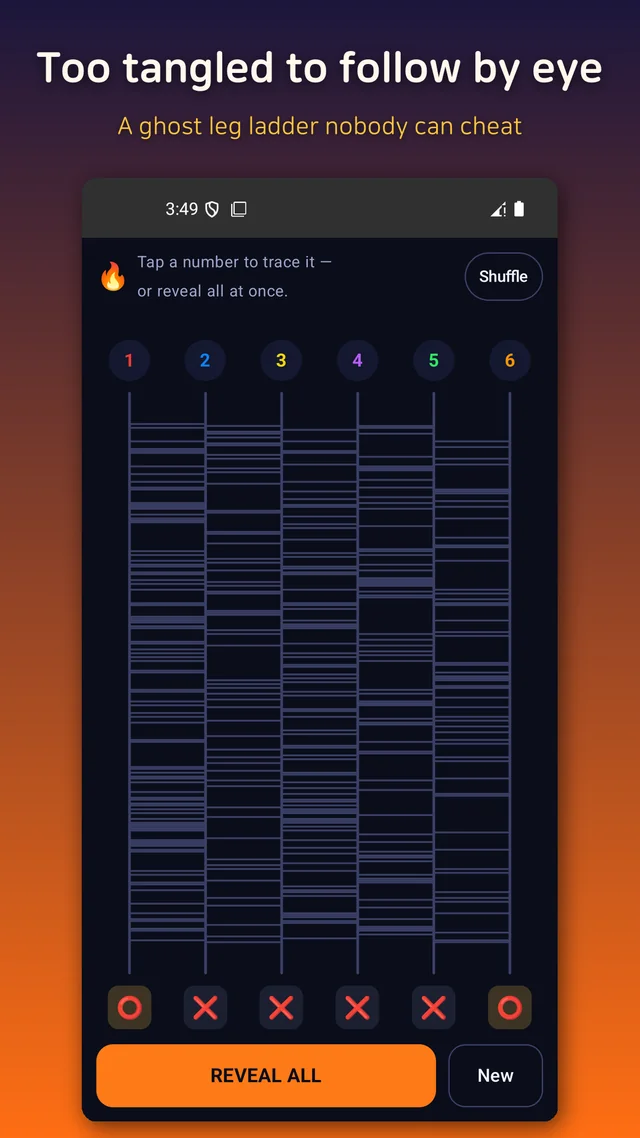
A ghost leg game that stays a mystery until the last second
Most ladder apps draw a handful of rungs, which makes the outcome readable in about two seconds. People compensate by covering the screen with a hand, which is awkward and starts arguments about who peeked. My app goes the other way: the ladder is generated with a dense, wild mess of tangled lines that nobody can trace by eye. The randomness is real, and so is the suspense.
Tap your number and your path lights up and burns downward, streaking colour through the tangle until it arrives at a circle (win) or a cross (lose). Watching the fuse creep toward the bottom row while everyone at the table shouts "not me, not me" is the entire reason the app exists.
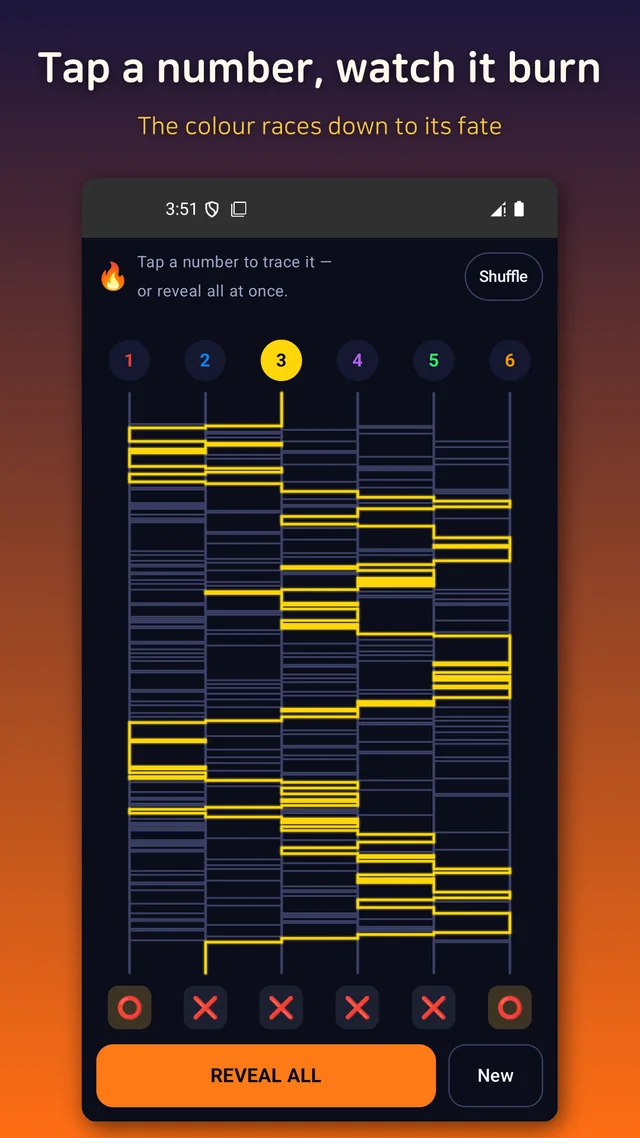
Tap one number, or reveal all ten at once
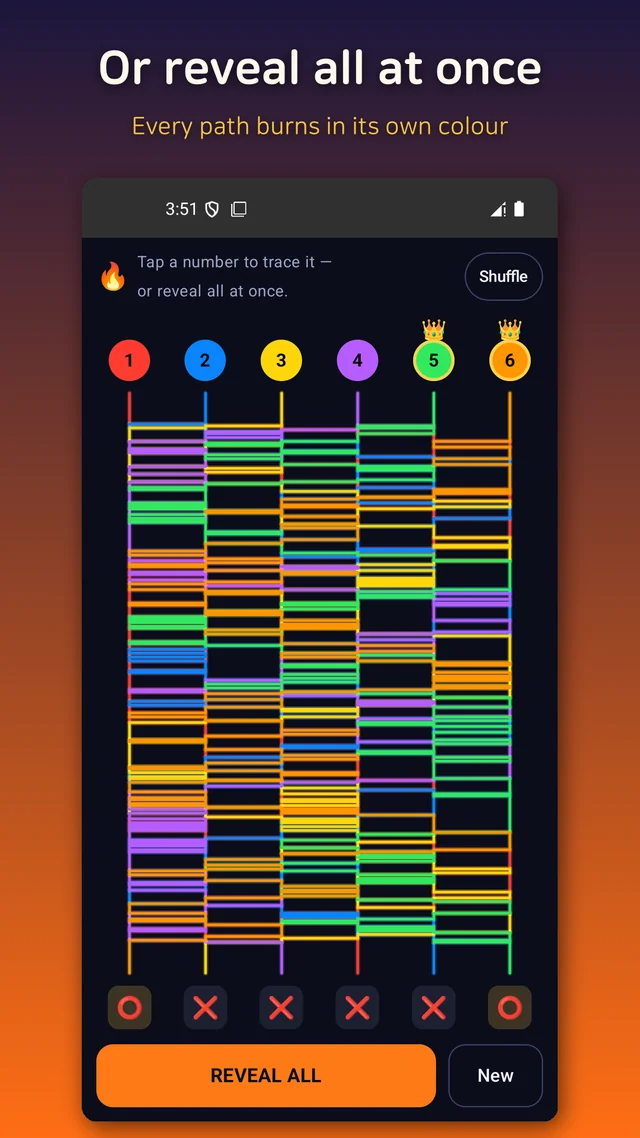
You can burn paths one at a time for maximum drama, or hit Reveal All and every player ignites simultaneously, each in a different colour of the rainbow. With ten players that is ten fuses racing through the same tangle, and you genuinely do not know who is caught until the final instant. The winners get a crown on their number so the result is obvious even from across the table.
When it is over, every path stays drawn on screen. Anyone who wants to check the result can follow their line at their own pace and see it was fair.
Two settings, and how they cover bets, chores and lunch
There are exactly two settings: how many players (2 to 10) and how many winning spots. Everything else is a lose automatically. That small pair of numbers covers most of what a group needs. One winning spot among eight players picks a single loser for the penalty, or a single winner for a prize. Winning spots set to half the players splits the group into two teams. And it does not have to be people: for lunch picks, set the players to the number of restaurants and the winning spots to one, and the restaurant is chosen in three seconds instead of twenty minutes of debate.
It runs fully offline. No login, no data collection, nothing to set up — open it and draw.
The fairness problem with paper
Paper ladders have three flaws I wanted gone. The person who draws it sees the answer first. Anyone can add one more rung after the fact and change the outcome, which is where the arguments come from. And past six or seven people the napkin runs out of room. In the app the ladder does not exist until you press start, so nobody knows the result in advance, not even the person holding the phone; the paths cannot be edited; and ten players fit on one screen.
The thing I got wrong early on was making the burn animation too fast. It was efficient and completely joyless. Slowing it to a real fuse crawl is what turned a random pick into a moment.
Who this is for
- Groups that need to pick who pays, who cleans, or who goes first — without arguing about it
- Party hosts who want a penalty draw people actually watch
- Anyone who has ever covered a ladder app with their hand to stop people cheating
- Teams that need a quick random pick for lunch, coffee runs or chores
Download (Google Play, free): https://play.google.com/store/apps/details?id=com.thefacegood.sadari
If you use it for something I have not thought of, tell me — and if a setting is missing for your kind of draw, say what it is. Two settings was a deliberate choice, but it is not a rule.


Comments
Post a Comment