Gift Tax in Korea: How Much You Can Give Your Child Tax-Free
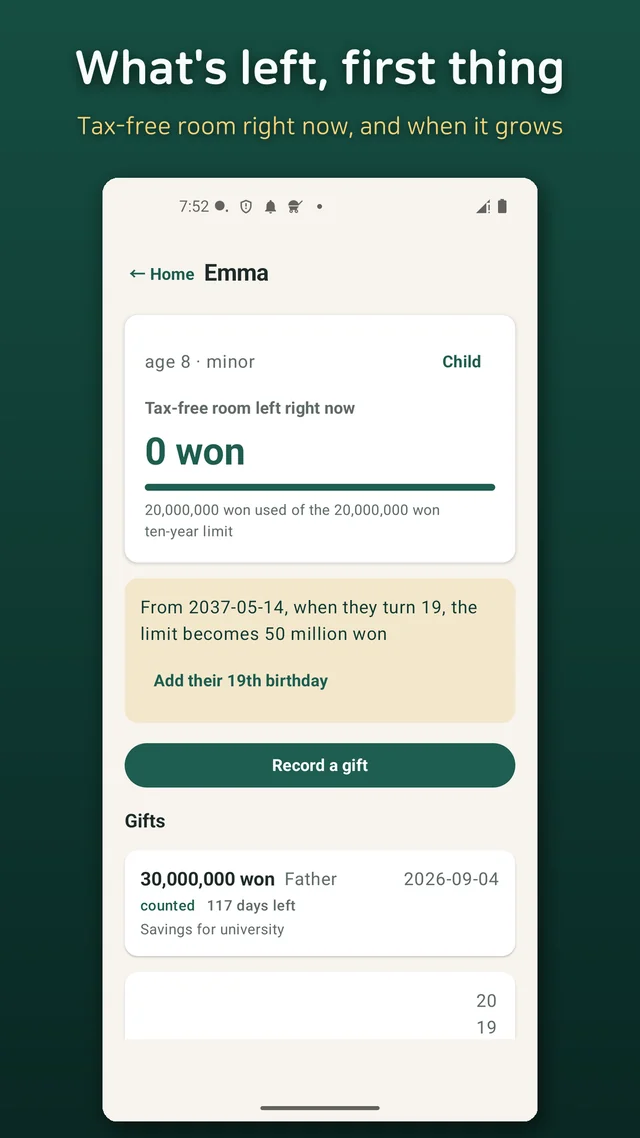
In Korea, a child can receive 20 million won from their direct ascendants (parents and grandparents) free of gift tax over any ten-year period if the child is a minor, and 50 million won if the child is an adult. That allowance is one shared pot for the whole direct line above the child, not one allowance per giver.
Those two sentences are where most families go wrong. The rules below follow the Korean Inheritance and Gift Tax Act as of 2026 in simplified form, with worked examples, so you can check a plan before moving money. Treat everything here as a reference, not tax advice.
The allowance: two numbers and one ten-year window
| Child receiving the gift | Tax-free deduction from direct ascendants | Window |
|---|---|---|
| Minor (under 19) | 20 million won | 10 years, all ascendants combined |
| Adult | 50 million won | 10 years, all ascendants combined |
The window looks back ten years from the date of each new gift. A gift made ten years or more before the new one drops out of the calculation, which is why people say the allowance “comes back” every ten years. When the child turns 19 the limit changes from 20 to 50 million won, so a long-term plan has a second milestone at that birthday.
One pot for the deduction, but two different grouping rules
Two separate rules are easy to blend together:
- The deduction is shared. Father, mother and all four grandparents draw from one 20 million won pot for a minor. If the parents have used it up, a grandparent's gift next month gets no deduction.
- The tax is aggregated per giver. When adding up earlier gifts to calculate the tax, gifts from the same person count together, and a married couple counts as one person. Each set of grandparents is counted separately from the parents.
So the deduction asks “how much has anyone in the direct line given in ten years?”, while the tax base asks “how much has this same giver given in ten years?”.
How the tax is calculated
- Add the new gift to earlier gifts from the same giver (a couple counts as one giver) within the ten-year window. That is the taxable value.
- Subtract the deduction left after other givers in the direct line have used part of it. The result is the tax base.
- Apply the progressive rate to the tax base.
- If the giver is a grandparent (a generation skip), add a 30 percent surcharge. For a minor receiving more than 2 billion won it is 40 percent.
- Subtract tax already worked out on earlier gifts that were added in step 1, so the same money is not taxed twice.
- If you file on time, take a 3 percent reporting credit.
| Tax base | Rate | Quick formula |
|---|---|---|
| Up to 100 million won | 10% | base × 10% |
| Up to 500 million won | 20% | base × 20% − 10 million |
| Up to 1 billion won | 30% | base × 30% − 60 million |
| Up to 3 billion won | 40% | base × 40% − 160 million |
| Over 3 billion won | 50% | base × 50% − 460 million |
Worked examples
Each row assumes a single gift with nothing given in the previous ten years, and that the return is filed on time:
| Case | Tax base | Calculated tax (won) | Generation-skip surcharge (won) | Payable after 3% credit (won) |
|---|---|---|---|---|
| Minor child, 100 million won from the parents | 80,000,000 won | 8,000,000 | 0 | 7,760,000 |
| Minor child, 200 million won from the parents | 180,000,000 won | 26,000,000 | 0 | 25,220,000 |
| Minor child, 100 million won from a grandparent | 80,000,000 won | 8,000,000 | 2,400,000 | 10,088,000 |
| Adult child, 50 million won from the parents | 0 won | 0 | 0 | 0 |
| Adult child, 80 million won from the parents | 30,000,000 won | 3,000,000 | 0 | 2,910,000 |
Now the situations that cause trouble. Both parents give 20 million won each. Because a couple counts as one giver, the two gifts are added together: 40 million won less the 20 million won deduction leaves a base of 20 million won, so about 2 million won of tax (1.94 million after the credit). Many parents assume 40 million won, 20 each, is free. It is not.
A parent gives 20 million won, then a grandparent gives 20 million won. The deduction was already used by the parent, so the grandparent's gift has no deduction. The base is 20 million won, tax 2 million won, plus the 30 percent generation-skip surcharge of 600,000 won, so about 2.52 million won after the credit.
Deadlines and what to file
The filing deadline is three months from the end of the month in which the gift was made. A gift on 15 March has an end-of-month date of 31 March, so the deadline is 30 June. Even a gift that results in zero tax is usually worth recording with its date and amount, because it counts against the allowance for the next ten years.
Common mistakes
- Treating the allowance as one per parent or one per grandparent instead of one for everyone in the direct line.
- Forgetting the generation-skip surcharge on grandparent gifts.
- Losing track of small earlier gifts (a child’s New Year money moved into an investment account counts).
- Missing the 19th birthday, when the limit jumps from 20 to 50 million won.
- Assuming a gift from years ago still counts when it is already outside the ten-year window.
What this does not cover
The rules above leave out valuing real estate or unlisted shares, gifts that carry a debt, and special start-up funding relief. For any of those, or for a return you are actually going to file, ask a Korean tax professional. Rates and allowances can change, so check the current National Tax Service figures before you act.
Keeping the ledger on your phone
Child Gift Ledger is a free Android app that records each gift by giver, shows how much of the ten-year allowance is left, calculates the tax line by line, and can add the filing deadline to your phone calendar. It connects to no bank or tax-office account; you type the entries yourself. It is an independent project, not affiliated with the National Tax Service.


Comments
Post a Comment