Google Sky Alternative: Nebula Photos Where They Really Are
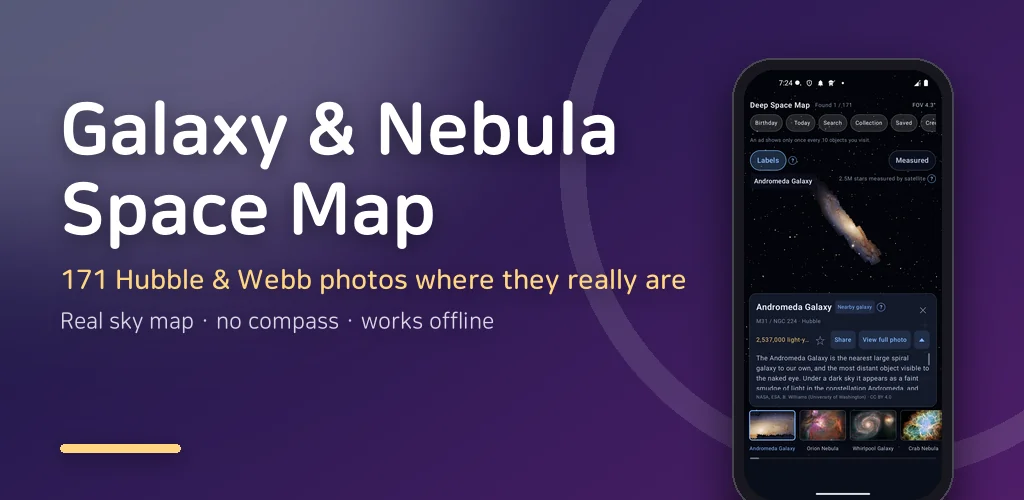
I rebuilt the part of Google Sky I missed most. Back around 2008 I would sit in a browser dragging the sky around for hours: pull the map and the sky moved; zoom in and a nebula photograph you half remembered resolved right there at its own coordinates. Going back recently, the address just bounced to the ordinary street map. The browser version is gone. What I wanted as a Google Sky alternative was not another app you hold up to the night. It was that map, in my hand, on a sofa, in daylight, under cloud. So I made one; it is listed on Google Play as Galaxy & Nebula Space Map.
▶ Get it on Google Play (free): https://play.google.com/store/apps/details?id=com.thefacegood.starmap
A Google Sky alternative for the living room, not the back garden
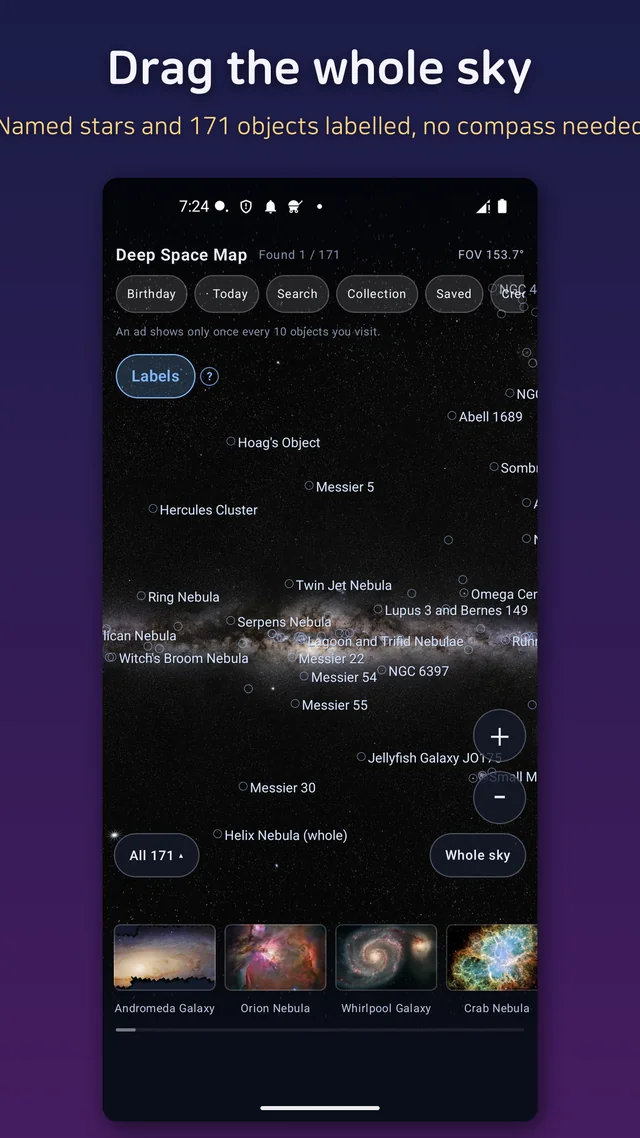
The first decision was what to leave out. Read the reviews of current stargazing apps and the top complaint is always the compass: the view drifts, points at the wrong patch, needs recalibrating with a figure of eight. The moment you attach a sensor you inherit that complaint. So there is no sensor. No location, no camera, no compass. You drag, pinch and zoom the whole sky the way you would browse a street map. It works the same at noon, in a bright city, or on a cloudy night, and it never asks for a permission it does not need.
Underneath everything sits an actual Milky Way panorama that ESO released under a CC BY licence. It arrived with a problem: as a hand-stitched mosaic it was warped by two to four degrees in places, so the stars in the picture did not sit where the stars actually are. I measured the offset against 549 bright reference stars and straightened it; the median error is now 0.06 degrees.
How big Andromeda really is in the sky
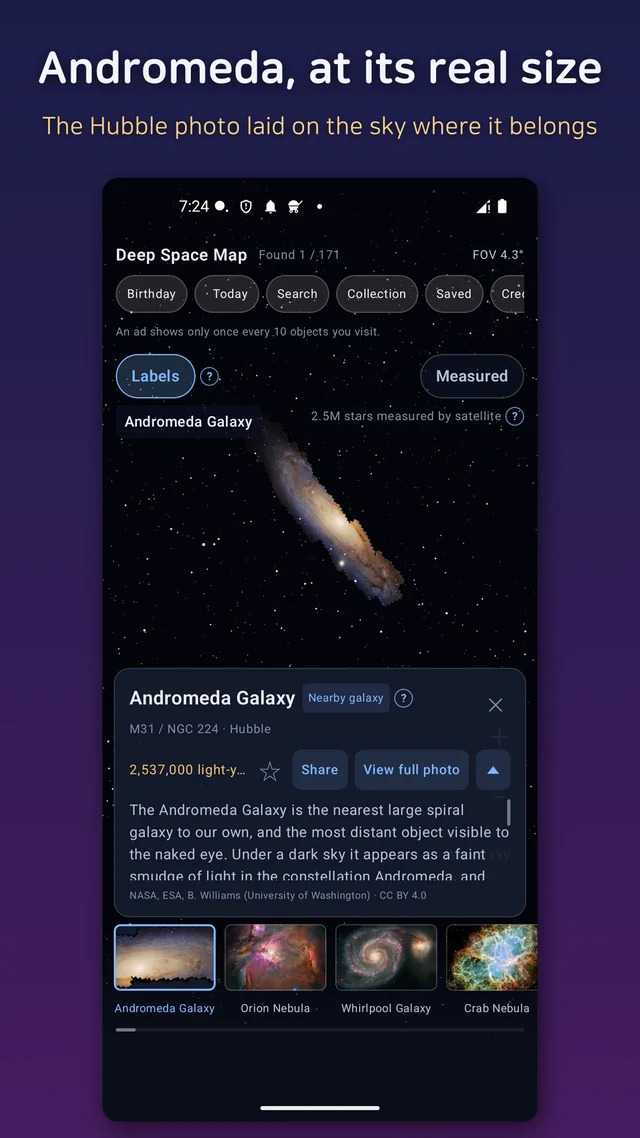
This is the screen the whole thing was built for. Choose a photo in the strip along the bottom edge and the map flies to its coordinates; keep zooming and the photograph appears at the angular size it actually occupies in the sky. The Andromeda galaxy is about six full moons wide. In a gallery app every object is the same square card and that fact is invisible. Here, on a real sky map, you can browse 171 famous galaxy & nebula photos and see each one at its true footprint, exactly where it sits.
Getting that right took longer than anything else. My first version pinned each photo north-up at its catalogue position. Then I noticed the Twin Jet nebula was rotated 36 degrees and M51 came out smaller than the background suggested. Press-release images are each rotated their own way and centred slightly off the catalogue point. The fix was to pull the embedded sky coordinates out of every original file and compute the rotation and stretch from those.
Measured sky, photographed sky, same spot
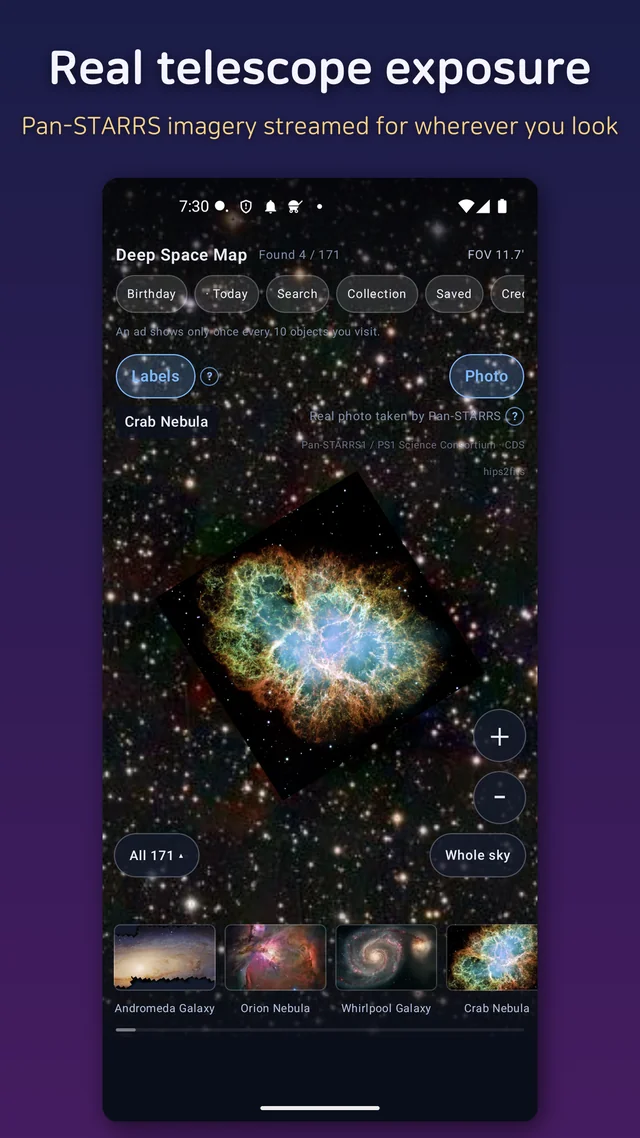
Top right of the map is a toggle. By default the sky is rebuilt from Hipparcos satellite measurements of 2.5 million stars, drawn on the phone with no connection at all. Flip the toggle and the same patch of sky is replaced by a real exposure from Pan-STARRS, an image a telescope actually took of that spot. I wanted the measured sky and the photographed sky to be swappable without losing your place, so it is a toggle on the map rather than a separate screen. It uses mobile data, so it is off by default and asks first. Offline or online, the map itself is always there.
The 171 photos on top are all real observations: the deep, narrow views from Hubble and from the James Webb Space Telescope (esahubble.org and esawebb.org respectively), and the wide fields from the big ground telescopes of ESO and NOIRLab in Chile and Arizona. Each caption says which telescope took it, and because the two space telescopes see different wavelengths, the same nebula can look wildly different between them. Galaxies, nebulae, star clusters and supernova remnants are all in there.
The birthday photo, the daily object, and the collection
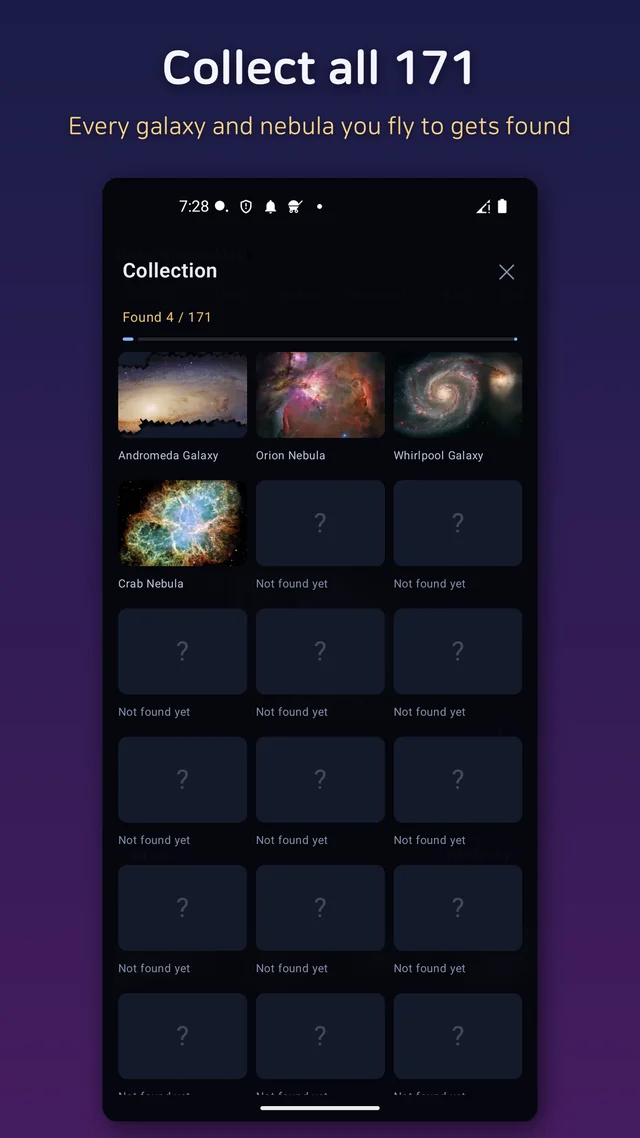
A map alone gets opened twice and forgotten. So there are three reasons to come back. Pick any date and the app shows a space photo that was actually published on that day; all 366 days are matched to genuine release dates, so your birthday and a friend's birthday bring up different pictures, and you can share the result as a card. A new object of the day is pinned to the map daily, with an optional evening notification you can decline without losing anything. And every object you find goes into a collection automatically. Adding the collection changed my own habit: I stopped closing the app after one lap and started opening it to see how many were still missing. Search takes Messier numbers like M31 or plain names like Horsehead.
What went wrong while building it
Two things, mainly. The panorama warp above, which I did not expect a published all-sky image to have. And the photo alignment, which I assumed was a matter of reading one coordinate and turned out to be a matter of reading the file's own astrometric header for every one of 171 images. Neither shows up in a screenshot, and both are the difference between a pretty picture and a map.
Who this is for
- Anyone who remembers Google Sky and wants that drag-the-universe feeling back
- People who installed a stargazing app and uninstalled it over compass drift
- Parents who want to show a child real galaxy and nebula photos with "and this is where it is"
- Anyone curious about the sky who has no time to go outside at night
Everything except two things works with no connection: the telescope-exposure toggle and the ads are the only parts that touch the network. Free, with ads.
Download (Google Play, free): https://play.google.com/store/apps/details?id=com.thefacegood.starmap
※ The photographs are CC BY 4.0 material from the Hubble and Webb archives (esahubble.org, esawebb.org), and every one carries its original credit line. No space agency (NASA, ESA, ESO or any other) is affiliated with, endorses or sponsors this app, and it has no connection to Google Sky or Google.
One person built this, so something is bound to be missing. If there is an object you want on the map, say so in a review and it goes on the list for the next version.


Comments
Post a Comment