Heating Bill Calculator: What One Degree Costs in Your Home
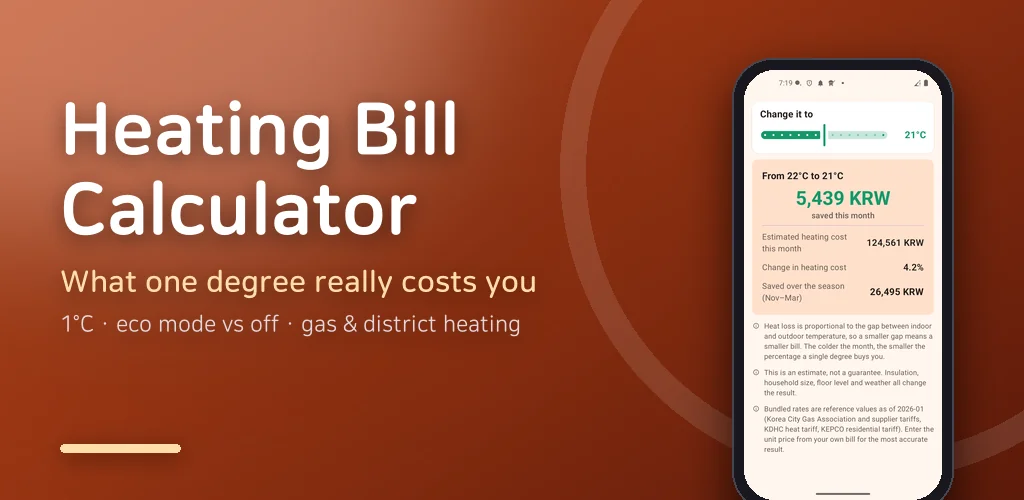
90,000 won in December. 170,000 won in January. The only thing that changed in my apartment between those two gas bills was the boiler setting, nudged from 22 to 23 degrees. Was that one degree really worth 80,000 won, or was January simply colder? I had no way to know, no heating bill calculator would tell me, and that is the maddening thing about heating: the bill tells you what happened, never what would have happened if you had done something else.
The internet's answer was "turn it down" and "use eco mode when you go out". True, and useless, because I wanted a number. If a degree saves 3,000 won a month I will stay warm; if it saves 30,000 I am buying thermal underwear. Nobody would give me that number, so I built a heating bill calculator that does.
▶ Get it on Google Play (free): https://play.google.com/store/apps/details?id=com.thefacegood.nanbangcalc
Why a normal heating bill calculator could not answer my question
My first draft was the usual thing: meter reading times unit price. Then I realized every gas company website already does that, and it still cannot answer "what if". You have to know the usage first, and the usage was exactly the thing I wanted to predict.
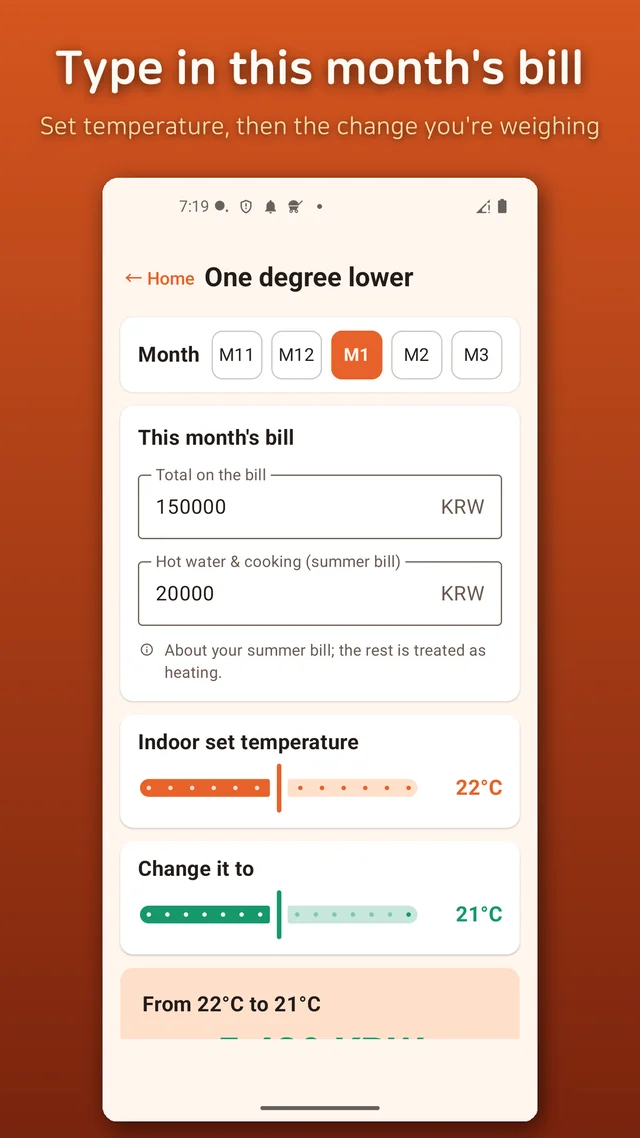
So the app works backwards. Enter one month's bill, the size of your place, your heating system and your region, and it estimates how fast your home loses heat. Two apartments of the same size can differ wildly; a new mid-floor unit and a twenty-year-old house with drafty windows are not the same building, and until you know your own heat-loss rate every piece of advice is about somebody else's home. Your bill, it turns out, is a surprisingly honest measurement of your insulation.
From there you change conditions and watch the number move. Regional city gas tariffs, district heating rates and the residential electricity brackets are bundled, and you can overwrite them with the unit price printed on your own bill, which is the accurate way to do it.
What one degree is actually worth
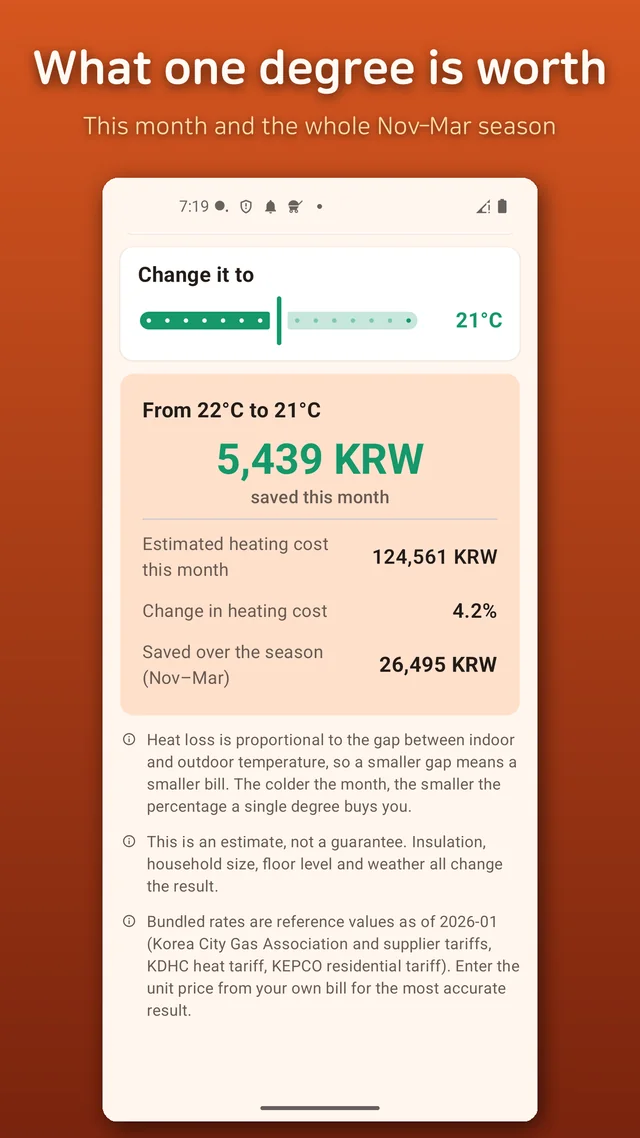
This is the screen I open most. Put in your current setting and the one you are considering, and it lays out the gap between them: first for the current month, then across the entire heating season from November to March. One month looks like pocket change. Five months added together is a different conversation, and that gap is why so much heating advice feels either alarmist or pointless: it depends on which of the two numbers you are looking at.
The value of 1°C also changes from home to home. A well-wrapped middle-floor apartment barely notices a degree; a drafty corner unit feels the same degree hard. The "7% per degree" figure that gets repeated everywhere is an average. Your figure comes only from your own bill.
Eco mode or off? The result that surprised me
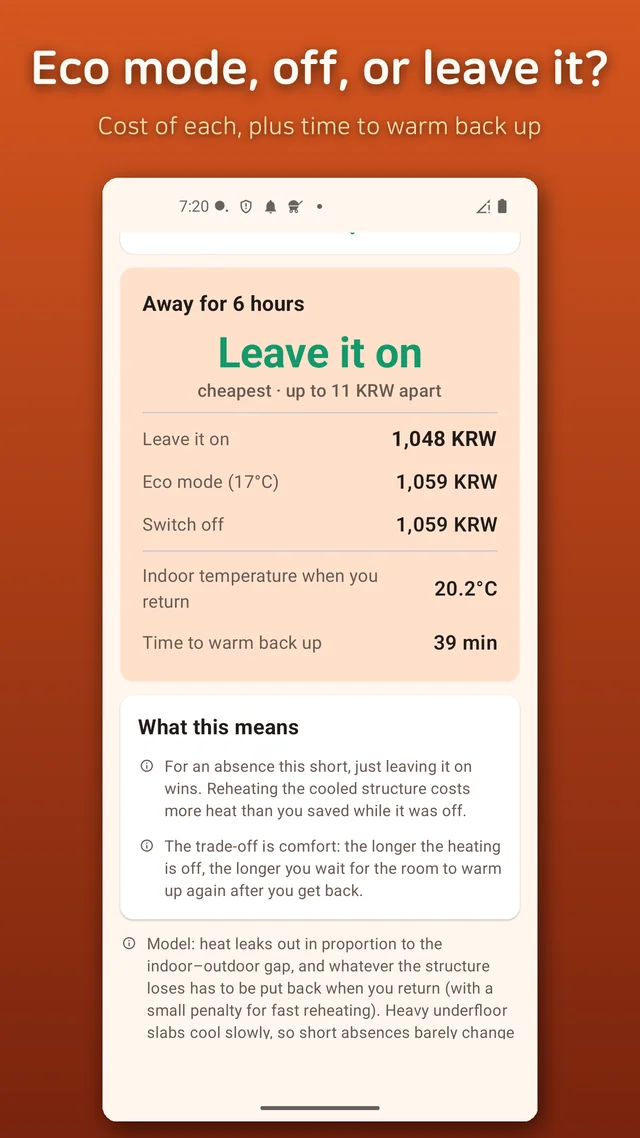
I assumed this one was obvious: leaving for a few hours, switching the boiler off must be cheaper than eco mode. Then I added the cost of reheating a cooled-down home to the model and ran it. For short absences the answer flipped more often than I expected; the energy spent dragging the rooms back up to temperature ate the savings from having switched off.
I was sure the code was wrong and re-read it several times. It was not. So instead of a one-line verdict, the screen shows why: the number of hours you will be out, the rate at which your home loses heat, and the time needed to warm it back up once you are home. Whether gas or district heating, you see the reasoning and decide for yourself.
Is my bill high, and what would district heating cost instead
The second question everyone asks is "is this normal for a place my size?" A single national average is meaningless, so the app builds a reference band from floor area, heating system, region and month and shows where your bill sits inside it. Middle of the band is ordinary; well above it is a reason to look at insulation or habits.
Next to that is a comparison of heating types: an identical quantity of heat, priced side by side for city gas, district heating, electric heaters, kerosene and LPG. If you are about to move, or wondering whether a plug-in heater is a sensible supplement, it is a five-second sanity check. It also shows, brutally, why electric heating has its reputation once you climb into the upper tariff bracket.
A separate screen turns a meter reading (cubic meters, Mcal or kWh) into an itemized bill, with condensing versus conventional boiler efficiency included.
Who this is for
- Anyone living in Korea who opened a winter bill and said "why?"
- People who want the number, not the lecture, before touching the thermostat
- Anyone who hesitates at the boiler panel every time they leave the house
- Households comparing gas, district heating and electric before a move or a boiler swap
- Expats reading a Korean gas or district-heating statement for the first time
The app runs offline, sends nothing to a server, and asks for no account. The tariff tables are Korean, so it is built for homes in Korea rather than a generic converter.
Download (Google Play, free): https://play.google.com/store/apps/details?id=com.thefacegood.nanbangcalc
※ Every number the app shows is an estimate, derived from published tariff tables and multi-year average temperatures. Nothing here guarantees a saving; the bill you actually receive depends on insulation, weather, floor level, household size and your contract. Treat it as a comparison tool.
I built a winter app and spent the whole summer on it. If a result looks off for your home, especially if you are on district heating where my data is still thin, leave a review with what your statement actually said and I will tune it before the cold arrives.


Comments
Post a Comment