Kimchi Calculator: How Much Gochugaru per Cabbage, Instantly
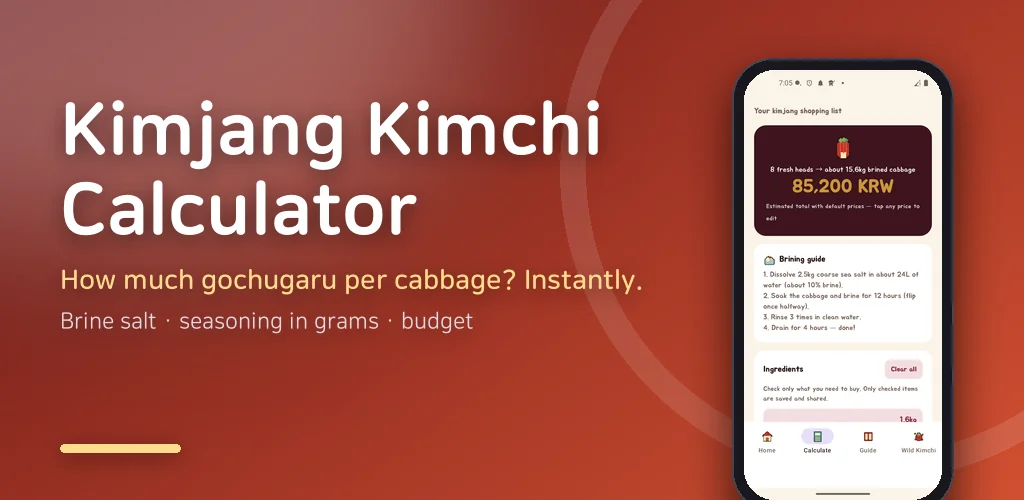
Four recipes, four different numbers. That is what I got when I tried to answer one question: how much coarse salt for ten heads of napa cabbage? One blog said a cup per head. Another gave a percentage of brine. A cookbook measured by weight of cabbage, a video by eye. I gave up, told my mother "about that much", and that year's kimchi was salty. A kimchi calculator would have ended the call in ten seconds, and there was not one, so I built it.
The odd thing is that kimjang — the big autumn batch, or any batch really — is mostly multiplication. Once you know the weight of cabbage, the gochugaru, garlic, ginger and fish sauce all follow from ratios. Yet every November people search the same questions and read someone else's household numbers, then do the division in their heads.
▶ Get it on Google Play (free): https://play.google.com/store/apps/details?id=com.thefacegood.kimjangcalc
Why every kimchi recipe disagrees, and what a kimchi calculator does about it
Before writing any code I went looking for a reference, and found one: the Rural Development Administration in Korea publishes reference ratios for Korean kimchi-making, expressed as percentages of brined cabbage weight. I laid widely used home recipes over those figures and settled on values close to the middle. The ratios were never the hard part.
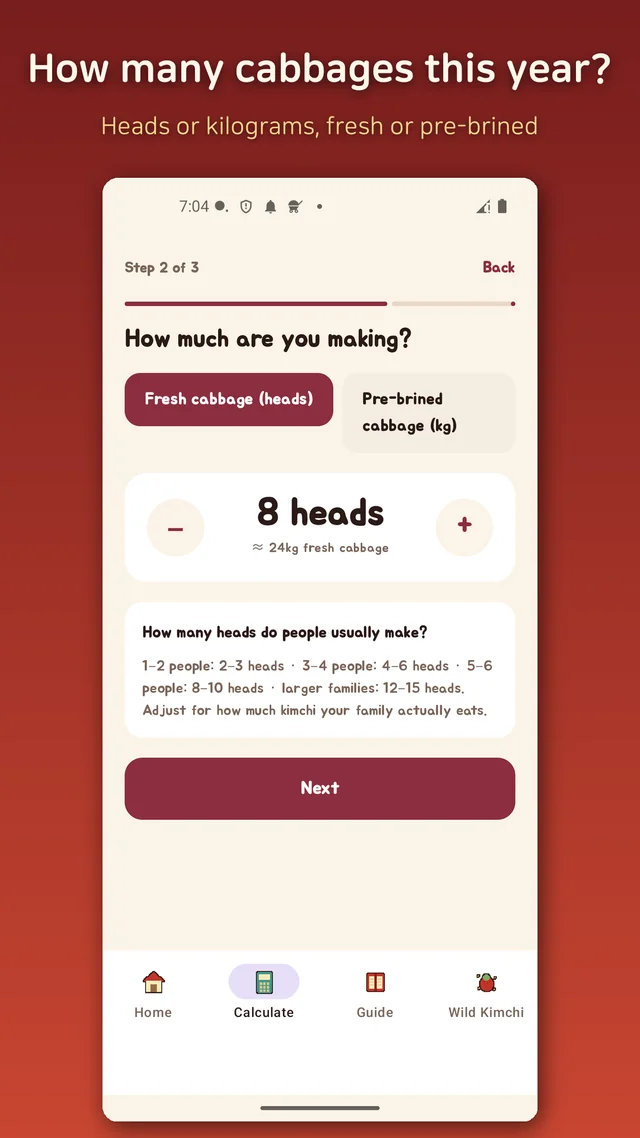
The hard part was units. Some people count fresh heads. More and more buy pre-brined cabbage by the kilogram. The two are not interchangeable, and most recipes silently assume one of them. So the app takes either as its starting point and does the conversion itself, with a family-size guide beside it for people who do not know how many heads they even need.
Three taps to a shopping list
First tap: which kimchi. Napa cabbage kimchi is the default, but chonggak radish, kkakdugi and green onion kimchi each have their own screen, because plenty of households make two or three kinds in one weekend and want to merge the lists.
Second tap: how much, as fresh heads or brined kilograms. Third tap: your taste — a spice level, and whether your family leans on salted shrimp or anchovy sauce, which changes the seasoning amounts noticeably.
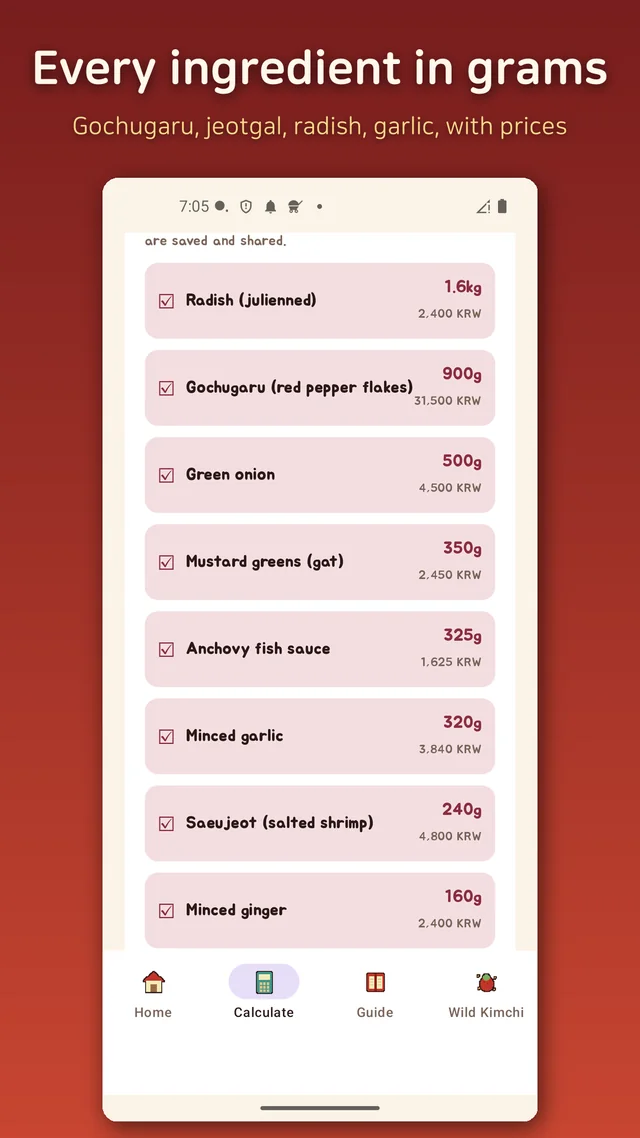
Then the list appears in shopping order: chilli flakes, minced garlic, ginger, salted seafood (jeotgal), radish, spring onion, mustard leaf, and the sweet rice flour that thickens the paste, each in grams. If you have ever typed "kimchi seasoning ratio" into a search box, this screen is the answer you were looking for, already multiplied by your cabbage.
Starting from fresh cabbage: the brine salt step you cannot undo
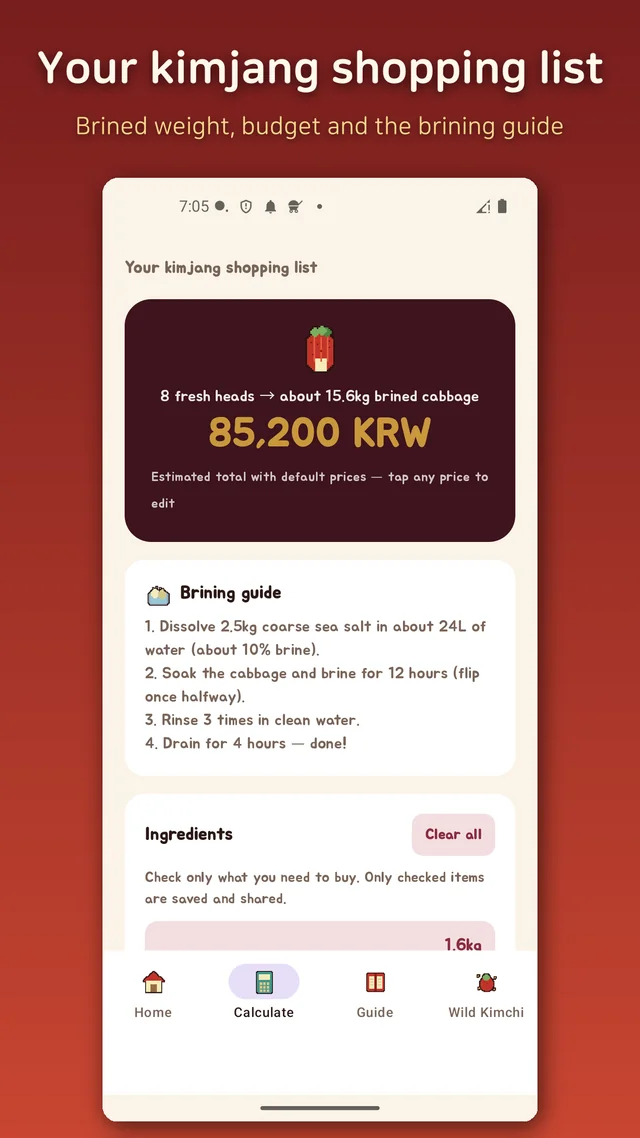
The salt question from that phone call is in here too. Start from fresh heads and the app adds a brining guide: how much coarse salt, how much water, how long to leave it, and a reminder to turn the cabbage once halfway.
I gave this screen the biggest numbers and the shortest steps on purpose. Seasoning can be rescued — too salty a paste just means more radish. Brining cannot. Cabbage that is under- or over-brined ruins every jar made from it, and there is no fixing it the next morning. If the app only prevents one ruined batch, it has done its job.
What it will cost, with your own prices
The app also gives a rough cost for the batch, and I was careful about how. It has no server and no live market feed, and it should not pretend otherwise. So the default price per ingredient is only a starting point, and every one of them can be edited to what your local market or Korean grocery actually charges. Enter supermarket prices in one pass and market prices in another and you have a comparison.
From there you tick the items you need, save it as your own list, cross things off while shopping, and share the whole thing as an image to the family chat. That last feature turned out to be the one I use most: "buy this" and a picture beats reading a list aloud.
The guide I added after the first testers
The first version showed numbers and nothing else. People who make kimchi every year understood it instantly. First-timers asked "fine, but in what order?" — and they were right that a calculator alone was not enough. So there is now a short guide: picking good napa cabbage, brine ratio and rinsing, the order to mix the paste, storage and fermentation, and when Koreans traditionally do their kimjang. An evening tip notification is there if you want it during the run-up.
Everything runs on the phone, with no sign-up and no data collection. It works in a market with no signal, and it is free.
Who this is for
- Anyone attempting kimjang for the first time and not sure what to buy or how much
- People who bought pre-brined cabbage by the kilo and need the seasoning scaled to it
- Households making radish or green onion kimchi alongside the cabbage batch
- Anyone who wants a rough budget before the shopping trip
- Koreans abroad and kimchi enthusiasts tired of re-searching the same ratios every autumn
Download (Google Play, free): https://play.google.com/store/apps/details?id=com.thefacegood.kimjangcalc
※ The quantities and prices are estimates derived from reference ratios. No two households season kimchi the same way, so use the output as a baseline and adjust from there.
If a number looks off or an ingredient your family always uses is missing, leave a review or write to me. I would like it sharper before this year's kimjang season.


Comments
Post a Comment