Knitting Gauge Calculator: Stitches to Cast On and Yarn Needed
To turn a gauge into a cast-on number, divide your swatch count by the swatch width, multiply by the width you want, and round. If the label says 22 stitches per 10 cm but your swatch gives 19, a 52 cm piece needs about 99 stitches, not the 114 the label's gauge would suggest.
The same few formulas also answer the other questions knitters ask: how many balls of a substitute yarn to buy, and how to decrease or increase evenly across a row.
Step 1: measure your own gauge
Knit a swatch, let it rest, and count stitches and rows across a measured stretch. Convert to stitches per 10 cm:
stitches per 10 cm = stitches counted / width in cm x 10
For example, 27 stitches over 14 cm is 27 / 14 x 10 = 19.3 stitches per 10 cm. Do the same for rows, measured vertically.
Step 2: cast-on count for a target width
cast-on = target cm / 10 x stitches per 10 cm
| Gauge (st per 10 cm) | Target width | Calculation | Cast on |
|---|---|---|---|
| 22 (pattern) | 52 cm | 5.2 x 22 = 114.4 | 114 |
| 19 (your swatch) | 52 cm | 5.2 x 19 = 98.8 | 99 |
That 15-stitch difference is about 8 cm of fabric at your real gauge, which is why the swatch is worth the bother.
Step 3: convert a pattern's counts to your gauge
If the pattern says 114 stitches at 22 per 10 cm and you knit 19, multiply by your gauge over the pattern's: 114 x 19 / 22 = 98.5, so roughly 98 or 99. Apply the same ratio to row counts, and check each result against the schematic measurement in the pattern.
How many balls of yarn?
Patterns give yardage for the designer's yarn. Convert it to your own:
balls = pattern total metres / metres per ball, rounded up
With 1,000 m needed and 120 m per ball, you get 8.33, so 9 balls. Adding a 10% margin for swatches, ends and tension differences gives 9.17, so buy 10. If the pattern lists a ball count and a length per ball instead, multiply them to get the total metres first.
If you only know the weight category, these are typical averages per 50 g ball, not brand figures; the label always wins.
| Weight category | Needle size | Typical metres per 50 g |
|---|---|---|
| Lace (0) | 1.5-2.25 mm | 400 |
| Fingering (1) | 2.25-3.25 mm | 200 |
| Sport (2) | 3.25-3.75 mm | 150 |
| DK (3) | 3.75-4.5 mm | 120 |
| Worsted/Aran (4) | 4.5-5.5 mm | 90 |
| Bulky (5) | 5.5-8.0 mm | 60 |
| Super Bulky (6) | 8.0-12.75 mm | 40 |
"Decrease 30 stitches evenly across the row"
Spread the changes over equal blocks. Going from 120 to 90 stitches means 30 decreases, and 120 / 30 = 4, so each block uses 4 stitches: [k2, k2tog] repeated 30 times. Check: each block uses 4 stitches and leaves 3, so 30 blocks take 120 stitches to 90.
When the numbers do not divide evenly, use two block sizes. From 100 to 70 stitches you need 30 decreases with 100 / 30 = 3 remainder 10, so work [k2, k2tog] 10 times and [k1, k2tog] 20 times. That uses 10 x 4 + 20 x 3 = 100 stitches and leaves 70. Increases work the same way: 80 to 100 stitches is 20 increases over blocks of 4, so [k4, M1] repeated 20 times.
Two limits are worth knowing. You cannot decrease evenly if you need to remove more than about half the stitches, because each k2tog block needs at least two stitches. And an even spread is only the starting point; many patterns shape on purpose in particular places.
If you'd rather not do it by hand
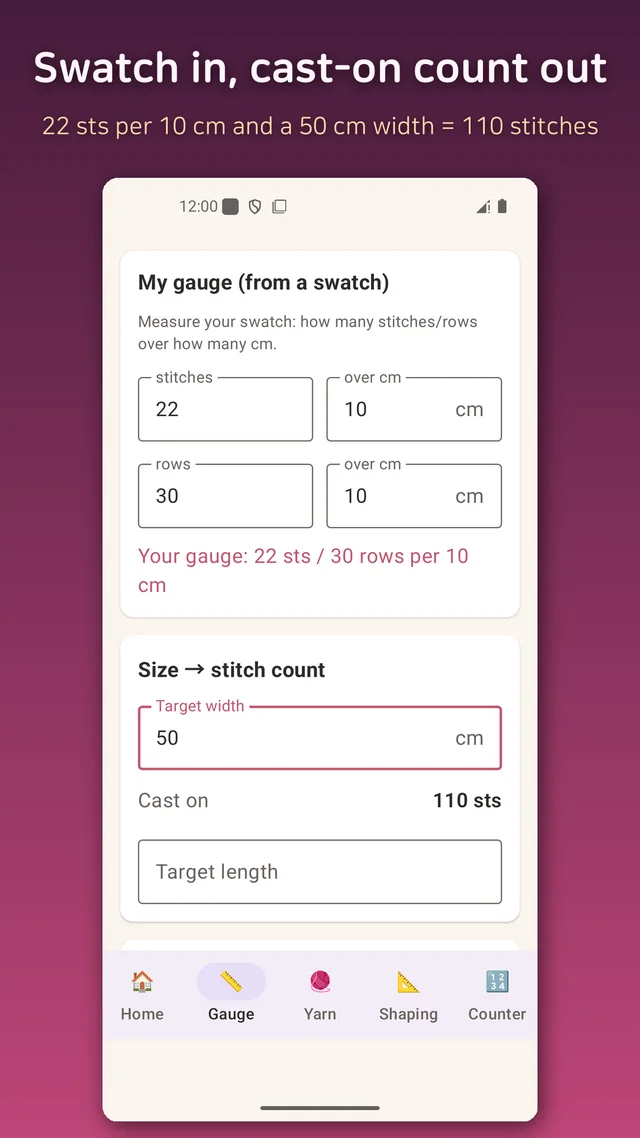
KnitCalc is a free offline calculator that does the sums above: gauge conversion, a yarn estimate with a margin you can adjust, even increase and decrease instructions written like a pattern line, and several row counters with repeat lengths that keep the screen on and save their counts. Yardage varies by yarn, so treat its results as a guide and check the label. It has no account and is available in English, Korean, German, Spanish, French and Russian.


Comments
Post a Comment