Korean Wedding Gift Money: How Much to Give, by Relationship
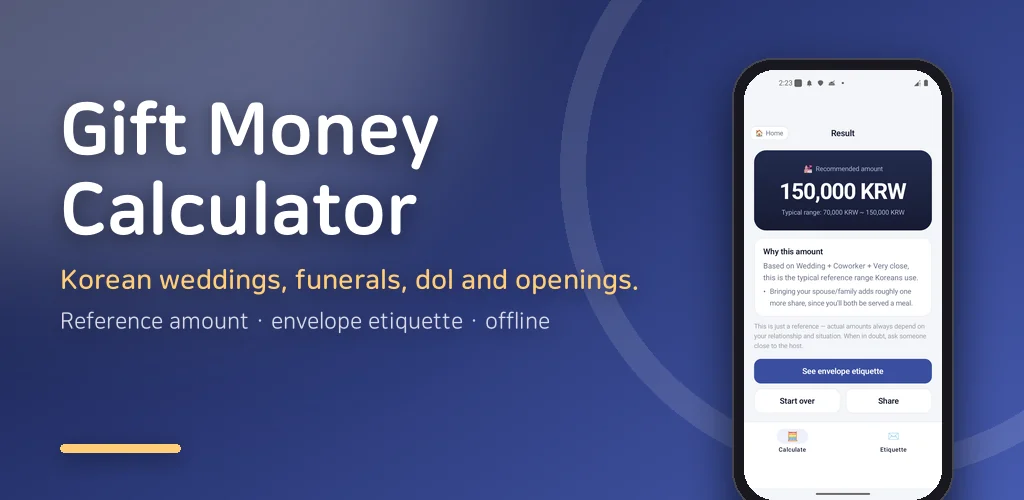
In Korea, a wedding invitation quietly comes with a homework question: how much cash goes in the envelope? There is no gift registry. Guests hand an envelope to a reception desk, someone writes the amount into a ledger, and the couple will see that number later. Korean wedding gift money is not a secret sum you forget about. It is remembered, and often returned in kind years later.
Every autumn I received a handful of invitations and did the same thing each time. I searched, opened a dozen blog posts, read the comments, and ended up with "it depends on the relationship". True, but useless when the ceremony is on Saturday. What I wanted was a number for my situation: this coworker, this closeness, and whether I could actually go. So I wrote down the reasoning I was doing in my head and turned it into a small app.
▶ Get it on Google Play (free): https://play.google.com/store/apps/details?id=com.thefacegood.cashcalc
Why Korean wedding gift money is so hard to guess
The customs are more precise than they look from outside. Amounts come in round steps that people actually use: 30,000, 50,000, 70,000, 100,000, 150,000, 200,000, 300,000 won and up. Under 100,000 won an odd number of ten-thousand notes is traditional, and anything with a four in it is avoided, because the word for four sounds like the word for death.
On top of that, the right step moves with who the person is to you. A teammate you have lunch with, a boss two levels up, a university friend and a cousin all land in different bands. Foreigners working in Korea hit this wall first, but plenty of Koreans search how much money to give at a Korean wedding every single season too. The gift money calculator exists because the rules are real, just scattered.
Four questions, one reference amount
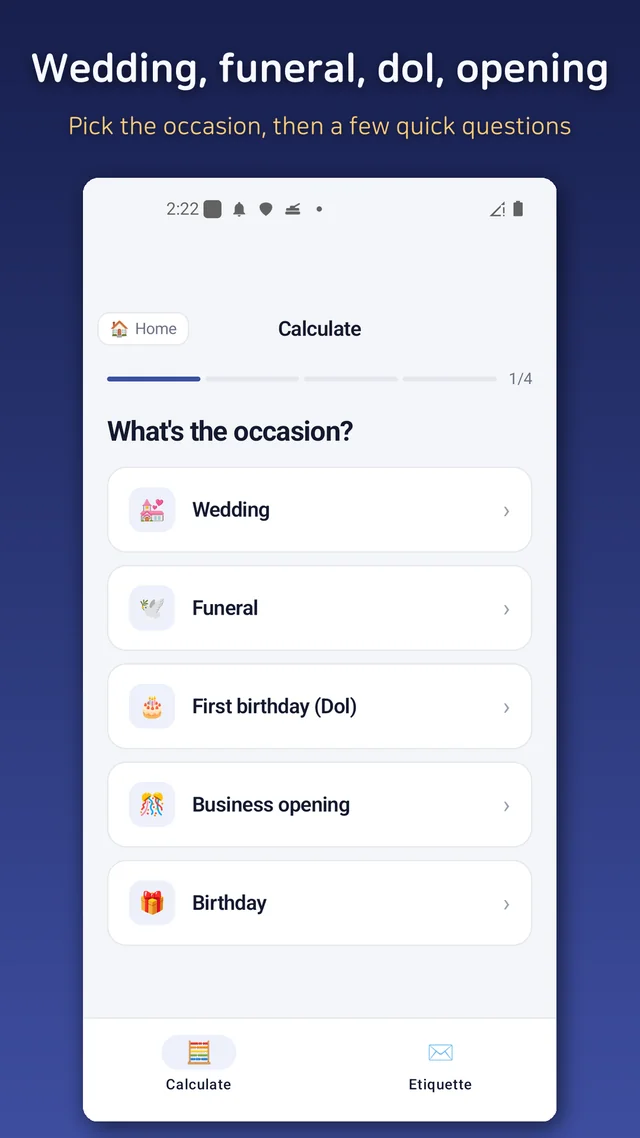
The app asks one thing per screen. First the occasion, then your relationship, then how close you are, then whether you are attending in person and bringing anyone along. No typing, no account.
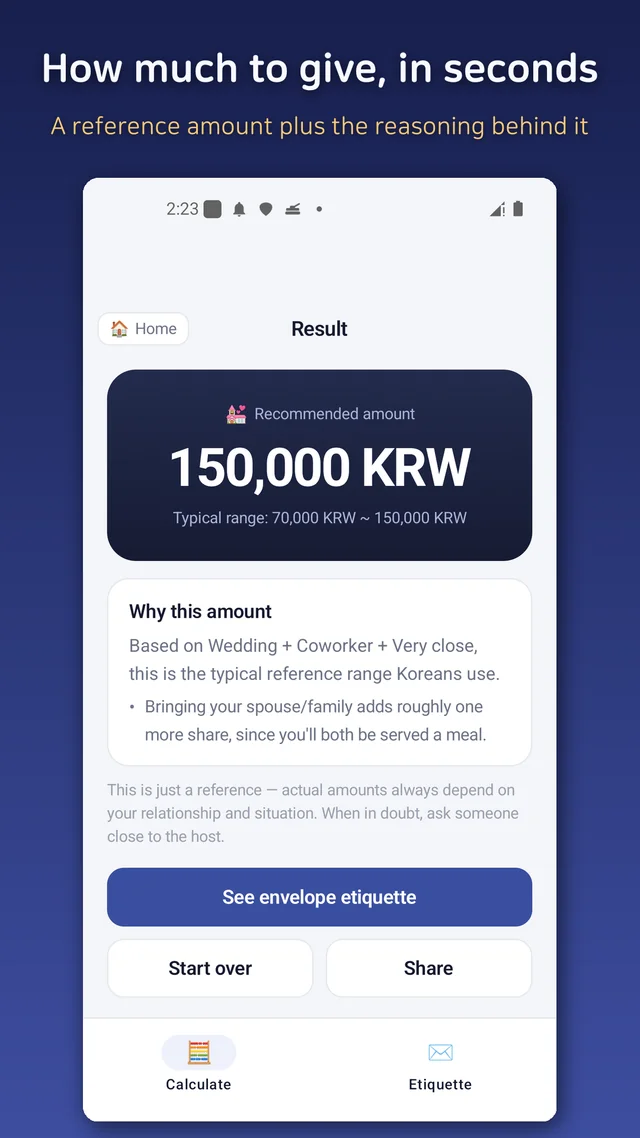
The result screen gives a recommended figure, the typical range around it, and a plain sentence explaining why. That last part mattered to me. A bare number feels like an order; a number with its reasoning lets you adjust with confidence. If you want to give a little more because the couple helped you last year, the range tells you how far is still normal.
When you cannot go, or you bring your partner
These two cases were the ones search results handled worst, and they change the amount the most.
If you cannot attend and send money through a colleague or a bank transfer, the custom is roughly half, since you are not eating the reception meal the couple is paying for. If you bring a spouse or family member, you add about one more person's share for the same reason in reverse. In the screenshot above, a very close coworker plus a spouse comes out at 150,000 won. The app snaps every adjusted figure back onto the usual steps, so you never end up with an awkward 125,000.
Funerals, dol parties and shop openings are not weddings
Weddings are seasonal, clustered in spring and autumn. Funerals are not, and they arrive without warning, usually when you have no energy to research anything. Condolence money follows its own steps, usually 50,000 to 100,000 won for a coworker or friend and more for relatives, and knowing how much to give at a Korean funeral in thirty seconds is a small mercy.
A baby's first birthday party (dol) and a friend's business opening each have separate bands as well. Reusing wedding numbers for them tends to look off in one direction or the other, so every occasion is calculated on its own table.
The envelope: what to write and where your name goes
Once the amount is settled, the envelope is the next stumble. The second tab is all about envelope etiquette. Pick the occasion and it shows the traditional phrase to write on the front, in Hangul and Hanja with its English meaning, so you can copy it even if you do not read Korean.
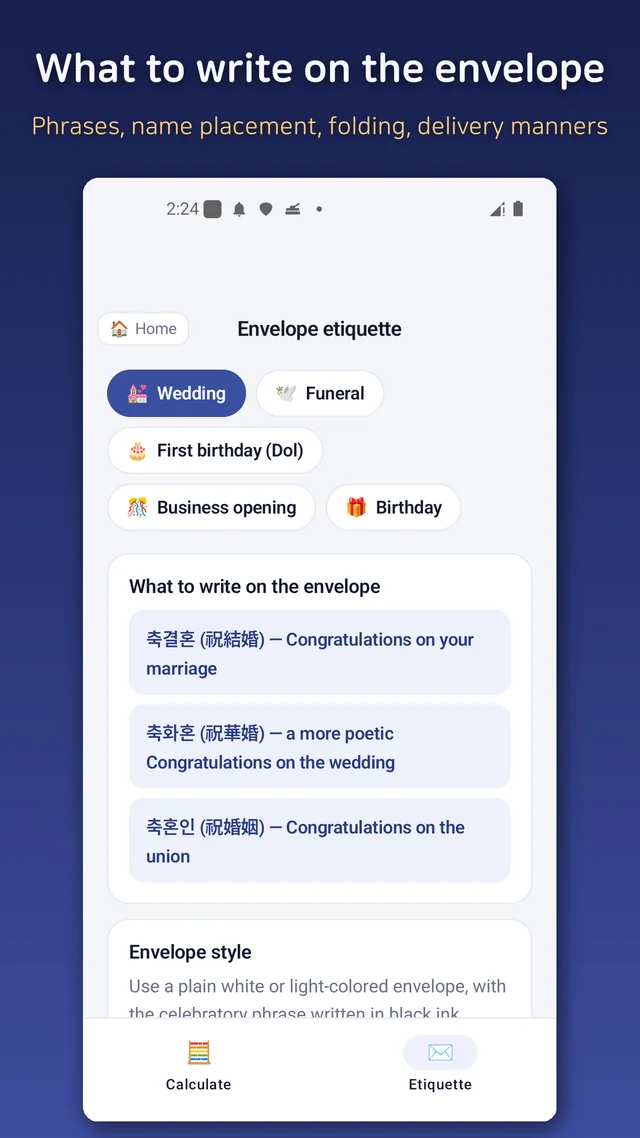
It also covers where your name goes on the back, which envelope colors are off limits at a funeral, why crisp new bills are preferred and how to fold them, and what to say when you hand the envelope over. If you have ever stood at a convenience store counter wondering what to write on a Korean money envelope, this is the screen for that moment.
What I was careful not to do
Money and relationships are touchy, so the app never claims to know the one correct answer. Every result says it is a reference based on common customs, and suggests asking someone close to the host when in doubt. Families and regions differ, and I did not want an app that makes someone feel judged.
Everything runs offline on the phone. There is no sign-up and nothing you enter leaves the device. Recent calculations are kept locally, so when a second invitation from the same office arrives, you can see what you worked out last time.
Who this is for
- Expats and foreign workers invited to a Korean colleague's wedding
- Anyone who needs a figure for a funeral tonight, not after an hour of searching
- Friends of new parents heading to a dol party and unsure what is normal
- Korean diaspora who grew up abroad and want to get the envelope right
- Busy office workers who get invitations faster than they can research them
Download (Google Play, free): https://play.google.com/store/apps/details?id=com.thefacegood.cashcalc
※ Treat every figure in the app as a starting point drawn from custom, not a rule. Your region and family may do it differently.
If your family or region does it differently, leave a review and tell me. I would rather the tables be right than tidy.


Comments
Post a Comment