Name Compatibility Test on Paper: The Stroke-Count Method
A name compatibility test on paper works in four steps: turn every letter into a small number, shuffle the two names together letter by letter, add neighbouring numbers keeping only the last digit, and read the two numbers left at the end as a percentage. It is a pen-and-pencil game with no scientific basis, so treat it as entertainment only.
Below is the exact procedure, followed by two fully worked examples you can check yourself. The rules here are the ones used by the Korean name-match game that kids traditionally scribbled in notebooks.
What you need
- Two names, written in Hangul or in the Latin alphabet.
- A letter-to-number table (given below).
- Paper and a pencil. Mistakes in adding are the only real way to get this wrong.
The four steps
- Give each letter a number. For English names, each letter A to Z has a fixed value (table below). For Korean names, each syllable block gets a stroke count.
- Interleave the two names. Take one letter from name 1, then one from name 2, and so on. When the shorter name runs out, add the leftover letters of the longer name at the end.
- Collapse the row. Add each number to the one on its right. If the sum is 10 or more, subtract 10 (so you keep only the last digit). Write the new row underneath. It is one number shorter than the row above.
- Repeat until two numbers remain. Read them side by side as the percentage. "00" counts as 100%, and "07" is just 7%.
Example 1: English letters (LUNA and MAX)
Here are the values used for the Latin alphabet:
| A | B | C | D | E | F | G | H | I | J | K | L | M |
|---|---|---|---|---|---|---|---|---|---|---|---|---|
| 3 | 3 | 1 | 2 | 4 | 3 | 3 | 3 | 3 | 2 | 3 | 2 | 4 |
| N | O | P | Q | R | S | T | U | V | W | X | Y | Z |
| 3 | 1 | 2 | 2 | 3 | 1 | 2 | 1 | 2 | 4 | 2 | 3 | 3 |
LUNA has four letters and MAX has three, so the interleaved order is L, M, U, A, N, X and then the leftover A. Their values are 2, 4, 1, 3, 3, 2, 3. Now collapse row by row:
| Row | Numbers | How |
|---|---|---|
| 1 | 2 4 1 3 3 2 3 | starting values |
| 2 | 6 5 4 6 5 5 | 2+4, 4+1, 1+3, 3+3, 3+2, 2+3 |
| 3 | 1 9 0 1 0 | 11 becomes 1, 9, 10 becomes 0, 11 becomes 1, 10 becomes 0 |
| 4 | 0 9 1 1 | 1+9=10 becomes 0, 9+0=9, 0+1=1, 1+0=1 |
| 5 | 9 0 2 | 0+9=9, 9+1=10 becomes 0, 1+1=2 |
| 6 | 9 2 | 9+0=9, 0+2=2 |
Two numbers remain, 9 and 2, so LUNA and MAX score 92%.
Example 2: Korean names (Minjun and Seoyeon)
This is the version that started the game, so it is worth seeing once. A Hangul syllable block is built from an initial consonant, a vowel and sometimes a final consonant, and its number is the strokes of those pieces added together. The pieces we need are these:
| Piece | ㅁ | ㅣ | ㄴ | ㅅ | ㅓ | ㅈ | ㅜ | ㅇ | ㅕ |
|---|---|---|---|---|---|---|---|---|---|
| Strokes | 4 | 1 | 2 | 2 | 2 | 3 | 2 | 1 | 3 |
These counts follow the table in the game's own calculation, which is the common notebook convention rather than strict calligraphy (for example, ㅁ counts as 4 here). If you switch to a different table you will get a different percentage, which is part of why it is a game.
Take the made-up names 민준 (Minjun) and 서연 (Seoyeon). Each syllable is one unit:
- 민 = ㅁ 4 + ㅣ 1 + ㄴ 2 = 7
- 서 = ㅅ 2 + ㅓ 2 + no final = 4
- 준 = ㅈ 3 + ㅜ 2 + ㄴ 2 = 7
- 연 = ㅇ 1 + ㅕ 3 + ㄴ 2 = 6
Interleaving gives 민, 서, 준, 연, so the row is 7 4 7 6.
| Row | Numbers | How |
|---|---|---|
| 1 | 7 4 7 6 | starting values |
| 2 | 1 1 3 | 7+4=11 becomes 1, 4+7=11 becomes 1, 7+6=13 becomes 3 |
| 3 | 2 4 | 1+1=2, 1+3=4 |
Two numbers remain, 2 and 4, so the result is 24%. I checked both examples with a short script that applies the same rules, and both match the hand calculation.
Common mistakes
- Forgetting to subtract 10. Every sum from two digits must be reduced to its last digit, otherwise the row stops being a single digit.
- Not interleaving. Writing name 1 and then name 2 gives a different answer than alternating the letters.
- Counting spaces or digits. Only letters have values. Ignore spaces, numbers and punctuation.
- Misreading the end. A final row of 0 and 7 is 7%, and a final row of 0 and 0 is 100%.
- Very short names. If the two names add up to just two letters, there is nothing to collapse, so there is no step 3.
Doing this on your phone
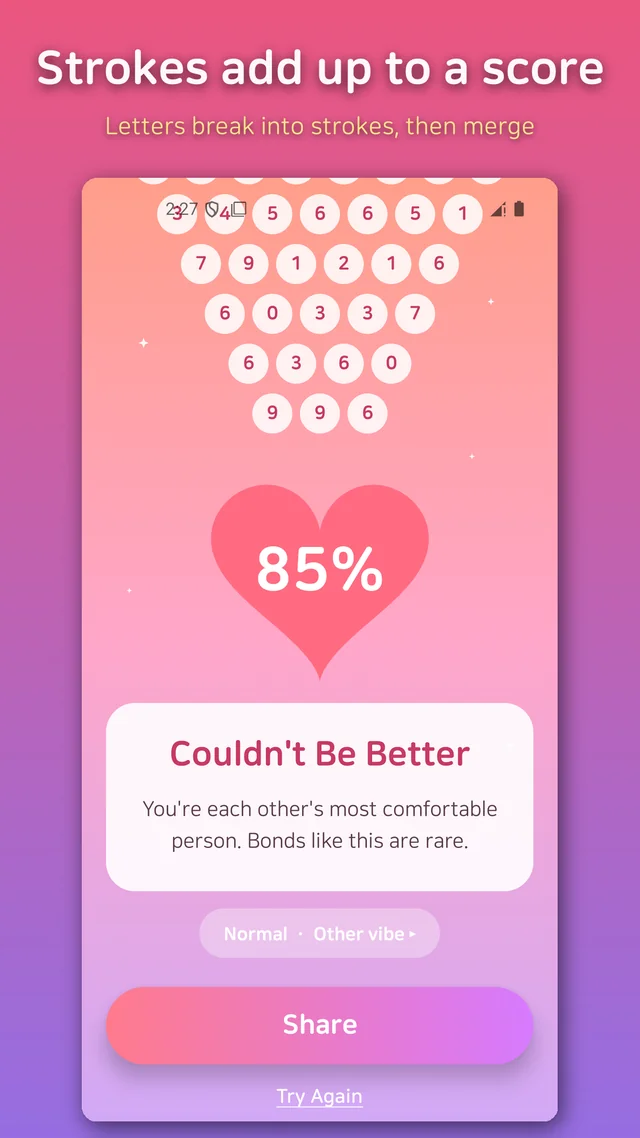
If you do not feel like adding by hand, the Dugeun app runs this same stroke-and-add procedure on any two names and shows each row of the tree as it collapses. The app also turns the percentage into a short result comment in one of 24 tiers, and you can replay the same score in three tones: Normal, Classy or Chaos. Product page: wing40.github.io/apps/namematchnew. Get it on Google Play.
Remember, the percentage means nothing about real compatibility. It is arithmetic on letter shapes, meant for fun.


Comments
Post a Comment