Pyeong to Square Meters: What 84㎡ Really Means in Korea
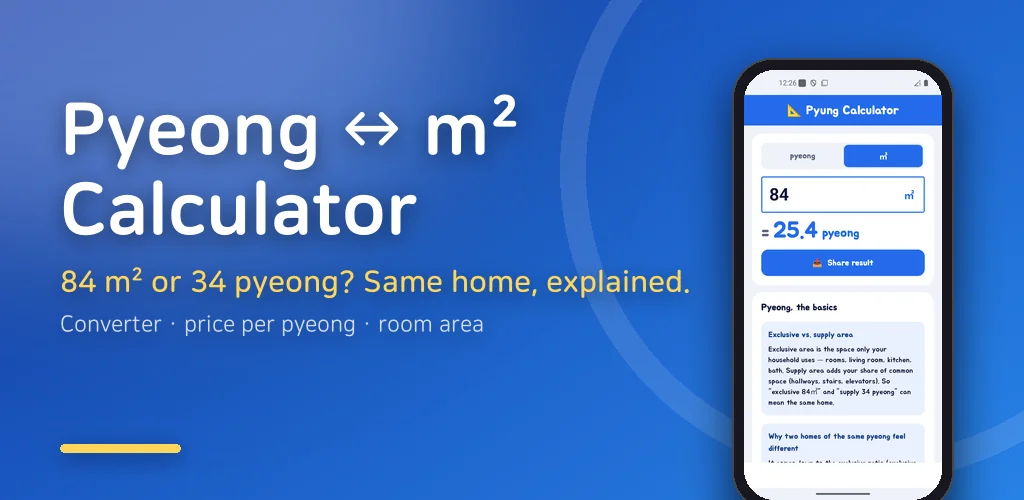
How many square meters is one pyeong? If you have looked at a Korean apartment listing, you have asked this, probably while trying to work out why the ad says "84 square meters" and the agent keeps saying "34 pyeong". The short answer is 3.3058, and the long answer is that pyeong to square meters is only the first of about three conversions you need before a Korean listing makes sense. I built a small calculator to do all of them, because I was doing them by hand every time I moved.
Pyeong is the traditional Korean unit of floor area. It has been legally retired since 2007, everyone still uses it, and a foreigner house-hunting in Seoul ends up living in both systems at once. This app is for that person — and, honestly, for a lot of Koreans too.
▶ Get it on Google Play (free): https://play.google.com/store/apps/details?id=com.thefacegood.pyungcalc
Pyeong to square meters, both directions
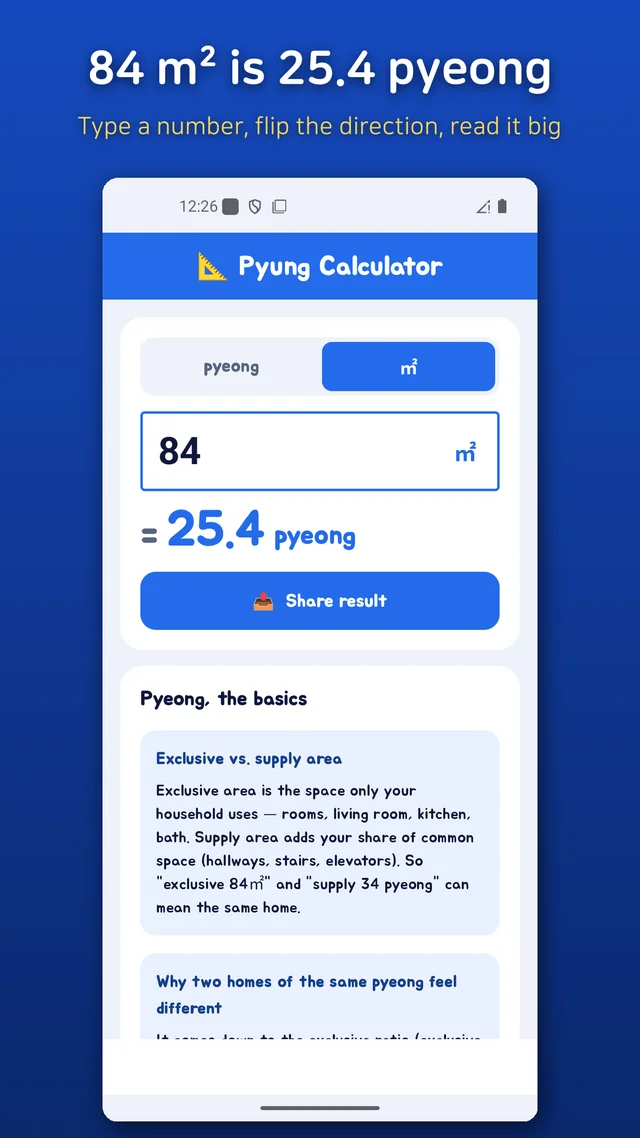
The main screen is a two-way converter. Type a number, pick the direction, and it shows the other unit instantly: 84 square meters comes back as about 25.4 pyeong, 34 pyeong as about 112 square meters. One pyeong is defined as 3.3058 square meters (it is the area of two traditional tatami-style floor mats), so going from m² to pyeong means dividing by 3.3058 and the reverse means multiplying. The app does the arithmetic and shows the result large enough to read across a room, which matters more than it sounds when an agent is talking fast.
Any result can be shared as a card image, which is how I settle "how big is that place, really" questions in family chats.
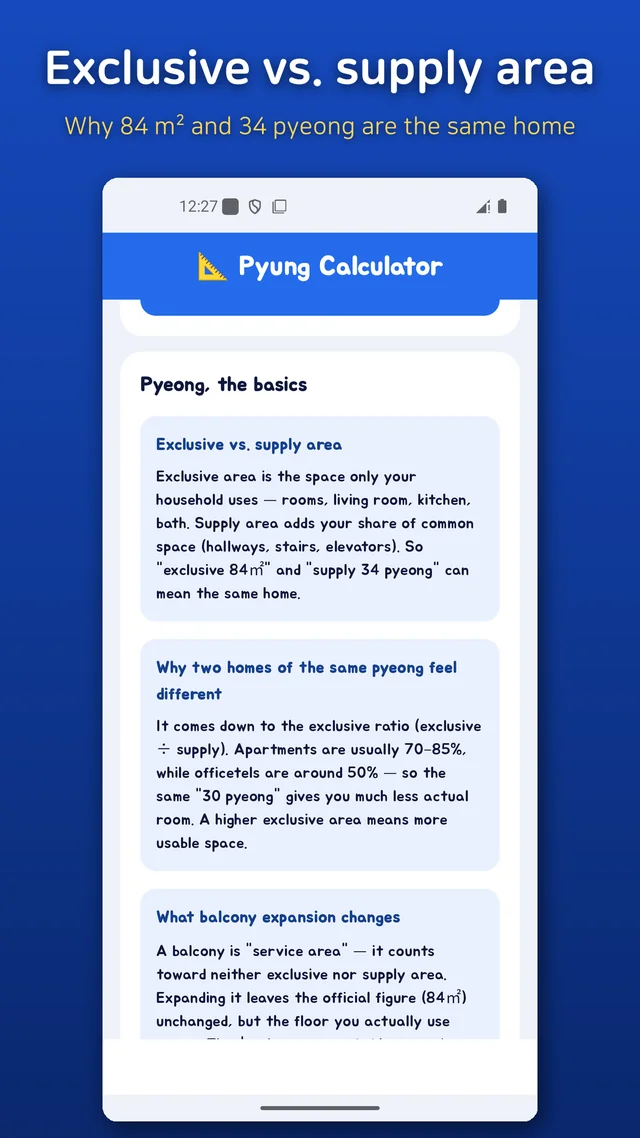
Why 84 square meters and 34 pyeong are the same apartment
This is the confusion that made me build the app. Korean listings quote two different areas. Exclusive area — the apartment net area, in listing-site English — is the space only your household uses: rooms, living room, kitchen, bathroom. Supply area, or gross area, adds your share of the building's common space: hallways, stairs, the elevator lobby. So "exclusive 84 square meters" and "supply 34 pyeong" (roughly 112 square meters) can describe the very same home. Neither number is wrong; they are measuring different things.
There is a third term, service area, which covers balconies. It counts toward neither figure, which is why an apartment with an expanded balcony feels noticeably roomier than its official 84 square meters suggests. The app carries a short explainer for all three, written in plain English, because I could not find one that was.
Price per pyeong and the exclusive ratio
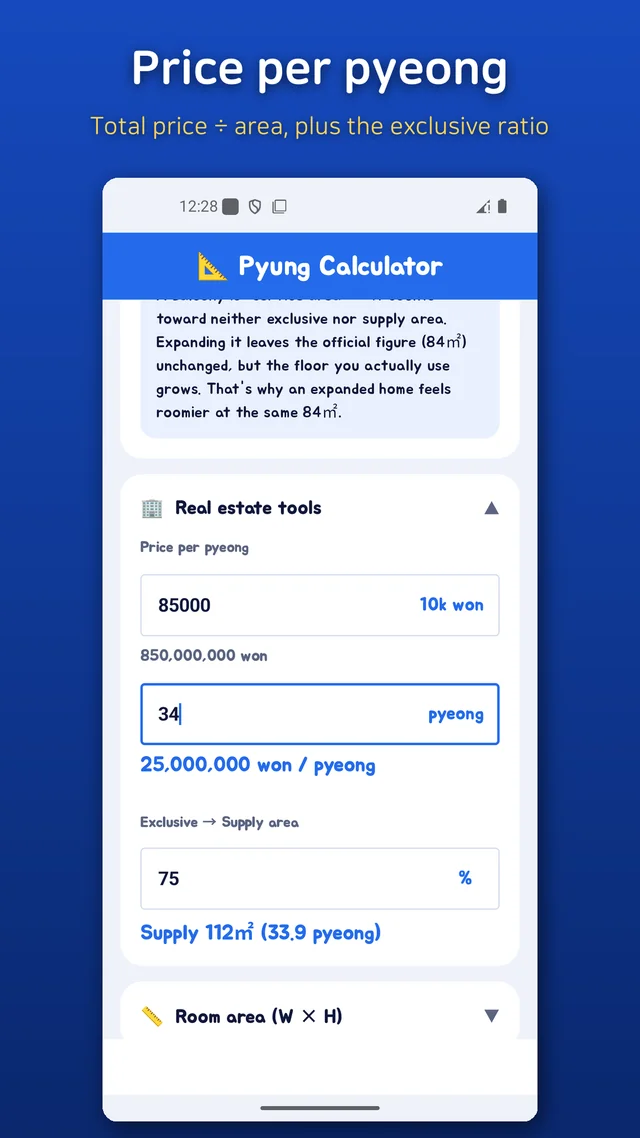
Two tools live under the "Real estate" section. The first is a price per pyeong calculator: enter a total price and an area and it divides one by the other, which is how Koreans compare listings of different sizes. To be clear about what this is and is not: it is a division of the numbers you type in. The app has no market data, does not estimate what a home is worth, and offers no investment advice of any kind.
The second is the exclusive ratio. Enter an exclusive area and a ratio and it gives you the supply area. Apartments usually sit at 70 to 85 percent; officetels — the studio-style buildings common in Korean cities — are often closer to 50. That single number explains why two units both advertised as "30 pyeong" can feel like completely different sizes once you are inside.
Measuring a room with a tape and a phone
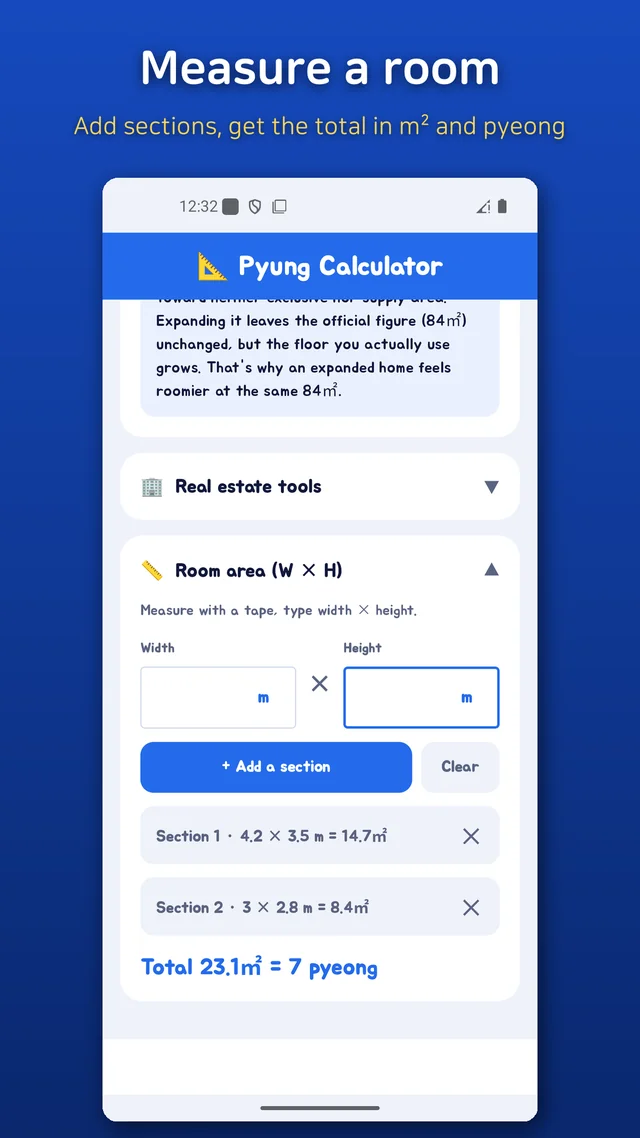
The last tool is for after you move in, or for a viewing. Measure a room's width and height with a tape, type them in, and add it as a section. Keep adding sections — the bedroom, the L-shaped living room in two pieces — and the app totals them in square meters and pyeong. It is a simple thing, but it has saved me from buying a sofa that would not fit twice.
The mistake in my first version
The first version converted numbers and nothing else. It was accurate and nobody used it twice, because a single conversion is something you can do in your head once you know 3.3. What people actually needed was the vocabulary: which of the two areas the listing meant, why the ratio matters, what the balcony does to the number. Adding those explanations turned a throwaway calculator into something people open before every viewing.
Who this is for
- Expats and students house-hunting in Korea who keep converting listing sizes
- Anyone who has stared at "84 square meters" and "34 pyeong" and assumed one was a typo
- People comparing an apartment against an officetel and wondering why the pyeong lies
- Anyone who wants to know how much floor space they actually have before buying furniture
It works fully offline and collects no personal data; every calculation stays on your phone.
Download (Google Play, free): https://play.google.com/store/apps/details?id=com.thefacegood.pyungcalc
※ Pyung Calculator only converts and explains area. It has no market data and gives no guidance on property prices, investing or buying.
If there is a Korean housing term that still confuses you after the explainers, tell me which one and I will add it. The explainer section exists because of exactly those questions.


Comments
Post a Comment