Reaction Time Test: What Is a Good Score in Milliseconds?
In the rough benchmark curve we use for phone tests, the median reaction time is about 255 milliseconds, and anything under 200 ms puts you in roughly the top 18%. Those figures are approximate and for fun rather than a lab result, but they give you something concrete to compare your own number against.
What is a good reaction time in milliseconds?
This table is the benchmark curve bundled in our reflex-game app for the classic "tap when the screen turns green" test. It was built to approximate published benchmark distributions, and the app interpolates between the points. Treat it as an estimate of where you stand, not a medical measurement.
| Average reaction time | Roughly where you rank |
|---|---|
| 120 ms | Top 1% |
| 150 ms | Top 3% |
| 175 ms | Top 8% |
| 200 ms | Top 18% |
| 225 ms | Top 32% |
| 255 ms | Top 50% (the median) |
| 290 ms | Top 68% |
| 340 ms | Top 84% |
| 410 ms | Top 95% |
| 520 ms | Top 99% (slowest 1%) |
The app turns the percentile into a grade: top 5% is "Superhuman", up to top 20% is "Lightning", up to top 45% is "Solid", up to top 70% is "Warming up", and anything slower is "Half asleep".
Why a phone score is usually a little slower than a web test
A web reaction test measures a mouse click. On a phone, the delay also includes your thumb travelling to the glass, the touchscreen registering the touch, and the display refresh. Those add some milliseconds that you cannot train away, which is why you should compare phone scores with phone scores, and not with a figure from a desktop page.
How to measure it properly
One tap is a poor measurement, because a single lucky or lazy reaction swings the number. A fair test follows a few rules:
- Average several rounds. Our test averages five rounds, and a tap before the screen turns green does not count: the round is simply replayed.
- Do not guess the timing. The wait before the colour change is random on purpose. Tapping early is anticipation, not speed.
- Use the same hand and the same position each time, so that you are comparing like with like.
- Repeat on a different day. A single session says little about you; the trend across several does.
How to improve your reflexes, realistically
We have not measured how much practice improves a simple reaction time, so we will not promise a number. What you can control is consistency: fewer false starts, a steady posture and the same routine every time. If your score jumps around between sessions, look at your slowest round first, because that is usually where a distraction crept in.
Reaction time is one skill, not all of them
Quick reactions say nothing about memory or timing. People are often lopsided, fast at tapping and poor at remembering sequences, or the other way round. The same benchmark idea can be applied to other tests, and the app bundles curves for four more:
| Test | What is measured | A middling result | A very strong result |
|---|---|---|---|
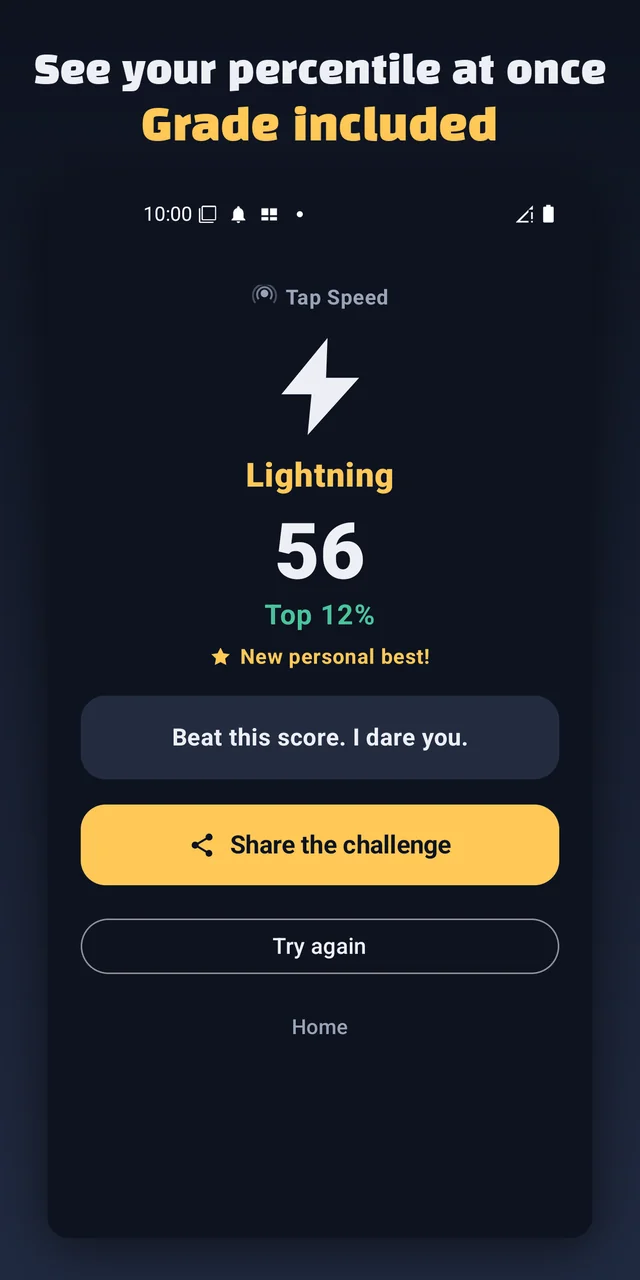
| Tap speed | Taps in 5 seconds | About 40 taps (top 46%) | About 66 taps (top 3%) |
| Number memory | Numbers you can recall in order | 7 numbers (top 56%) | 14 numbers (top 3%) |
| Sequence | Length of a flashing pattern you can repeat | 9 steps (top 44%) | 18 steps (top 2%) |
| Time sense | Average error when stopping at exactly 5.00 s | Within about 160 ms (top 40%) | Within about 25 ms (top 2%) |
Number memory starts at four numbers and ends after three mistakes. The sequence test starts at three flashes and adds one each round. Time sense averages three attempts.
Testing yourself on your phone
We built an Android app, Reflex Battle, that runs all five tests, shows your percentile and grade after each one, and turns a result into an image card you can send to a friend. Product page: wing40.github.io/apps/reflexbattle. Google Play: Reflex Battle on Google Play.
This is a game for fun. Nothing here is medical or lab-grade, and the percentile figures are estimates.


Comments
Post a Comment