Star Size Comparison at True Scale, Person to Biggest Star
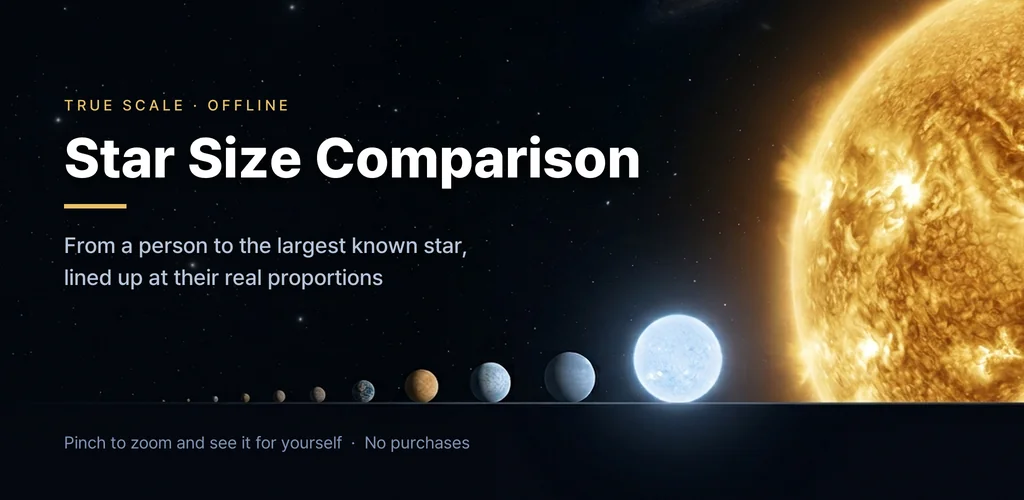
I watched a star size comparison video with my kid. The Sun came up, then Betelgeuse, then Stephenson 2-18 filled the frame and the clip ended. About thirty seconds in came the question: "So where are we?" We scrolled back. Earth had been on screen for the first two seconds and then it was simply gone. That struck me as backwards. The point of showing something enormous is to measure it against something you know, and once the reference disappears all that is left is a vague "wow". So I built an app where you pinch your way up from a person's height to the largest known star, and Earth never leaves the screen.
▶ Get it on Google Play (free): https://play.google.com/store/apps/details?id=com.thefacegood.starsize
The star size comparison video that loses Earth after two seconds
Before writing a line of code I installed the existing apps. Most line planets and stars up side by side, and most of them quietly shrink the big objects so everything fits on one screen. It is comfortable to look at, and it means the ratio your eyes are reporting is false. An app about size that lies about size has nothing left to offer.
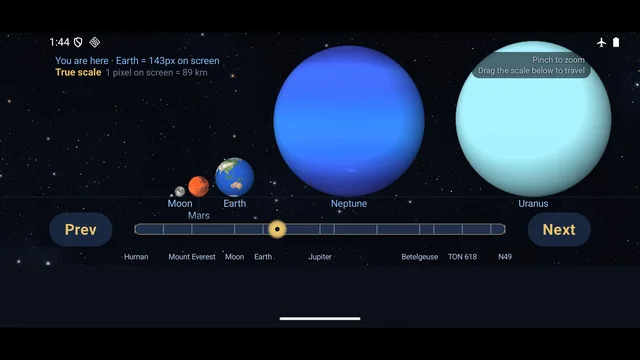
One scale, the real one, and a slider for a trillion-fold range
So this app has no overview mode. There is one scale, the real one, and a slider on the right that carries you through it on a logarithmic track. From a person to a supernova remnant is a factor of about a trillion, which no amount of pinching would ever cross; the slider makes the whole range one thumb-length. The ladder starts at a person, climbs past the Hubble Space Telescope, a Saturn V rocket, Everest and the Moon, crosses the planets and the Sun, then runs on through the stars: Sirius and Pollux first, Arcturus, Rigel and Antares, Betelgeuse, then the red hypergiants UY Scuti, VY Canis Majoris and WOH G64, ending at Stephenson 2-18. Beyond the stars sit the black holes: Sagittarius A*, M87* and TON 618. Fit the Sun on screen and Earth is a fingernail. Fit Betelgeuse and the Sun is dust.
I did try the squashed version first. It looked far better. Then I noticed that after using it I still could not answer "how many times bigger than Earth is the Sun", because the ratio I had seen was not the ratio that exists. I deleted the mode. The app lost its prettiest screen, and everything it says became true.
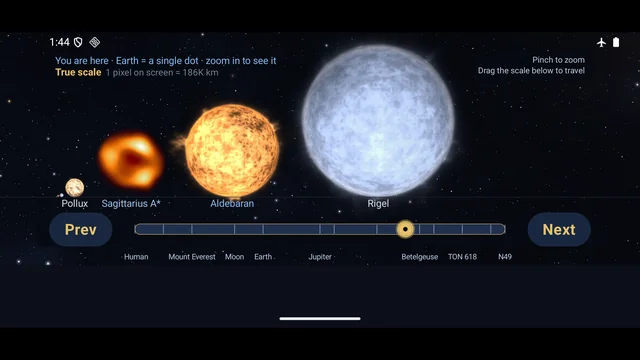
Earth shrinks to a dot but never disappears
Objects that fall below one pixel are not removed. A "you are here" marker keeps reporting how many pixels Earth currently occupies, and when it is too small to see, a single dot stays in its place. That dot is the app's whole argument: zoom into it and that is where we live. The feeling of scale comes from "I am there", not from "that is big".
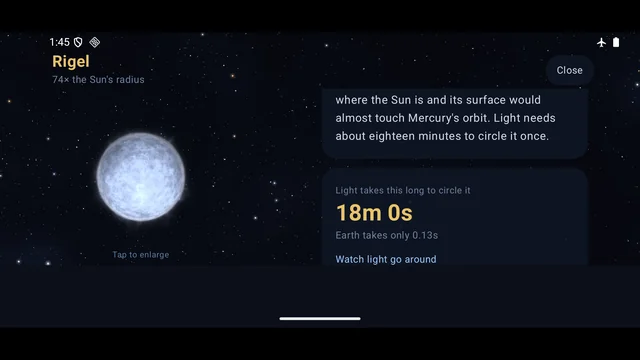
Tap any object and a spark of light sets off around its equator. For Earth the lap is over in 0.13 seconds; for the Sun it is 14.5 seconds; for the biggest stars it runs into hours. A progress bar that refuses to move says more than any radius figure. Each object also lists how many Suns would fit inside, its radius, diameter, temperature and distance, and where every one of those numbers comes from.
The middle rungs of the ladder exist because of a mistake. My first ladder went straight from a person to Everest, a jump of five thousand times, and pinching across it showed nothing at all for ages. Adding the telescope and the rocket gave the eye something to hold on to at every step; a ladder only works if the rungs are evenly spaced.
The biggest star has changed since that video
The most surprising thing I learned building this: the ranking in the old videos is out of date. For years UY Scuti wore the title of largest star in the universe; newer measurements cut it to roughly 909 solar radii. Stephenson 2-18 remains disputed, so nobody can honestly hand it the crown. The app writes that dispute down next to the object instead of picking a winner, and shows the sources. If someone asks what is the biggest star in the universe, "it depends on which measurement you trust, and here they are" is the only honest answer.
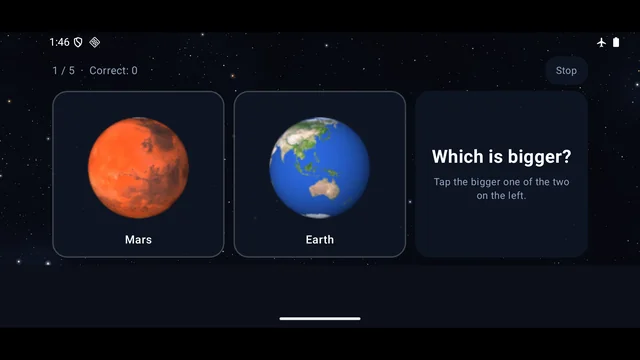
Which one is bigger? A quiz that snaps to true proportions
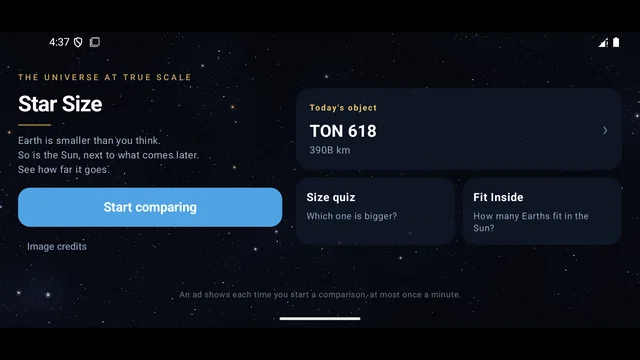
Two objects appear at the same size; you pick the bigger one, and the pair jumps to its real ratio. I lost several times to my own quiz. Sagittarius A* has around four million times the mass of the Sun and is still smaller than Arcturus. A streak counter keeps score, and an object of the day gives you a reason to open it again tomorrow.
Who this is for
- People who have watched star size comparison videos and wanted to hold one instead of watching it
- Parents who want to show a child the Earth-to-Sun gap on a screen instead of in words
- People who want the current answer to "biggest star", not the one from a decade ago
- Anyone tired of astronomy apps buried in ads; this one shows one only now and then at the start button
Everything runs offline, with the data and imagery bundled, so it works on a plane; there is no account and no sign-up. For the planets and the Sun the imagery is real, built from data that NASA, ESA and ESO have released; the star field behind them comes from Hipparcos measurements. Most stars have never had their surface photographed, so those are rendered from the size and temperature that were measured, and each screen states plainly which kind you are looking at.
Download (Google Play, free): https://play.google.com/store/apps/details?id=com.thefacegood.starsize
If a value looks wrong or a rung is missing, leave a review. The ladder was rebuilt once already because of a question from a child; I am happy to do it again.


Comments
Post a Comment