Dinosaur Size Comparison: How Big Were They Next to You?
Argentinosaurus is estimated at about 35 meters long, roughly 20 times the height of a 1.7 m person lying end to end, while Tyrannosaurus rex was about 12 meters long and stood around 4.5 meters tall. Those numbers are easy to read and hard to feel, so this guide compares the main dinosaurs with the one thing you can measure yourself: your own height.
Dinosaur lengths next to a 1.7 m person
| Dinosaur | Length | Estimated height | Estimated mass | Lengths of a 1.7 m person |
|---|---|---|---|---|
| Argentinosaurus | 35 m | 12.04 m | 70,000 kg | 20.6 |
| Diplodocus | 24–32 m | 4.97 m | 15,000 kg | 15.3 |
| Brachiosaurus | 18–22 m | 12.05 m | 35,000 kg | 11.8 |
| Spinosaurus | 14–15 m | 4.65 m | no single estimate | 8.2 |
| Giganotosaurus | 13 m | 4.13 m | 8,000 kg | 7.6 |
| Tyrannosaurus rex | 11–13 m | 4.52 m | 8,000 kg | 7.1 |
| Allosaurus | 8.5–12 m | 3.03 m | 2,000 kg | 5.6 |
| Stegosaurus | 7–9 m | 4.38 m | 3,500 kg | 5.3 |
| Triceratops | 8–9 m | 3.46 m | 8,000 kg | 5.3 |
| Ankylosaurus | 8 m | 1.86 m | 6,000 kg | 4.7 |
| Velociraptor | 1.5–2 m | 0.68 m | 15 kg | 1.1 |
| Microraptor | 0.8 m | 0.3 m | 1 kg | 0.5 |
| Compsognathus | 0.65 m | 0.19 m | 3 kg | 0.4 |
All figures are scientific estimates built from incomplete skeletons, and studies disagree. Where the data holds a range (Tyrannosaurus 11–13 m, Brachiosaurus 18–22 m, Velociraptor 1.5–2 m), the table shows the single value used for scale. Every height here is an estimate, not a measurement. The data follows the Paleobiology Database for period and classification.
How to compare a dinosaur to yourself
- Pick your own height in centimeters, for example 170.
- Divide the dinosaur’s length by your height. A 12 m animal is about 7 people lying head to toe.
- Do the same with estimated height. A 4.5 m tall Tyrannosaurus is about 2.7 times as tall as someone 170 cm tall.
- Add a familiar yardstick for the unfamiliar part: a car for the small ones, a bus for the mid-size ones.
Shapes matter as much as the totals. Most of a long sauropod is neck and tail, so a 26 m Diplodocus is only about 5 m tall at the top of its estimated height, far lower than Brachiosaurus at around 12 m, which had a very upright neck.
The sizes people get wrong
- Velociraptor was small. About 1.8 m long, with an estimated height of 0.68 m. Half of that length is tail. Movie raptors are closer to the larger Deinonychus or an invented animal than to the real Velociraptor.
- Tyrannosaurus is not the longest meat-eater. In this data Spinosaurus (14 m) and Giganotosaurus (13 m) both outrun Tyrannosaurus (12 m) in length.
- The biggest names are the least certain. The largest sauropods are known from partial skeletons, so their lengths carry the widest margins.
- Pterosaurs are not dinosaurs. The flying reptiles Pterodactylus and Pteranodon belong to a separate group. Birds, on the other hand, are living dinosaurs.
The tiny end of the list is just as interesting. Microraptor was about 0.8 m long and about 1 kg, and Compsognathus about 0.65 m and 3 kg. Both are in the same family tree as Argentinosaurus.
Dinosaurs named from Korean fossils
A few dinosaurs have been named from fossils found in Korea, including Koreaceratops, Koreanosaurus, Pukyongosaurus and the recently named Doolysaurus. The southern coast is better known for trackways than for skeletons: during the Cretaceous the area was a wide, shallow lake ringed by mudflats, which preserve footprints well. Goseong, Haenam and Hwasun are among the best-known fossil sites there.
Putting your own height next to a dinosaur
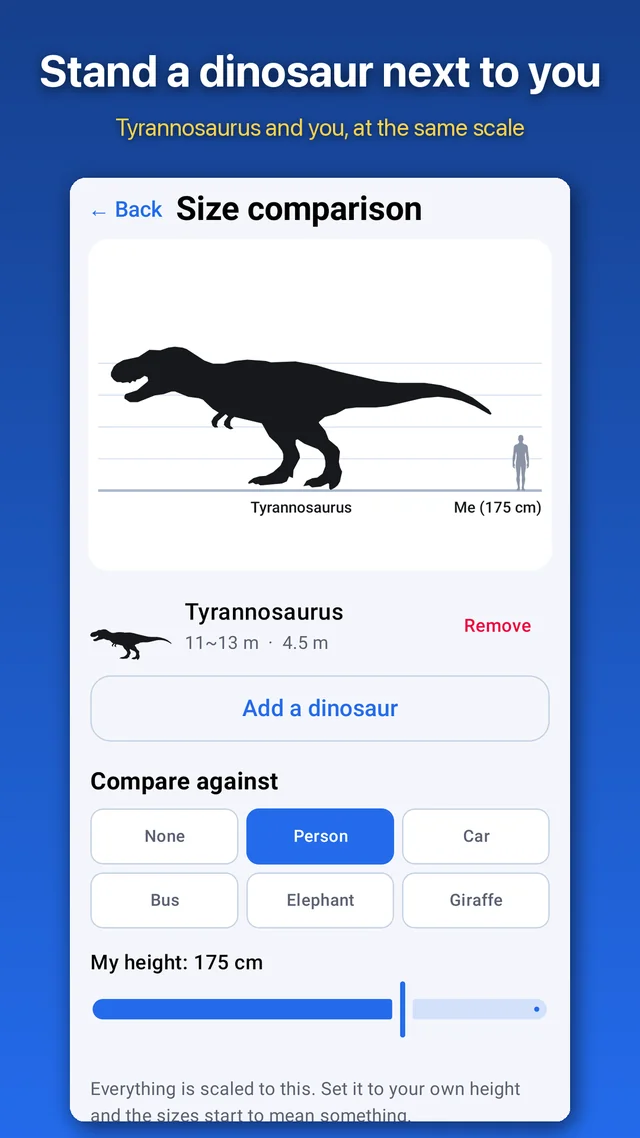
Dino Scale is a free Android app built on this idea: you enter your height, add up to three dinosaurs, and they are drawn at the same scale as a figure of you. It covers about 240 dinosaur genera with sizes, periods, diets and name meanings, and an evidence-labelled set of notes on common myths. It works offline and has no account.


Comments
Post a Comment