Korean Oldies of the 1970s and 80s: Genres and No. 1 Hits
"7080" is how Koreans refer to the popular music of the 1970s and 1980s, the decades before K-pop became a global export. In a catalogue of 903 songs from 1970 to 1989, the biggest genre is the ballad (285 songs), followed by folk (224), trot (141) and rock (120). The rest is dance (60), band or "group sound" (22), disco (12) and other tracks (39).
Below is a short guide to what those genres sound like, who topped the weekly charts in the 1980s, and how to work out how old you or your parents were when a song was a hit.
The genres of Korean oldies
| Genre | Songs in this catalogue | Examples in the catalogue |
|---|---|---|
| Ballad | 285 | The largest group, |
| Folk | 224 | Lee Yong-bok, "Born March 4, 1943" (1971); Choi Yang-sook, "Autumn Letter" (1971) |
| Trot | 141 | Lee Mi-ja, "Assi" (1970); Bae Ho, "Rainy Myeongdong" (1970); Cho Mi-mi, "If the Sea Were Land" (1970) |
| Rock | 120 | Park In-soo, "Spring Rain" (1970); Kim Chu-ja, "It's a Lie" (1971) |
| Dance | 60 | Park Hye-ryeong, "Black Cat Nero" (1970) |
| Group sound (bands) | 22 | Hi-Six, "Splendor in the Grass" (1971); Young Sound, "Lantern" (1972) |
| Disco | 12 | - |
| Other | 39 | - |
Song titles are the English renderings used in the catalogue, and genre labels are approximate.
Weekly No. 1s on the KBS Gayo Top 10, 1981 to 1989
The chart records in the catalogue cover the 1980s KBS "Gayo Top 10" show. This is the song with the most weeks at No. 1 in each year according to that data.
| Year | Song | Artist | Weeks at No. 1 |
|---|---|---|---|
| 1981 | Chotbul (Candlelight) | Cho Yong-pil | 7 |
| 1982 | Motchatgetda Ggoegori | Cho Yong-pil | 10 |
| 1983 | Dokbaek | Hye Eun-i | 6 |
| 1984 | Apartment | Yoon Su-il | 5 |
| 1985 | Geudaeyeo | Cho Yong-pil | 7 |
| 1986 | Heogong | Cho Yong-pil | 5 |
| 1987 | Haneuriyeo | Kim Hak-rae | 6 |
| 1988 | Hwanhui | Jung Soo-ra | 8 |
| 1989 | Sarangui Bulsichak | Park Nam-jung | 7 |
Cho Yong-pil has the top song in four of the nine years. The 1984 and 1986 entries tie with another song at the same number of weeks, so treat the single names in those rows as one of two.
How old were you when it came out?
The age is simply the release year minus the birth year. Someone born in 1955 was 20 in 1975, and someone born in 1968 was 14 in 1982, the year of Cho Yong-pil's ten-week run at No. 1. It is the quickest way to find the songs from the year a parent turned twenty, and it is why these songs are often remembered by age rather than by year.
Why a song counts as a classic
Lists of "golden oldies" feel arbitrary unless each entry says why it is there. The catalogue tags songs by evidence: 599 carry a hit label, 139 come from albums on a critics' list, 50 won a year-end award, 26 won a campus song festival grand prize and 22 were big sellers. A song with no verifiable record simply gets no tag.
Listening tips
- For many 1970s songs no video from the year of release survives, so the best available clip is often a later TV performance by the same singer.
- Start with a year rather than a genre. A single year shows ballad, folk and trot side by side.
- If you are choosing for a parent, begin with the year they turned 18 to 25.
Checking it on your phone
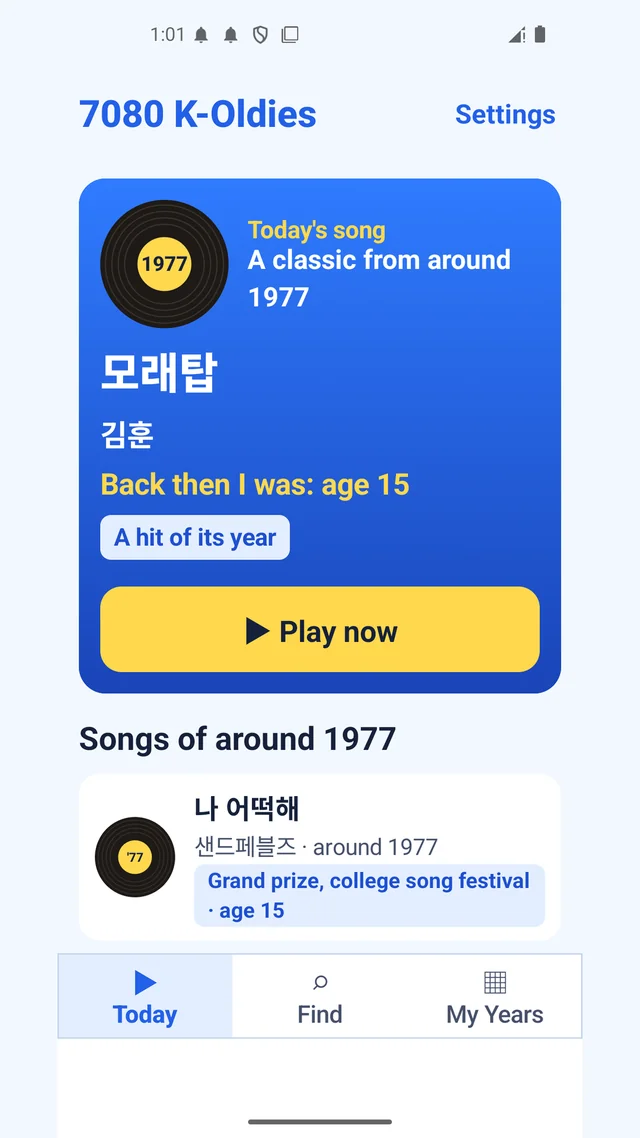
7080 K-Oldies has the 903 songs, search by title or artist and filters by year and genre. Enter a birth year and each song shows your age that year; add family members and every song shows theirs too. There is a daily song at 11 a.m. (you can move or switch it off), a 20-slot timeline for 1970 to 1989 and shareable cards. Videos play in the official YouTube player, so you need a connection, and nothing keeps playing once the screen turns off. The song notes are currently in Korean only. It needs no account and has no lyrics.


Comments
Post a Comment