Is the 5 second rule real? What the research found
No, the five-second rule is not a reliable safety rule: bacteria can move onto dropped food in less than a second, so picking it up quickly does not make it clean. Longer contact does transfer more, but the evidence for "five seconds is safe" is weak.
The idea is that food stays safe if you grab it before the count ends. Two studies are usually cited against it, and both are summarized below, along with how other common food beliefs compare.
What the research on dropped food found
- Rutgers University, 2016. Researchers tested 128 scenarios across 4 foods and 4 surfaces, with more than 2,500 measurements. Transfer can begin in under 1 second.
- Which foods pick up the most. Moist foods such as watermelon picked up the most bacteria, and gummy candy the least.
- Clemson University, 2007. An earlier study found that Salmonella transferred to food within 5 seconds.
The practical reading is that time matters less than what you dropped and where. A wet food on a dirty surface is the worst case, and a short count does not change that.
Food beliefs compared: what people say vs. how strong the evidence is
The same set of research summaries covers many other kitchen beliefs. The last column is the evidence grade for the claim in the middle column. "Little evidence" means research gives the claim weak support, and "essentially a myth" means no supporting evidence was found.
| Common belief | Evidence grade | What the research summary says |
|---|---|---|
| Food is safe if picked up within 5 seconds | Little evidence | Transfer can start in under 1 second (Rutgers, 2016). |
| Double-dipping a bitten chip puts bacteria in the dip | Well supported | Clemson (2009): runny salsa took on about 1,000 bacteria/mL, roughly 5 times more than chocolate or cheese dips (150-200/mL). Actual infection risk depends on who shares the dip. |
| Refrozen thawed meat is dangerous | Little evidence | Per the USDA, meat thawed in the refrigerator can be refrozen without cooking. The cost is juiciness, not safety. Meat thawed in cold water or the microwave must be cooked first. |
| Food is unsafe once the printed date passes | Little evidence | Per the USDA, dates mostly indicate quality, not safety (infant formula is the exception). Off smells, sliminess or mold are the real signs. |
| The fridge stops spoilage | Little evidence | Cold slows most bacteria but does not stop them. Listeria can multiply below 40°F (4°C) and is not killed by freezing. |
| Washing removes all pesticide residue | Little evidence | Washing reduces residue but does not remove it all. A UMass study (2017) found a baking-soda soak worked better than water, but took 12-15 minutes and could not reach residue inside the peel. |
| Microwaving destroys nutrients | Little evidence | Heating time and water used drive losses. In one study, vitamin C retention was about 79% microwaved vs. about 66% boiled. |
| Burnt food causes cancer | Contested | IARC lists acrylamide as "probably carcinogenic to humans," but this rests mainly on high-dose animal studies. Human evidence is weak. |
| Swallowed gum stays in your stomach for 7 years | Essentially a myth | Gum passes through with other food within a few days. Very large amounts plus constipation have rarely caused blockages, mostly in children. |
How to use this table
Look at the grade, not just the verdict
Two rows with the same "little evidence" grade can still carry different advice. Refreezing meat is mostly a matter of how it was thawed, while the fridge row is a reminder that cold storage has limits. The grade tells you how well research backs the claim. It does not replace reading the source.
Where caution still makes sense
- Moist foods and dirty floors are the worst combination for dropped food.
- Meat thawed in cold water or the microwave should be cooked before refreezing.
- For dated foods, check smell, texture and mold rather than the date alone.
- Treat anything health-related as general information. If a belief affects your health, ask a professional.
Checking other beliefs on your phone
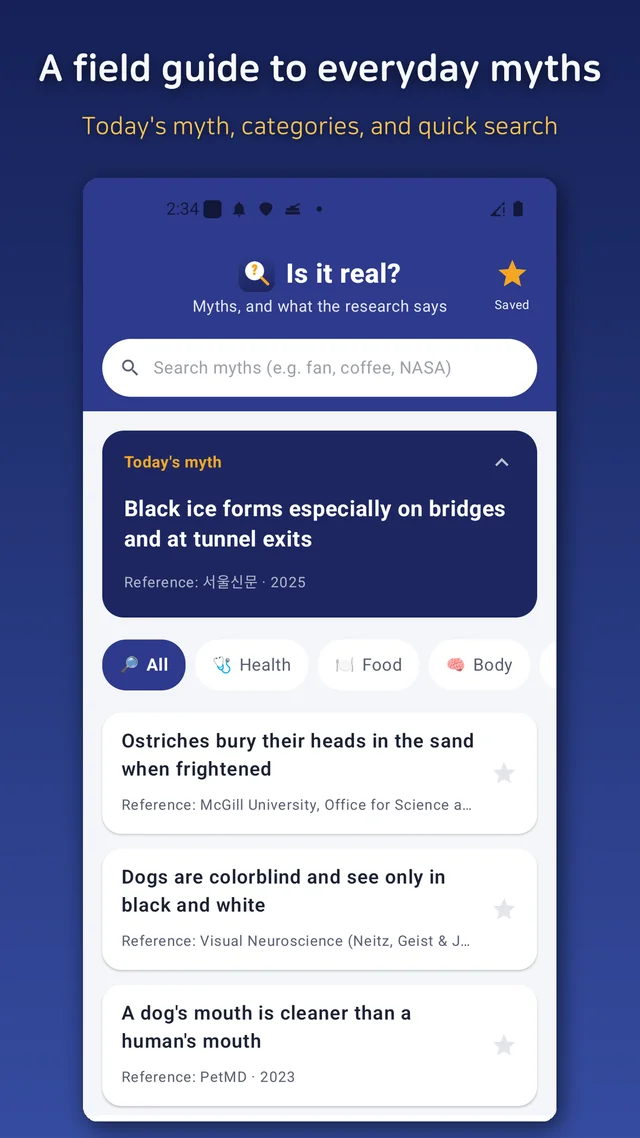
If you want this kind of source-first summary for other sayings, the free Android app "Is it real?" collects 117 folk beliefs and myths with a short research summary, the year and publisher, and links to the original pages. It shows an evidence level on each detail page and leaves the conclusion to you. More details are on the product page, or you can get it on Google Play.


Comments
Post a Comment